Nicaragua is the largest country in Central America by land area, a republic of roughly seven million people wedged between Honduras to the north and Costa Rica to the south, with coastlines on both the Pacific Ocean and the Caribbean Sea. It is best known for its chain of active volcanoes, its two great lakes, and a modern history marked by revolution, civil war, and a political system that remains tightly controlled by one party.
Where Is Nicaragua Located?
Nicaragua sits on the Central American isthmus, bordered by Honduras to the northwest and Costa Rica to the south. The Pacific Ocean lies along its western edge and the Caribbean Sea along its eastern, giving the country a two-coast geography that shapes everything from its climate to its ethnic makeup. Its capital and largest city is Managua, located on the shore of Lake Managua in the west of the country. According to World Bank data, Nicaragua covers about 120,340 square kilometers of land, making it the largest of the seven Central American nations, though one of the least densely populated.
The Geography of Nicaragua
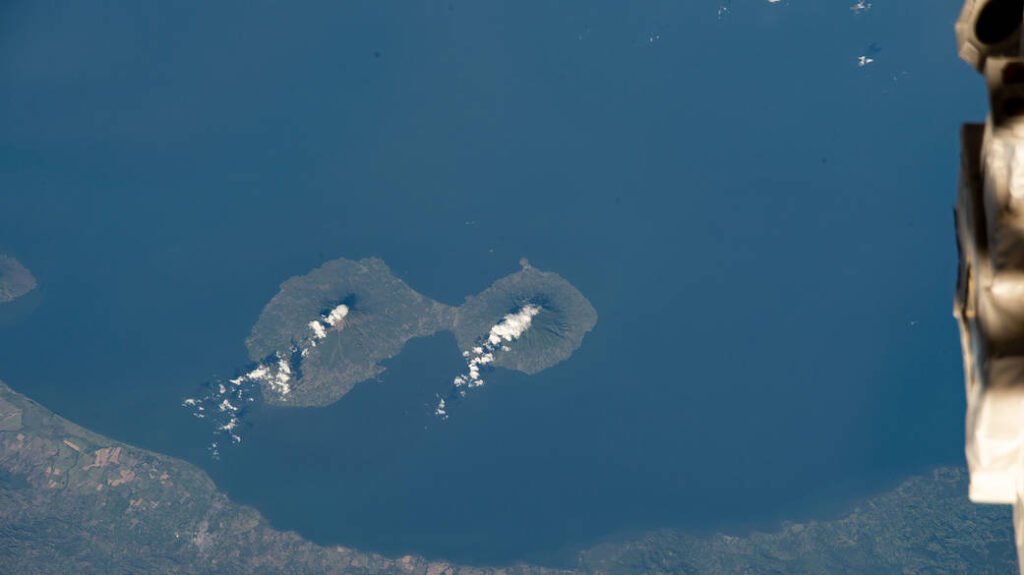
Nicaragua’s defining physical features are its volcanoes and its lakes. A chain of volcanoes, many still active, runs along the Pacific lowlands, including Momotombo and the volcanoes of the Maribios range. To the south lies Lake Nicaragua, the largest freshwater lake in Central America, according to UNESCO’s Man and the Biosphere Programme, and Lake Managua sits farther north. Rising from Lake Nicaragua is Ometepe, an hourglass-shaped island formed by two volcanoes, Concepción and Maderas, joined by a narrow isthmus of old lava flow. UNESCO designated Ometepe a Biosphere Reserve in 2010, citing both its ecological value and its archaeological significance, including petroglyphs and ceramic artifacts dating back roughly 1,700 years.
The country divides broadly into three zones: the volcanic Pacific lowlands where most of the population and agriculture are concentrated, a mountainous central highland region, and the low, wet Caribbean coast, historically known as the Mosquito Coast, which is thinly populated, ethnically distinct, and governed under a system of regional autonomy.
A Brief History of Nicaragua
Before Spanish contact, the Pacific region of present-day Nicaragua was home to Indigenous peoples including the Chorotega and Nicarao, while the Caribbean coast developed separately under different Indigenous and, later, British colonial influence. Spanish conquest began in the 1520s, and Nicaragua became part of the Captaincy General of Guatemala within the Spanish Empire. It gained independence from Spain in 1821 as part of a broader Central American independence movement, briefly joining the Mexican Empire and then the Federal Republic of Central America before becoming a fully separate state in 1838, according to Encyclopaedia Britannica.
The 19th century was marked by rivalry between the cities of León and Granada and by a bizarre episode of foreign conquest: in 1855, the American adventurer William Walker was invited into a Nicaraguan civil conflict and by 1856 had made himself president, before a coalition of Central American armies drove him out in 1857. The early 20th century brought recurring United States military intervention, including Marine occupations from 1912 to 1925 and again from 1926 to 1933. Resistance to the American presence was led by Augusto Sandino, who fought on until the Marines withdrew in 1933, only to be assassinated the following year on the orders of National Guard commander Anastasio Somoza García. Somoza seized the presidency in 1937, founding a family dynasty that ruled Nicaragua for more than four decades.
The Somoza dictatorship was overthrown in 1979 by the Sandinista National Liberation Front (FSLN), which took its name from Sandino. The new government nationalized industries and pursued land reform, but its increasingly authoritarian turn and ties to Cuba and the Soviet bloc drew fierce opposition from the United States, which funded the Contra rebels through the 1980s. The resulting civil war, combined with a U.S. trade embargo, devastated the economy: inflation exceeded 30,000 percent annually by 1988, per Britannica’s historical account. In internationally observed elections on February 25, 1990, opposition candidate Violeta Barrios de Chamorro defeated Sandinista incumbent Daniel Ortega, and power passed peacefully that April, ending the war.
Ortega returned to the presidency in the 2007 election and has held office continuously since. A politically sensitive and still-unfolding matter concerns Nicaragua’s current governance. Constitutional amendments ratified in January 2025 restructured the presidency into a co-presidency, extended presidential terms from five to six years, and expanded the constitutional role of the military, according to International IDEA’s Global State of Democracy tracker. Separately, the United Nations Human Rights Office has documented what it describes as a sweeping concentration of power, including the cancellation of thousands of civil society organizations’ legal registrations and cases of arbitrary detention and forced exile, in a report covering mid-2024 to mid-2025 (OHCHR, October 2025). These are findings and characterizations from an international body rather than settled historical consensus, and the Nicaraguan government disputes such characterizations; readers should treat this as an active and contested situation rather than closed history.
Government and Economy
Nicaragua is formally a presidential republic with a unicameral National Assembly elected by proportional representation. In practice, the FSLN has held dominant control of the executive, legislature, and judiciary for close to two decades, a concentration reflected in what International IDEA measures as a very low effective number of political parties. Because current officeholders and the details of the 2025 co-presidency arrangement remain a fast-moving and contested subject, this entry describes the structure rather than asserting a fixed roster of names.
Economically, Nicaragua is classified as a lower-middle-income country. The World Bank reported GDP growth of about 3.6 percent in 2024 and a per capita GDP near $3,173 in 2025, with the economy driven substantially by remittances from Nicaraguans abroad, mining (notably gold), agriculture and coffee exports, construction, and services. Remittances alone equaled roughly 26.6 percent of GDP in 2024, an unusually high figure that reflects how central emigration and diaspora income have become to household survival. Public debt stood at about 50.3 percent of GDP in 2025, and inflation has stayed low, around 2 percent, giving the country a degree of macroeconomic stability even amid its political turmoil, according to the World Bank’s Nicaragua country overview.
Culture and People
Nicaragua’s population is predominantly of mixed Spanish and Indigenous, or mestizo, heritage in the Pacific and central regions, while the Caribbean coast is home to distinct Indigenous and Afro-descendant communities, including the Miskitu, Creole, Mayangna, Rama, and Garifuna peoples, who retain their own languages and a degree of regional political autonomy. Spanish is the dominant language nationwide, while English-based Creole and several Indigenous languages remain in everyday use on the Caribbean coast. Nicaragua’s 2005 national census, conducted by the government’s Instituto Nacional de Información de Desarrollo, found that about 8.6 percent of the population self-identified as belonging to an Indigenous or ethnic community, with the Miskitu the largest single group among them.
Nicaragua has an outsized literary reputation for its size: the poet Rubén Darío (1867 to 1916), widely regarded as the founder of the Spanish-language literary movement known as modernismo, transformed poetry across the Spanish-speaking world and remains a source of national pride. Another distinctive cultural touchstone is El Güegüense, a centuries-old satirical drama blending theater, dance, and music, in which a wily Indigenous elder outwits Spanish colonial officials through wordplay rather than confrontation. UNESCO inscribed it on the Representative List of the Intangible Cultural Heritage of Humanity in 2008, noting that its central idiom, essentially “putting on the Güegüense’s face,” has entered everyday Nicaraguan speech as a byword for outward compliance masking quiet defiance.
What Is Nicaragua Known For?
- Its chain of volcanoes and twin lakes, especially the striking twin-volcano silhouette of Ometepe Island rising from Lake Nicaragua.
- The colonial architecture and rivalry of its two historic cities, Granada and León, the latter home to the largest cathedral in Central America.
- A turbulent 20th-century political history: the Somoza dictatorship, the 1979 Sandinista revolution, and the U.S.-backed Contra war of the 1980s.
- The poet Rubén Darío, a towering figure in Spanish-language literature.
- Being one of the poorer, more agriculturally dependent economies in the Western Hemisphere, heavily reliant on remittances from citizens working abroad.
Why Nicaragua Matters
Nicaragua’s significance extends well beyond its size. Its geography, a narrow isthmus with a large interior lake, made it a leading candidate for a trans-oceanic canal in the 19th and early 20th centuries, before the Panama Canal was built instead, and canal proposals have resurfaced periodically since. Its 20th-century civil conflicts became a defining Cold War battleground in Latin America, drawing direct U.S. military and financial involvement and shaping regional politics for decades. Today, the country is a closely watched case study in democratic backsliding, as international bodies document a rapid, formalized concentration of state power, making Nicaragua a frequent reference point in discussions of governance and human rights in the Americas.
Key Takeaways
- Nicaragua is the largest country in Central America by land area, bordered by Honduras and Costa Rica, with coasts on both the Pacific and the Caribbean.
- Its landscape is defined by active volcanoes and two large lakes, especially Lake Nicaragua, home to the twin-volcano island of Ometepe, a UNESCO Biosphere Reserve since 2010.
- Nicaragua has two UNESCO World Heritage Sites: the Ruins of León Viejo (2000) and León Cathedral (2011).
- Its modern history runs from Spanish colonization and 1821 independence through the Somoza dictatorship, the 1979 Sandinista revolution, and the 1980s Contra war.
- Constitutional reforms ratified in January 2025 created a co-presidency and extended presidential terms to six years; the United Nations Human Rights Office has separately reported a broad concentration of power and restrictions on civil society.
- The economy relies heavily on remittances, agriculture, coffee, and gold mining, and Nicaragua is classified as a lower-middle-income country by the World Bank.
- The poet Rubén Darío and the UNESCO-recognized satirical drama El Güegüense anchor Nicaragua’s outsized literary and cultural identity.
Sources
- Encyclopaedia Britannica, “Nicaragua”
- Encyclopaedia Britannica, “History of Nicaragua”
- Encyclopaedia Britannica, “Nicaragua: Foreign Intervention”
- Encyclopaedia Britannica, “Nicaragua: The Sandinista Government”
- UNESCO World Heritage Centre, Nicaragua State Party page
- UNESCO Intangible Cultural Heritage, “El Güegüense”
- UNESCO Man and the Biosphere Programme, “Ometepe Island”
- World Bank Open Data, Nicaragua
- World Bank, Nicaragua Country Overview
- International IDEA, Global State of Democracy Tracker: Nicaragua
- UN Office of the High Commissioner for Human Rights, “Nicaragua: Power Concentrated, Rights Denied”
- Instituto Nacional de Información de Desarrollo (INIDE), VIII Censo de Población, 2005
Key facts
- Nicaragua's land area is about 120,340 square kilometers, the largest in Central America1
- Population was estimated at 7,007,502 in 20251
- Nicaragua has two UNESCO World Heritage Sites: Ruins of León Viejo (2000) and León Cathedral (2011)5
- Ometepe Island, formed by two volcanoes in Lake Nicaragua, became a UNESCO Biosphere Reserve in 20107
- Constitutional reforms ratified in January 2025 created a co-presidency and extended presidential terms to six years10
Quick checkWhat two volcanoes make up the hourglass-shaped island of Ometepe in Lake Nicaragua?Show answer
Concepción and Maderas.
Sources
- Encyclopaedia Britannica. Nicaragua. Undated (accessed 2026-09-28)
- Encyclopaedia Britannica. History of Nicaragua. Undated (accessed 2026-09-28)
- Encyclopaedia Britannica. Nicaragua: Foreign Intervention. Undated (accessed 2026-09-28)
- Encyclopaedia Britannica. Nicaragua: The Sandinista Government. Undated (accessed 2026-09-28)
- UNESCO World Heritage Centre. Nicaragua - States Parties. Undated (accessed 2026-09-28)
- UNESCO Intangible Cultural Heritage. El Güegüense. 2008 (accessed 2026-09-28)
- UNESCO Man and the Biosphere Programme. Ometepe Island. Undated (accessed 2026-09-28)
- World Bank. World Bank Open Data: Nicaragua. 2025 data (accessed 2026-09-28)
- World Bank. Nicaragua Country Overview. 2025 (accessed 2026-09-28)
- International IDEA. Global State of Democracy Tracker: Nicaragua. 2025 (accessed 2026-09-28)
- UN OHCHR. Nicaragua: Power Concentrated, Rights Denied. 2025-10 (accessed 2026-09-28)
- INIDE, Government of Nicaragua. VIII Censo de Población. 2005 (accessed 2026-09-28)
- NASA. The Island of Ometepe Is Home to Two Volcanoes. 2023-03 (accessed 2026-09-28)
Editorially reviewed by Specialty Digest Editorial TeamLast reviewed September 28, 2026Researched and drafted with AI assistanceReport an issue