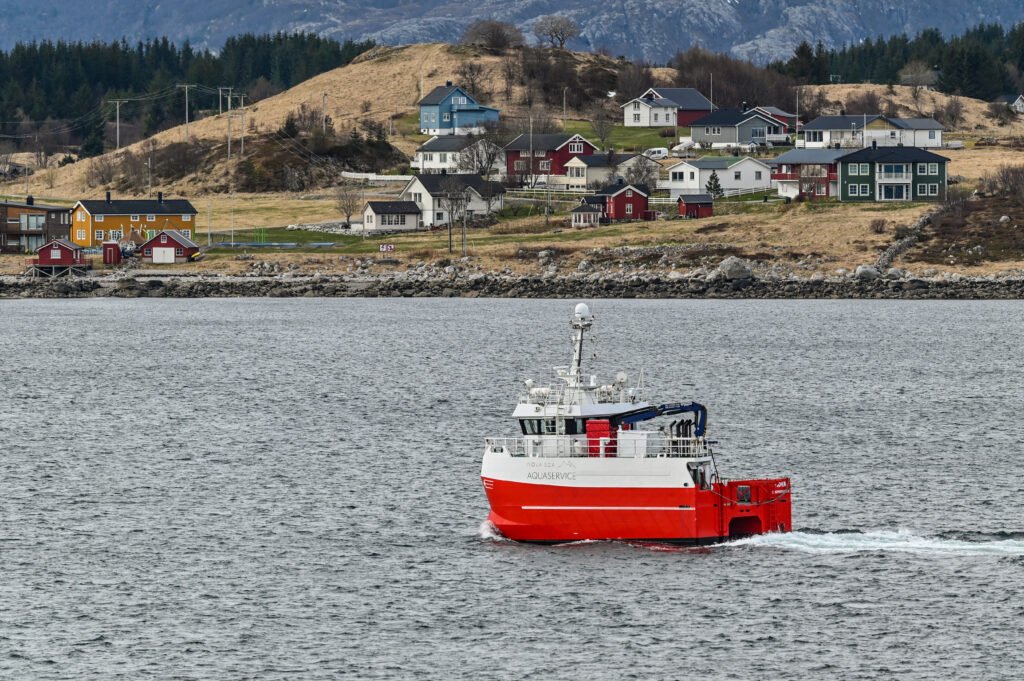
Offshore aquaculture is fish or shellfish farming conducted in open ocean waters farther from shore than traditional coastal operations, typically in deeper water with stronger currents and greater exposure to waves and weather. It represents an effort to expand aquaculture production into new areas while reducing some of the environmental and spatial conflicts associated with crowded nearshore farming sites.
Why Move Farming Offshore
Nearshore waters in many regions face competition from shipping, tourism, recreational use, and existing coastal development, limiting available space for new aquaculture operations and sometimes concentrating environmental impacts in enclosed or slow-flushing bays. Offshore sites offer stronger water currents that can disperse fish waste and excess nutrients more effectively than sheltered coastal waters, potentially reducing localized environmental impact.
Engineering Challenges
Offshore aquaculture equipment must withstand far harsher conditions than nearshore systems, including larger waves, stronger currents, and more severe storms, requiring specially engineered submersible cages, reinforced mooring systems, and vessels capable of safely operating and servicing farms far from port. Some offshore cage designs can be partially or fully submerged during rough weather, reducing wave stress on the structure and the fish inside.
Current Applications
Offshore aquaculture has been piloted and commercially developed for species including salmon, in areas such as parts of Norway’s more exposed coastline, as well as for finfish like cobia and amberjack in warmer offshore waters including parts of the Gulf of Mexico and Asia-Pacific region. Regulatory frameworks for offshore aquaculture remain less developed in many countries than those governing nearshore operations, since permitting and environmental review processes were largely designed with coastal sites in mind.
Potential Benefits
Proponents argue offshore aquaculture could substantially expand global seafood production without requiring additional nearshore space, while potentially reducing visual impact on coastlines and limiting the concentrated local nutrient loading that can occur in sheltered bays with limited water exchange. Several governments and development organizations have identified offshore aquaculture as a priority area for research and investment given global seafood demand projections.
Remaining Obstacles
High capital costs for offshore-capable infrastructure, limited operational experience compared with decades of nearshore farming knowledge, and unresolved regulatory and permitting questions in many jurisdictions continue to slow offshore aquaculture’s expansion. Insurance costs and the logistics of servicing remote offshore sites, particularly during storms, also remain significant practical challenges that nearshore operations do not face to the same degree.
Environmental Monitoring
Researchers studying offshore aquaculture sites monitor seafloor conditions, water quality, and interactions with wild marine life to better understand the environmental footprint of farms operating in these less studied, more exposed ocean environments. Early research suggests offshore sites may in some cases have less concentrated local environmental impact than comparable nearshore farms, though comprehensive long-term data remains more limited than for established coastal aquaculture.
Future Development Outlook
Continued advances in materials engineering, autonomous monitoring technology, and remote operation capabilities are expected to gradually reduce the cost and risk associated with offshore aquaculture, potentially accelerating its adoption over the coming decades. Government interest in offshore aquaculture as a tool for expanding domestic seafood production, reducing import dependence, and creating coastal economic opportunities continues to grow in several countries with suitable offshore conditions.
Comparing Costs to Nearshore Farming
Per-unit production costs for offshore aquaculture currently tend to exceed those of established nearshore operations, reflecting the added expense of specialized equipment, vessels, and more complex logistics, though proponents argue these costs should decline as the technology matures and operational experience accumulates. Whether offshore aquaculture can ultimately achieve cost parity with nearshore farming remains one of the central open questions shaping investment decisions in this still-developing segment of the industry.
Looking Ahead
Offshore aquaculture is still a relatively young field, but it is attracting serious investment as coastal sites become more crowded and environmentally constrained. Moving farms into deeper, more exposed waters reduces conflicts with other coastal users and can improve water quality around the pens, but it also demands much sturdier infrastructure capable of withstanding larger waves and currents. Engineering advances in submersible pens, automated feeding systems that can operate with minimal crew, and remote monitoring technology are gradually making offshore sites more viable. Permitting remains a major hurdle in many countries, since offshore aquaculture often falls into a regulatory gray area between fisheries management and maritime law, and policymakers are still working out how to balance industry growth with environmental safeguards and other ocean uses.
Related Specialties
Offshore aquaculture builds on techniques developed for nearshore fish farming, adapted to withstand harsher open-water conditions. It is closely linked to marine engineering, since pen and mooring design has to account for wave loads and currents far beyond what sheltered coastal sites experience. The field also intersects with ocean governance and marine spatial planning, as regulators work to fit offshore farms alongside shipping routes, fisheries, and conservation zones.
Economic Considerations
Offshore aquaculture requires substantially more capital than nearshore or pond-based farming, since pens, moorings, and support vessels must be engineered to withstand far harsher ocean conditions. These higher upfront costs have so far limited offshore aquaculture mostly to larger, well-capitalized companies rather than small independent farmers. Proponents argue that offshore sites can ultimately support higher production volumes with fewer local use conflicts, which could improve long-term returns once the technology and permitting pathways mature further, but the sector remains capital-intensive and higher-risk than more established nearshore methods.
As offshore technology matures and more sites gain regulatory approval, the sector is expected to play a growing role in meeting global seafood demand without adding further pressure to already crowded nearshore waters.
Key facts
- Uses stronger currents to disperse waste more effectively than sheltered bays.|Requires specially engineered submersible cages and reinforced moorings.|Piloted for salmon, cobia, and amberjack in various regions.|Faces high capital costs and underdeveloped regulatory frameworks.
Quick checkWhy is offshore aquaculture considered more challenging than nearshore farming?Show answer
Offshore sites face harsher waves, currents, and storms, requiring specially engineered equipment and more costly infrastructure than sheltered nearshore farms.
Sources
- NOAA Fisheries; FAO Fisheries and Aquaculture Department
Editorially reviewed by Specialty Digest Editorial TeamLast reviewed November 3, 2026Researched and drafted with AI assistanceReport an issue