In simple terms
A phoneme is the smallest unit of sound that can change a word’s meaning in a particular language. SIL Global’s Glossary of Linguistic Terms calls it the smallest contrastive unit in a language’s sound system, and contrastive is the whole point: swap one phoneme and you have a different word.
English rip and lip differ by a single sound, so /r/ and /l/ count as two separate phonemes of English. Sounds that do not change meaning in a given language are not separate phonemes there, which is why the inventory differs from one language to the next.
How it works
Linguists find phonemes by looking for minimal pairs, two words that differ in only one sound. Lap and lab form a minimal pair for /p/ and /b/. In Cashinahua, spoken in Peru and Brazil, taka (liver) and daka (to rest) do the same work for /t/ and /d/.
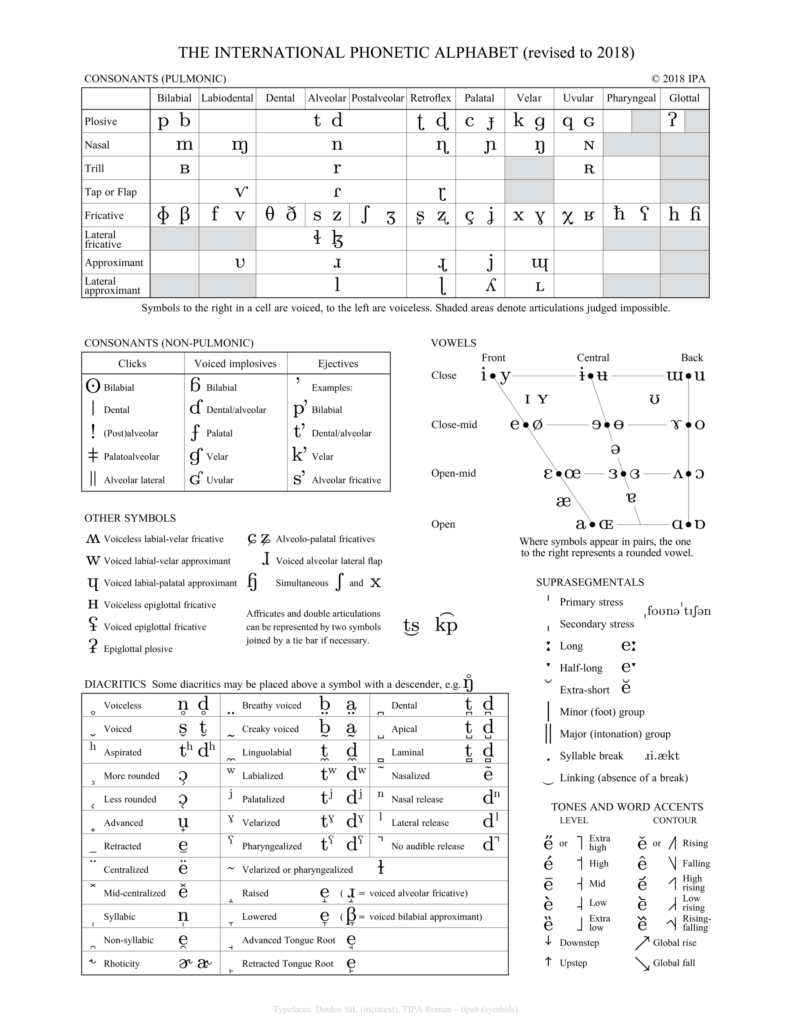
One phoneme can be pronounced several ways. Those predictable variants are allophones: in English a plain [p] and an aspirated [p] with a puff of air are allophones of the single phoneme /p/, and no English word depends on the difference. Phonemes are written between slashes, pronounced sounds in square brackets, using symbols from the International Phonetic Alphabet, a chart the International Phonetic Association has made freely available under a Creative Commons license since July 2012.
How to define a phoneme precisely remains an open debate. One tradition defines it through its allophones and the environments they appear in. Another defines it as a bundle of distinctive features.
Why it matters
Phonemes decide which sound differences a listener notices and which ones slip past unheard. That explains why a contrast obvious to one speaker is nearly inaudible to another, and it gives early reading instruction, speech therapy and speech recognition a unit small enough to measure.
Where you’ll see it
- Early reading lessons that ask children to isolate the separate sounds in a word
- Dictionary pronunciation guides written in International Phonetic Alphabet symbols
- Language courses that drill contrasts a learner’s first language does not use
- Speech therapy assessments and speech recognition research
Example
A teacher reads lap and lab aloud and asks which word the class heard. The test works because /p/ and /b/ are separate phonemes of English.
Often confused with
A phoneme is not a letter, and not a phone. A phone is any one of the sounds that occur in the world’s languages, while a phoneme is a contrastive unit inside one language’s system that may be pronounced several ways.
Key facts
- A phoneme is the smallest contrastive unit in the sound system of a language.1
- The English words rip and lip form a minimal pair, which is how /r/ and /l/ are shown to be separate phonemes.1
- A minimal pair is two words that differ in only one sound, such as lap and lab, or Cashinahua taka (liver) and daka (to rest).3
- In English, a plain [p] and an aspirated [p] are allophones of the single phoneme /p/, so the difference never changes a word's meaning.4
- Phonologists still differ on how to define a phoneme: through its allophones and environments, or as a set of distinctive features.1
- The International Phonetic Alphabet chart has been freely available under a Creative Commons Attribution-ShareAlike license since July 2012.2
Related concepts
Quick checkWhat test shows that two sounds are separate phonemes?Show answer
A minimal pair: two words that differ in only one sound, such as lap and lab.
Sources
- SIL Global. What is a Phoneme? Glossary of Linguistic Terms. Undated (accessed Accessed 21 October 2026)
- International Phonetic Association. Full IPA Chart. Undated (accessed Accessed 21 October 2026)
- SIL Global. What is a Minimal Pair? Glossary of Linguistic Terms. Undated (accessed Accessed 21 October 2026)
- SIL Global. What is an Allophone? Glossary of Linguistic Terms. Undated (accessed Accessed 21 October 2026)
Editorially reviewed by Specialty Digest Editorial TeamLast reviewed October 21, 2026Researched and drafted with AI assistanceReport an issue