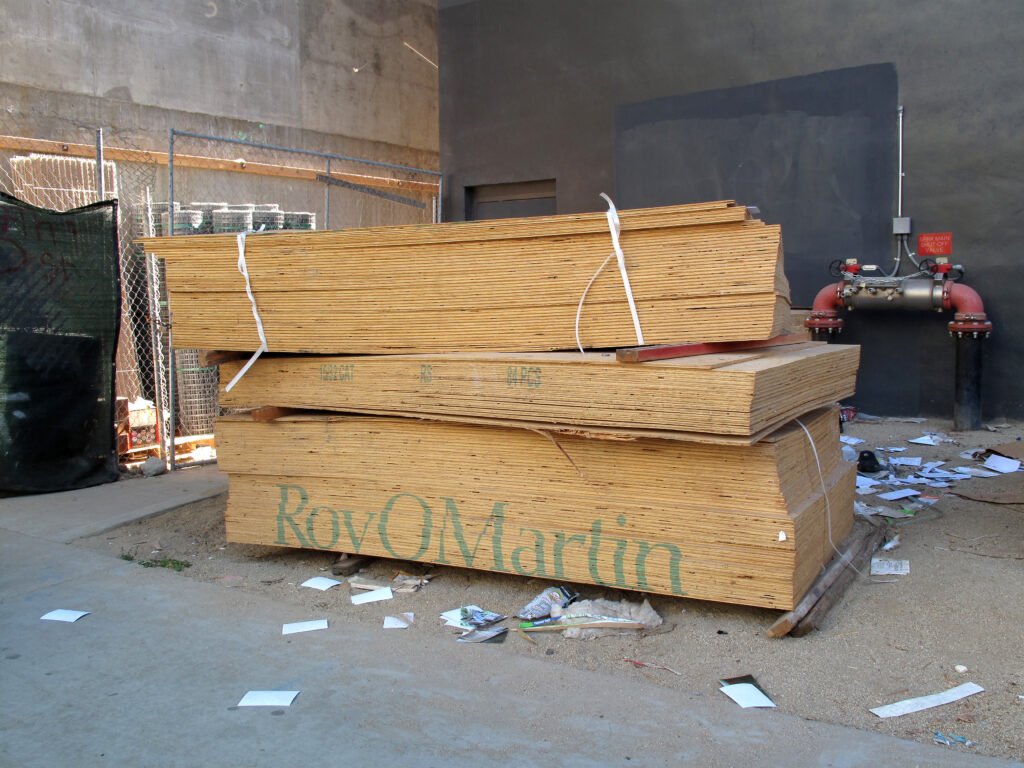
Plywood is an engineered wood panel made by gluing together thin layers of wood veneer with the grain direction of each layer rotated roughly ninety degrees relative to its neighbors. This cross-grain construction gives plywood strength and dimensional stability in multiple directions, making it less prone to warping, splitting, or shrinking unevenly than a solid board of similar thickness.
Manufacturing Process
Logs are first peeled into thin continuous veneer sheets on a rotating lathe, then dried, graded, and cut to size before being coated with adhesive and layered into a stack with alternating grain directions. The stacked panel is pressed under heat to cure the adhesive and bond the layers permanently, after which it is trimmed, sanded, and sometimes further finished before being graded for its intended use.
Common Uses and Grades
Plywood is produced in grades ranging from rough structural sheathing used in construction to smooth, void-free panels intended for furniture and cabinetry. Exterior-grade plywood uses waterproof adhesives to withstand moisture exposure, while interior-grade panels rely on less expensive adhesives suited only to dry conditions, making grade selection an important decision for builders matching the panel to its environment.
Core and Face Veneers
A plywood panel typically consists of a core, which provides most of the structural bulk, and face veneers on the outer surfaces chosen for appearance or wear resistance depending on the panel intended use. Hardwood plywood often uses a less expensive softwood core with attractive hardwood face veneers, balancing cost against the visual qualities buyers expect from furniture-grade material.
Specialty Plywood Types
Marine plywood uses waterproof adhesives and higher-grade veneers with minimal internal voids, making it suitable for boat building and other applications with constant moisture exposure. Flexible plywood, designed with thinner cross-sections and specific grain orientations, can bend around curved surfaces for furniture and architectural applications, while fire-retardant plywood is treated with chemicals during manufacturing to slow combustion in applications where fire codes demand it.
Economic Considerations
Plywood pricing is closely tied to the cost and availability of suitable peeler logs, which must be large enough and straight enough to be mounted on a lathe and peeled efficiently, making certain fast-growing softwood species particularly valuable to plywood manufacturers. Global plywood markets have also been shaped by shifts in manufacturing to regions with abundant low-cost timber and labor, with some countries becoming major exporters of hardwood plywood even as domestic softwood plywood production remains strong elsewhere for structural construction uses.
Looking Ahead
Demand for engineered wood panels continues to grow alongside construction activity worldwide, and plywood manufacturers are increasingly exploring faster-growing plantation species as a way to secure reliable peeler log supply without depleting slower-growing natural forests. Advances in adhesive technology are also improving plywood moisture resistance and reducing formaldehyde emissions, addressing both performance and indoor air quality concerns that have shaped the engineered wood panel market in recent years.
Related Specialties
Plywood manufacturing is closely tied to wood veneer production, since plywood is essentially built from stacked veneer sheets. It also overlaps with forest management, since the demand for straight, defect-free peeler logs influences how plantation forests are grown and harvested for the plywood industry specifically.
Quality and Defects
Plywood quality inspection focuses on internal voids, delamination between layers, and surface defects such as knots or discoloration, with higher grades requiring progressively fewer visible imperfections. Manufacturers use both visual inspection and, increasingly, ultrasonic or other non-destructive testing methods to detect internal bonding problems that would not be visible simply by looking at a finished panel surface.
Global Trade Patterns
International trade in plywood has shifted considerably over past decades, with manufacturing capacity moving toward regions offering lower-cost timber, labor, or both, while established markets in other regions have focused more heavily on specialty and higher-margin plywood products. Trade policy, including tariffs and environmental import restrictions tied to concerns about illegal logging, continues to shape where plywood is manufactured and how it moves between exporting and importing countries.
Panel Thickness and Layer Count
Plywood is manufactured across a wide range of thicknesses, with thinner panels using fewer veneer layers and thicker structural panels built from many more layers to achieve the required strength and stiffness. Manufacturers generally use an odd number of layers so that the outer face veneers run in the same grain direction, keeping the panel balanced and reducing the tendency to warp after manufacturing.
Buyers selecting plywood for a specific project are generally advised to match the panel grade and adhesive type carefully to the moisture exposure and load conditions the finished product will actually face.
Sanding and finishing techniques also vary depending on whether a plywood surface will remain visible or be covered by paint, laminate, or other final surface treatments in the completed project.
Specialty plywood products continue to emerge as manufacturers respond to niche demand, including lightweight honeycomb-core panels and high-density panels engineered for specific industrial uses beyond traditional furniture and construction markets.
Architects specifying exposed plywood surfaces in visible interior applications often select a specific grade and species combination well in advance to ensure consistent appearance across an entire building project.
Manufacturers continue to experiment with bio-based adhesives as a longer-term alternative to petroleum-derived resins currently used in most plywood production.
Testing labs that certify plywood performance often work closely with manufacturers during product development to identify potential failure points before a new panel type reaches the market.
Buyers comparing plywood suppliers often request sample panels to evaluate surface quality and consistency firsthand before committing to a large order for a major construction or furniture project.
Key facts
- Veneer layers are rotated roughly 90 degrees between layers; made via a rotary lathe peeling process; graded for structural or appearance use.
Quick checkWhy are plywood veneer layers rotated between each layer?Show answer
To give the panel strength and stability in multiple directions and reduce warping.
Sources
- Based on general wood products manufacturing literature.
Editorially reviewed by Specialty Digest Editorial TeamLast reviewed November 3, 2026Researched and drafted with AI assistanceReport an issue