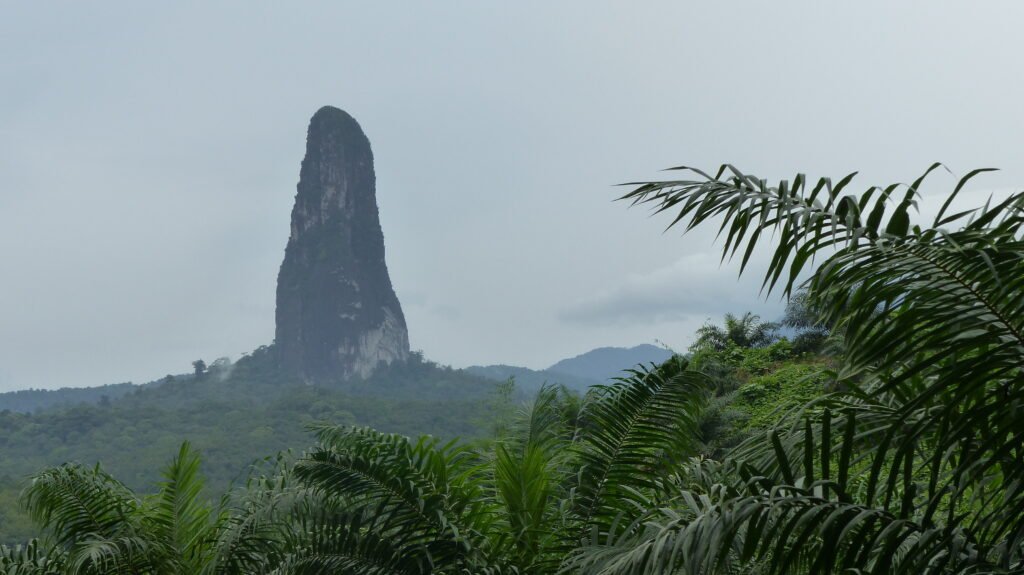
Sao Tome and Principe is a small island nation in the Gulf of Guinea, off the west coast of Central Africa. Made up of two main islands and several smaller islets, it is one of Africa’s smallest countries by both population and land area, and among the least visited nations on the continent.
Where Is Sao Tome and Principe Located?
Sao Tome and Principe sits in the Gulf of Guinea roughly 140 miles (225 kilometers) off the coast of Gabon, not far from Equatorial Guinea. The country’s two namesake islands, Sao Tome and Principe, are volcanic peaks belonging to the same chain that produces Mount Cameroon on the mainland. The capital, Sao Tome, sits on the larger island of the same name.
Geography and the Island Interior
Both islands rise steeply from the Atlantic into a rainforested, mountainous interior. On Sao Tome island, the terrain climbs to Pico de Sao Tome, the country’s highest point, but the single most recognizable natural feature is Pico Cao Grande: a needle-like volcanic plug that juts roughly 663 feet (202 meters) straight out of the rainforest canopy inside Obo Natural Park. Its sheer, almost vertical walls make it one of the most distinctive volcanic formations in Africa and the image most associated with the country.
A Brief History
The islands were uninhabited when Portuguese navigators reached them in 1470. Portugal colonized both islands and built a plantation economy, first on sugar and later on cocoa and coffee, worked first by enslaved labor brought from the African mainland and later by a contract-labor system that persisted into the twentieth century. Sao Tome and Principe gained independence from Portugal on July 12, 1975. A single-party socialist government ruled for the first fifteen years, and the country transitioned to multiparty democracy in the early 1990s.
Government and Economy Today
Sao Tome and Principe is a multiparty, semi-presidential democracy, and according to the World Bank it has served as something of a model for peaceful transitions of power in Central Africa. The Independent Democratic Action party held 30 of the 55 seats in the National Assembly as of the 2022-2026 governing term.[1] The economy remains heavily dependent on externally financed public spending, a model the World Bank describes as increasingly unsustainable as development assistance declines.[1] Gross domestic product per capita was about $4,044 in 2025, and an estimated 13.1% of the population lived below the international poverty line of $3 a day.[1] Growth slowed to roughly 1% in 2025 as power outages disrupted agriculture and services, while cocoa exports and tourism remain the country’s main sources of foreign earnings.[1]
Culture and People
Portuguese is the official language, but most people also speak one of several Portuguese-based creole languages, including Forro, Angolar, and Lung’Ie, each tied to a different wave of settlement and plantation history. Musical traditions such as ussua and socope grew directly out of plantation life, and the islands’ cuisine, built around fish, root vegetables, and the cocoa the country is famous for, reflects the same blend of African and Portuguese influence found across its culture.
What Is Sao Tome and Principe Known For?
Internationally, the country is best known for two things: cocoa, which once made it one of the world’s leading cocoa producers and still earns it a reputation among chocolate makers for high-quality beans, and its volcanic landscape, epitomized by Pico Cao Grande. Obo Natural Park, which covers much of the interior of both main islands, is also recognized for unusually high levels of species endemism, including birds found nowhere else on Earth.
Why Sao Tome and Principe Matters
As one of Africa’s smallest and most politically stable states, Sao Tome and Principe is often cited as a case study in peaceful democratic consolidation on a continent where transitions of power have frequently been contested. Its heavy reliance on cocoa exports and foreign aid, combined with its small size and exposure to sea-level rise, also make it a useful lens on the economic vulnerability that small island states face more broadly.
Key Takeaways
- Sao Tome and Principe is a two-island volcanic nation in the Gulf of Guinea, off the coast of Gabon.
- Its defining natural landmark is Pico Cao Grande, a 663-foot volcanic spire rising out of the rainforest.
- Settled by Portugal in 1470 and independent since July 12, 1975, it moved from one-party rule to multiparty democracy in the early 1990s.
- The economy still depends heavily on cocoa exports, tourism, and external development assistance.
- The World Bank has pointed to the country as a model of peaceful democratic transition in Central Africa.
Sources
Key facts
Quick checkWhat is the single most recognizable natural landmark in Sao Tome and Principe?Show answer
Pico Cao Grande, a needle-like volcanic spire rising about 663 feet out of the rainforest.
Sources
- World Bank. Sao Tome and Principe Overview. Undated, continuously updated (accessed 2026-10-04)
Editorially reviewed by Specialty Digest Editorial TeamLast reviewed October 4, 2026Researched and drafted with AI assistanceReport an issue