Serbia is a landlocked country in the Western Balkans and the largest economy in that subregion, built around the capital Belgrade at the confluence of the Danube and Sava rivers.
Where Is Serbia Located?
Serbia sits in the Western Balkans in southeastern Europe, bordered by Hungary to the north, Romania and Bulgaria to the east, North Macedonia and Kosovo to the south, and Montenegro, Bosnia and Herzegovina, and Croatia to the west. Belgrade, the capital, sits where the Sava River meets the Danube.
Geography and Landscape
The north of the country lies in the flat Pannonian Plain, an agricultural region historically known as Vojvodina, while central and southern Serbia become increasingly hilly and mountainous, rising toward ranges shared with neighboring Balkan states. The Danube crosses the country from the northwest to the southeast, forming part of the border with Romania at the dramatic Iron Gate gorge before continuing downstream.
A Brief History
Medieval Serbian kingdoms reached their height in the fourteenth century before falling under Ottoman rule for several centuries. Serbia regained independence in the nineteenth century and later became the core of the Kingdom of Yugoslavia and then the Socialist Federal Republic of Yugoslavia after the Second World War. Yugoslavia broke apart violently in the 1990s, and Serbia emerged as an independent state in its current form in 2006, after Montenegro voted to separate. Kosovo, a former Serbian province, declared independence in 2008, a status Serbia does not recognize.
Government and Economy Today
Serbia is a parliamentary republic and, according to the World Bank, an upper-middle-income country that is now the largest economy in the Western Balkans.[1] Belgrade has achieved substantial macroeconomic stabilization in recent years: public debt fell from a peak of 68.3% of GDP in 2015 to 45% of GDP in 2025, while the budget deficit narrowed to 2.4% of GDP in 2025, down from an average of 5.2% between 2010 and 2014.[1] Growth has nonetheless been slowing, decelerating to about 2% in 2025 from 3.9% in 2024, amid weaker consumption, higher inflation, and reduced investment.[1]
Culture and People
Serbian, written in both Cyrillic and Latin scripts, is the official language, and the Serbian Orthodox Church plays a central role in national identity and public life. Belgrade’s turbulent history as a frequently contested frontier city, bombed or besieged dozens of times over the centuries, has shaped a famously resilient urban culture, visible today in its sprawling nightlife district along the rivers and in a strong tradition of classical and folk music alike.
What Is Serbia Known For?
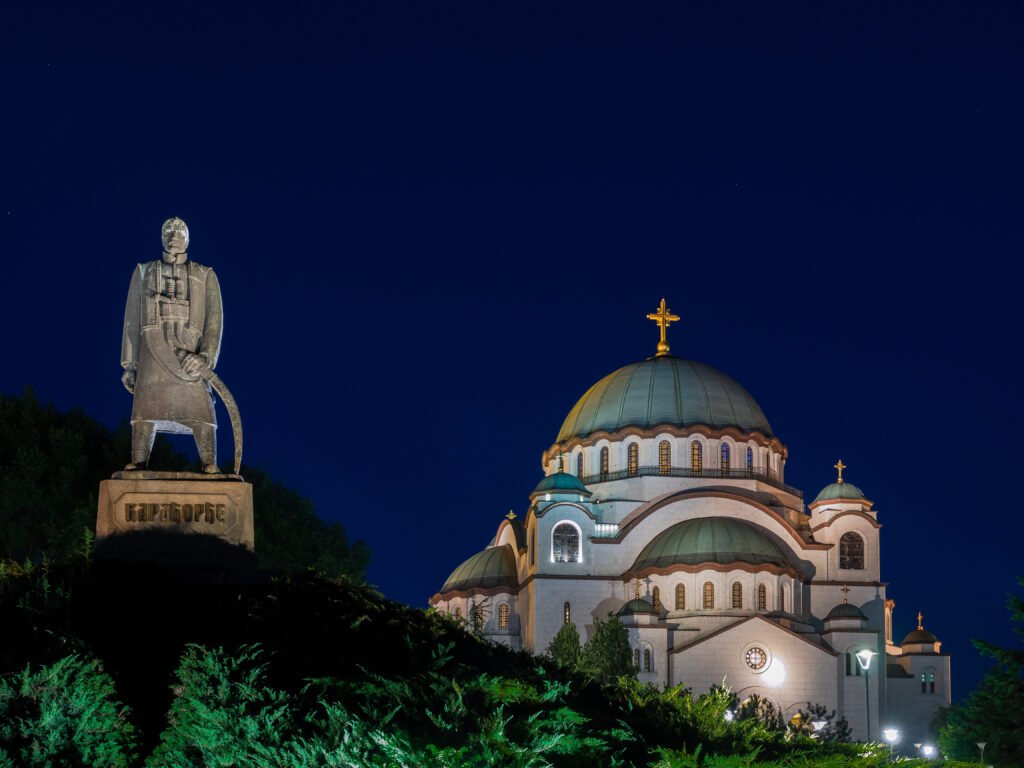
Serbia is widely known for the Church of Saint Sava in Belgrade, one of the largest Orthodox Christian churches in the world, built on the site where Ottoman forces are said to have burned the relics of the medieval saint. The country is also known for Belgrade Fortress overlooking the river confluence, its central role in the breakup of Yugoslavia during the 1990s, and its unresolved dispute with Kosovo over the latter’s independence.
Why Serbia Matters
As the largest economy and most populous state to emerge from the former Yugoslavia, Serbia remains central to stability in the Western Balkans, and its path toward European Union membership and its unresolved relationship with Kosovo continue to shape regional diplomacy. Its strategic position on the Danube has also long made it a crossroads between Central Europe and the Balkans.
Key Takeaways
- Serbia is a landlocked Western Balkan country centered on Belgrade, at the confluence of the Danube and Sava rivers.
- It emerged in its current form in 2006 after Montenegro separated from a shared union with Serbia.
- Kosovo, a former Serbian province, declared independence in 2008, a status Serbia does not recognize.
- Serbia is the largest economy in the Western Balkans, with public debt falling from 68.3% of GDP in 2015 to 45% in 2025.
- The Church of Saint Sava in Belgrade is one of the largest Orthodox Christian churches in the world.
Sources
Key facts
Quick checkWhat is the largest Orthodox Christian church landmark in Belgrade, Serbia?Show answer
The Church of Saint Sava, one of the largest Orthodox churches in the world.
Sources
- World Bank. Serbia Overview. Undated, continuously updated (accessed 2026-10-04)
Editorially reviewed by Specialty Digest Editorial TeamLast reviewed October 4, 2026Researched and drafted with AI assistanceReport an issue