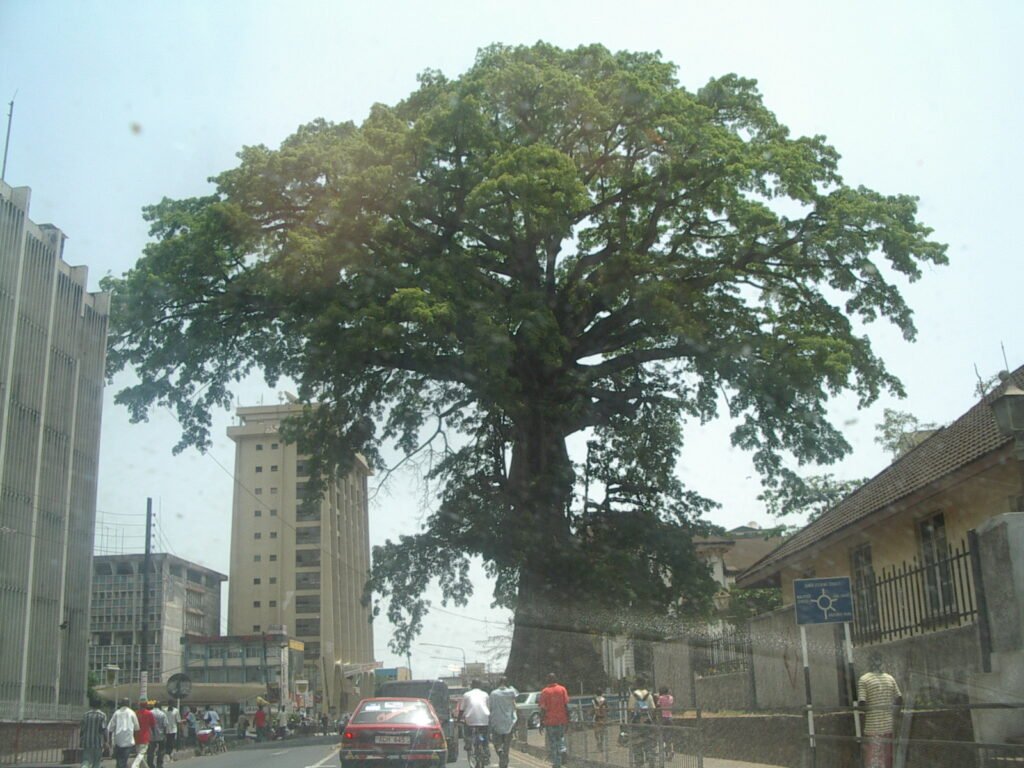
Sierra Leone is a West African country on the Atlantic coast, founded in part as a settlement for freed and formerly enslaved people, and known today for the Cotton Tree at the heart of its capital, Freetown.
Where Is Sierra Leone Located?
Sierra Leone sits on the Atlantic coast of West Africa, bordered by Guinea to the north and east and Liberia to the south. The capital, Freetown, sits on a peninsula around one of the largest natural harbors in the world.
Geography and Landscape
The country’s terrain rises from mangrove-lined coastal plains in the west to forested hills and the Loma Mountains in the northeast, home to Mount Bintumani, West Africa’s highest peak outside the Cameroon highlands. Sierra Leone holds significant mineral wealth, including diamonds, gold, bauxite, and rutile, which have shaped much of its modern economic and political history.[1]
A Brief History
Freetown was established in 1787 as a settlement for formerly enslaved people freed in Britain and its colonies, and it later became a major base for Royal Navy ships intercepting slave trading vessels after Britain abolished its own slave trade. Sierra Leone became a British colony and gained independence in 1961. Decades later, the country was devastated by a brutal civil war fought largely over control of its diamond fields, which ended in 2002 and whose effects, compounded by disease outbreaks and political division, have continued to constrain development since.[1]
Government and Economy Today
Sierra Leone is a presidential republic. On June 24, 2023, the country held its sixth general election since the end of the civil war, with incumbent President Julius Maada Bio of the Sierra Leone People’s Party winning re-election with 56% of the vote, while his party took 81 parliamentary seats against 54 for the opposition All People’s Congress.[1] Most of the population still works in subsistence agriculture, even as the country’s mineral wealth continues to draw investment, and successive governments have focused on rebuilding infrastructure and promoting national reconciliation since the war.[1]
Culture and People
English is the official language, but Krio, a creole language that grew out of Freetown’s founding by freed settlers from Britain, Nova Scotia, and Jamaica, serves as the country’s lingua franca and has deeply influenced its culture. More than a dozen ethnic groups live in Sierra Leone, the largest being the Temne and Mende, and traditions such as secret societies and masked performance remain significant in both rural and urban cultural life.
What Is Sierra Leone Known For?
Sierra Leone is best known for the Cotton Tree, a massive, centuries-old tree standing at the symbolic heart of Freetown, said to mark the spot where freed settlers held a thanksgiving service after arriving in 1792. The country is also known internationally for its diamonds, for the brutal civil war of the 1990s, and for the large Ebola outbreak that struck West Africa between 2014 and 2016.
Why Sierra Leone Matters
Sierra Leone’s founding as a haven for freed and formerly enslaved people gives it a distinctive place in the history of the Black Atlantic, while its post-war recovery has become a widely studied case of rebuilding state institutions and reconciling a society after a resource-driven civil conflict. Its continued mineral wealth, from diamonds to rutile and bauxite, keeps it tied closely to swings in global commodity markets.
Key Takeaways
- Sierra Leone sits on the Atlantic coast of West Africa, between Guinea and Liberia.
- Freetown was founded in 1787 as a settlement for formerly enslaved and freed people.
- The Cotton Tree, a centuries-old tree in central Freetown, is the country’s best-known landmark.
- A brutal civil war fought partly over diamond wealth ended in 2002.
- President Julius Maada Bio won re-election in June 2023 with 56% of the vote.
Sources
Key facts
Quick checkWhat is the best-known landmark at the heart of Freetown, Sierra Leone?Show answer
The Cotton Tree, a centuries-old tree tied to the founding of Freetown by freed settlers.
Sources
- World Bank. Sierra Leone Overview. Undated, continuously updated (accessed 2026-10-04)
Editorially reviewed by Specialty Digest Editorial TeamLast reviewed October 4, 2026Researched and drafted with AI assistanceReport an issue