South Korea, officially the Republic of Korea, is an East Asian country occupying the southern half of the Korean Peninsula. Its only land border is with North Korea, and it is otherwise surrounded by the Yellow Sea, the East Sea (Sea of Japan), and the Korea Strait. Its capital and largest city is Seoul. In just a few decades, South Korea transformed from a war-shattered, aid-dependent economy into one of the world’s most advanced, high-income nations, and today it is recognized as much for its technology and cultural exports as for its history.
Where Is South Korea Located?
South Korea sits at the southern end of the Korean Peninsula in East Asia, across the Korea Strait from Japan and facing China across the Yellow Sea. The country’s only land border runs along the Demilitarized Zone (DMZ), a buffer strip established after the 1953 Korean War armistice with North Korea. Mountainous terrain covers much of the interior, while the western and southern coasts are lined with lowlands, river plains, and thousands of small islands.
A Brief History of South Korea
Ancient Kingdoms and Dynastic Korea
Korea’s recorded history stretches back more than two thousand years through a succession of kingdoms and dynasties. The Joseon Dynasty, founded in 1392, ruled a unified Korea for more than five centuries and shaped much of the country’s Confucian social structure, government institutions, and written language, including the creation of the Hangeul alphabet under King Sejong the Great in the fifteenth century.
Division and the Korean War
Japan colonized Korea from 1910 until the end of the Second World War in 1945. The peninsula was then divided between a Soviet-backed north and a United States-backed south, a split that hardened into two separate states in 1948. The Korean War, fought from 1950 to 1953, ended in an armistice rather than a peace treaty, leaving the peninsula divided along the DMZ to this day.
From Recovery to Economic Powerhouse
Korea emerged from the war among the poorest countries on Earth. According to the World Bank, real gross domestic product grew by an average of 5.6 percent a year between 1980 and 2024, while gross national income per capita rose from about $67 in the early 1950s to over $36,000 by 2024.[1] Korea joined the Organisation for Economic Co-operation and Development’s Development Assistance Committee in 2010, becoming the first country to move from aid recipient to aid donor within that body, a transition the World Bank describes as one of the most significant development transformations in modern history.[1]
Government and Economy
South Korea is a presidential republic with a single-chamber National Assembly and a constitution, adopted in its current democratic form in 1987, that ended decades of military-backed rule. The World Bank classifies the economy as high income, with a population of approximately 51.75 million people as of 2024 and a gross national income per capita of about $36,750 that same year.[2] Exports, particularly semiconductors, electronics, automobiles, and shipbuilding, drive much of the country’s output, and South Korea ranked fourth in the world on the Global Innovation Index for a second consecutive year, according to the country’s official government information portal.[3]
Culture and People
Korean is the official language, written in Hangeul, the phonetic alphabet introduced in 1443 to make literacy accessible beyond the educated elite. Confucian traditions around family, education, and hierarchy still shape daily life alongside Buddhist heritage visible in the country’s older temples and palaces. Since the 1990s, South Korea has become a major exporter of popular culture, a phenomenon often called the Korean Wave, spanning K-pop music, television dramas, and film, including award-winning titles that have reached global audiences far beyond Asia.
What Is South Korea Known For?
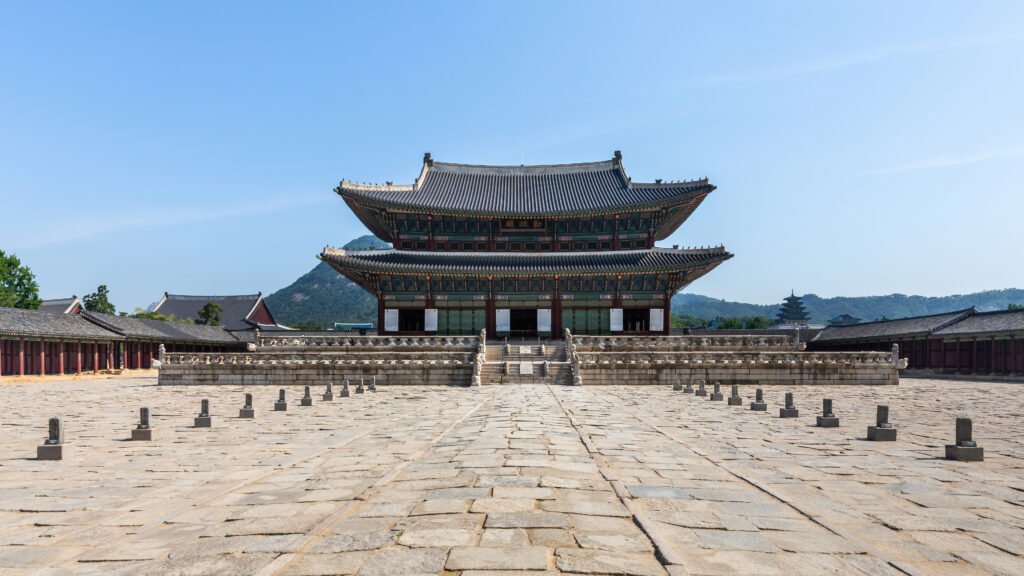
Seoul’s Gyeongbokgung Palace, the largest and most recognized of the city’s five grand Joseon-era palaces, stands as the country’s most iconic single landmark, with its Geunjeongjeon throne hall forming the ceremonial heart of the complex. Beyond the palace, South Korea is known globally for its technology companies, its K-pop and film industries, its cuisine built around rice, fermented vegetables, and barbecued meats, and the heavily fortified DMZ that still separates it from North Korea.
Why South Korea Matters
South Korea is frequently cited as a model of how a country can combine rapid economic growth with rising living standards and, eventually, democratic reform. Its path from a recipient of foreign aid to a donor nation and OECD member offers a widely studied template for development economists, while its position on a divided peninsula keeps it at the center of regional security questions involving Japan, China, and the United States. Its cultural exports, meanwhile, have made it one of the most recognizable national brands in the world, well beyond what its size alone would predict.
Key Takeaways
- South Korea occupies the southern half of the Korean Peninsula, bordered only by North Korea on land and surrounded by sea on three sides.
- Its capital is Seoul, and its population was approximately 51.75 million as of 2024.[2]
- Gross national income per capita rose from about $67 in the early 1950s to roughly $36,750 in 2024, among the fastest sustained growth records of any modern economy.[1][2]
- South Korea is the only country to move from an aid-recipient to an aid-donor member of the OECD Development Assistance Committee, joining in 2010.[1]
- Gyeongbokgung Palace in Seoul is the country’s most iconic single landmark.
- The Korean Peninsula remains divided along the Demilitarized Zone since the 1953 armistice that ended the Korean War.
Sources
- World Bank, “Republic of Korea Overview,” worldbank.org/en/country/korea/overview, accessed October 4, 2026
- World Bank Open Data (World Development Indicators), population and GNI per capita series for Korea, Rep., data.worldbank.org/country/korea-rep, 2024 data, accessed October 4, 2026
- Korea.net, official website of the Republic of Korea, Ministry of Culture, Sports and Tourism, korea.net/AboutKorea/Korea-at-a-Glance/Overview, accessed October 4, 2026
Key facts
- Population: approximately 51.75 million as of 2024.2
- Gross national income per capita (Atlas method): approximately $36,750 in 2024, classified high income by the World Bank.2
- Capital and largest city: Seoul.2
- First former aid recipient to join the OECD Development Assistance Committee, in 2010.1
- Ranked 4th in the world on the Global Innovation Index for a second consecutive year.3
Quick checkWhat is the capital of South Korea?Show answer
Seoul.
Sources
- World Bank. Republic of Korea Overview. 2026 (accessed 2026-10-04)
- World Bank Open Data. Population, total and GNI per capita, Atlas method, Korea Rep.. 2024 data (accessed 2026-10-04)
- Korea.net (Ministry of Culture, Sports and Tourism). Korea at a Glance: Overview. Undated (accessed 2026-10-04)
Editorially reviewed by Specialty Digest Editorial TeamLast reviewed October 4, 2026Researched and drafted with AI assistanceReport an issue