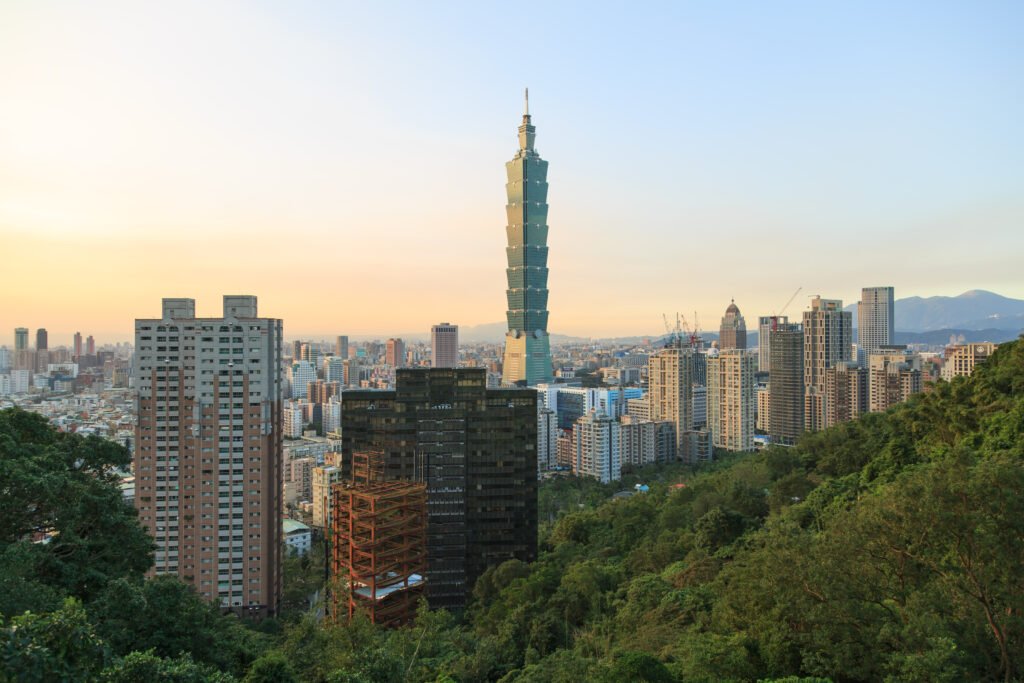
Taipei is the capital and largest city of Taiwan, sitting in a mountain-ringed basin in the island’s north where the Tamsui and Keelung rivers meet. It is Taiwan’s political, financial and cultural center, and the seat of the Republic of China government since 1949.
Where Is Taipei Located?
Taipei occupies the Taipei Basin in northern Taiwan, encircled by the Yangming Mountains to the north and lower hill ranges to the east, south and west. The city proper is a special municipality administered directly by Taiwan’s central government, and it forms the core of a wider metropolitan area that also includes New Taipei City and Keelung. The Tamsui River and its tributary the Keelung River run through the basin, historically giving the city its access to the sea and, before modern transport, its reason for existing as a trading post.
A Brief History of Taipei
The Taipei area was originally home to the Ketagalan, an Indigenous Austronesian people, before Han Chinese settlers began arriving in the 18th century during Qing dynasty rule. The settlement grew around the trading town of Bangkah (now the Wanhua district) and, later, the walled city built in the 1880s. In 1886, Qing authorities made Taipei the capital of Taiwan province, formalizing its administrative importance.
Japan governed Taiwan from 1895 to 1945 following the First Sino-Japanese War, and colonial administrators rebuilt much of Taipei along modern lines, laying out boulevards, rail lines and government buildings, several of which still stand. After Japan’s defeat in the Second World War, Taiwan reverted to Republic of China administration, and in 1949, following the Chinese Communist Party’s victory in the Chinese Civil War, the Republic of China government relocated to Taipei, which has served as its seat ever since. Rapid industrialization from the 1960s through the 1980s, followed by a shift toward electronics and technology, transformed the city into one of East Asia’s wealthier capitals.
Culture, Economy and Daily Life in Taipei
Taipei’s economy centers on finance, technology, trade and government administration, and the wider Taipei metropolitan area is headquarters to much of Taiwan’s electronics and semiconductor-adjacent business activity, even though major fabrication plants are concentrated elsewhere on the island, such as Hsinchu. The city is known for its extensive, heavily used Mass Rapid Transit (MRT) system, its night markets such as Shilin and Raohe, and a street-food culture built around dishes like beef noodle soup, oyster omelets and bubble tea, which is widely credited to Taiwan. Taipei is also a center of publishing, design and the arts in the Chinese-speaking world, and it hosts major international trade shows in computing and electronics.
Taipei’s Most Famous Landmarks
Taipei 101 is the city’s defining structure: a 101-story skyscraper completed in 2004 that held the title of the world’s tallest building until the Burj Khalifa surpassed it in 2010. Its design incorporates a giant steel tuned-mass damper to counteract typhoon winds and earthquakes, a visible feature on public viewing floors. Beyond the tower, the National Palace Museum holds one of the world’s largest collections of Chinese imperial art and artifacts, much of it brought from Beijing’s Forbidden City collection in the 1940s. The Chiang Kai-shek Memorial Hall, Longshan Temple and the historic Dihua Street market district are also central to how the city presents its layered history to visitors and residents alike.
What Is Taipei Known For?
Internationally, Taipei is best known for Taipei 101, its technology and electronics industry, its night-market food culture, and its role as the political center of Taiwan. It is also known for a reliable, dense public-transit network and a reputation, relative to many large Asian capitals, for order and low crime.
Why Taipei Matters
Taipei matters because it is the administrative, economic and cultural anchor of Taiwan, an island whose technology sector, particularly semiconductor manufacturing, is deeply embedded in global supply chains. The city’s political status is also significant: as the seat of the Republic of China government, Taipei sits at the center of one of the most closely watched geopolitical relationships in the world, that between Taiwan and the People’s Republic of China. Its blend of Qing-era, Japanese colonial and postwar architecture and institutions makes it a working record of Taiwan’s twentieth-century history.
Key Takeaways
- Taipei is Taiwan’s capital and largest city, seat of the Republic of China government since 1949.
- It became Taiwan’s provincial capital under Qing administration in 1886 and was substantially rebuilt during Japanese colonial rule (1895-1945).
- Taipei 101, completed in 2004, was the world’s tallest building until 2010.
- The National Palace Museum in Taipei holds one of the world’s largest collections of Chinese imperial art.
- The city anchors Taiwan’s technology-driven economy and remains central to Taiwan-China relations.
Sources
- Encyclopaedia Britannica, “Taipei”, undated, https://www.britannica.com/place/Taipei
- National Statistics, Republic of China (Taiwan), official statistics portal, undated, https://eng.stat.gov.tw/
- Taipei City Government, official city portal, undated, https://english.gov.taipei/
Key facts
Quick checkIn what year did the Republic of China government relocate its seat to Taipei?Show answer
1949, after the Chinese Communist Party won the Chinese Civil War.
Sources
- Encyclopaedia Britannica. Taipei. Undated (accessed 2026-10-06)
- National Statistics, Republic of China (Taiwan). Official statistics portal. Undated (accessed 2026-10-06)
- Taipei City Government. Official city portal. Undated (accessed 2026-10-06)
Editorially reviewed by Specialty Digest Editorial TeamLast reviewed October 6, 2026Researched and drafted with AI assistanceReport an issue