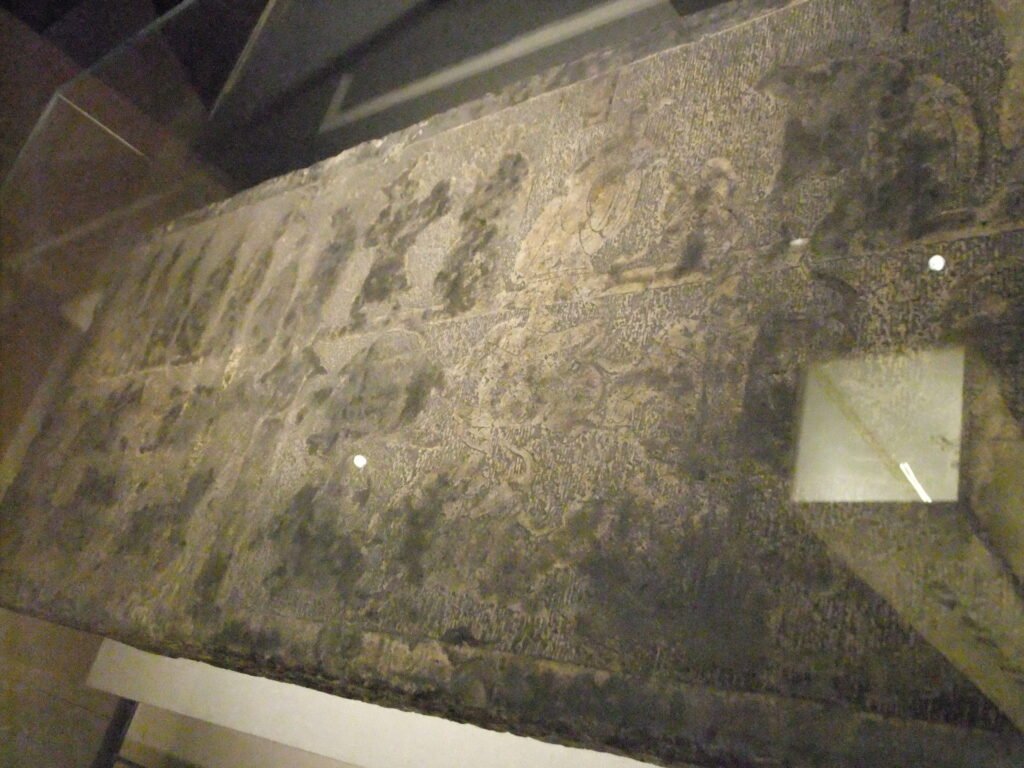
Overview
The Tao Te Ching, also rendered Daodejing, is a foundational text of Taoist philosophy traditionally attributed to the sage Laozi, though its precise authorship and date of composition remain debated among scholars. Composed of 81 brief, often paradoxical chapters, it explores the nature of the Tao, commonly translated as the Way.
Structure
The text divides traditionally into two sections, one emphasizing the Tao and the other emphasizing Te, or virtue, though manuscript evidence shows some variation in chapter order across different versions. Its concise, poetic style leaves much open to interpretation, and the text has generated an extensive commentarial tradition attempting to unpack its compressed language.
Central Concepts
The Tao is presented as an ineffable, generative principle underlying all existence, resistant to full verbal description yet accessible through intuitive attunement. Alongside this sits the concept of wu wei, often rendered effortless action or non-contrived action, describing a mode of acting in harmony with natural patterns rather than through forceful imposition of will.
Political and Ethical Dimensions
Beyond metaphysics, the text offers guidance for rulers, advocating restraint, humility, and minimal intervention as the most effective path to social order. Images of water, valleys, and uncarved wood recur throughout, illustrating strength found in yielding and simplicity rather than in rigid assertion.
Transmission and Versions
Archaeological discoveries, including manuscripts found at Mawangdui and Guodian, have given scholars earlier textual versions than previously available, illuminating the gradual formation of the received text and prompting revised understanding of its early transmission history.
Role Today
The Tao Te Ching remains central to Taoist religious and philosophical practice in China and has become one of the most widely translated texts in world literature, read internationally for its spiritual, ethical, and even political relevance to contemporary life.
Core Imagery
The text relies heavily on natural imagery to convey its teaching, repeatedly returning to water as a central symbol. Water yields to obstacles yet over time carves through stone, illustrating how softness and persistence can overcome rigid strength, a recurring theme running through the work central argument about the nature of effective action and genuine power.
Other recurring images include the uncarved block, representing a state of natural simplicity prior to artificial shaping, and the valley, representing receptivity and humility as sources of strength rather than weakness. These images work together to build a coherent vision of a life lived in harmony with underlying natural patterns rather than through assertive striving against them.
Relationship to Confucianism
Taoist and Confucian thought developed alongside one another in ancient China, often in implicit or explicit contrast. Where Confucian texts emphasize structured social roles, ritual propriety, and defined ethical obligation, the Tao Te Ching favors spontaneity, simplicity, and skepticism toward excessive formal structure, offering a philosophical counterpoint that shaped a productive and lasting tension within Chinese intellectual history.
Later Taoist Religion
Beyond its philosophical readership, the text became foundational scripture for organized Taoist religious movements that developed distinctive ritual, alchemical, and meditative practices over subsequent centuries. These religious forms of Taoism built elaborate theological and cosmological systems extending well beyond the terse philosophical statements found within the original text itself.
Modern Reception
In recent decades the text has found a wide international readership well beyond specialist academic circles, frequently cited in discussions of leadership, environmental thought, and personal well-being. This broad popular reception sometimes simplifies its more technical philosophical content, yet it has undeniably extended the reach of Taoist ideas into global cultural conversation far beyond their original context.
Authorship Debate
Historical evidence for a single historical author named Laozi remains thin, and many scholars now view the text as a compiled anthology of related sayings gathered over time rather than the unified composition of one identifiable individual writing at a single moment in history.
This uncertainty has not diminished its influence, and the text is studied today largely independent of questions about its precise authorship.
Translation Challenges
The compressed, often ambiguous grammar of classical Chinese poses substantial challenges for translators, who must make interpretive decisions that significantly shape how English-language readers understand key terms such as Tao and wu wei, producing a wide range of translations that sometimes differ considerably from one another.
Comparing multiple translations side by side has become a common practice among serious students seeking a fuller sense of the original range of meaning.
It remains one of the most frequently retranslated works in the history of world philosophical literature.
Closing Note
Its brevity, far from limiting its influence, has arguably helped sustain centuries of continued re-reading and reinterpretation across very different cultural settings.
That ongoing conversation shows no sign of slowing.
Relationship to Zhuangzi
The Tao Te Ching is often read alongside the Zhuangzi, another foundational Taoist text composed of more extended parables and anecdotes, with the two works together forming the core classical canon of philosophical Taoism studied and compared by scholars of Chinese thought.
Together these two texts offer complementary windows into the broader philosophical world of early Taoist thought.
Readers today continue to find fresh meaning in its spare and suggestive language.
Its influence on world thought remains considerable.
New readers keep discovering it every year.
Interest in the text keeps growing across many countries.
Interest shows no sign of fading anytime soon among readers and scholars worldwide.
It remains a living and widely read text today.
Few works of its length have left so large a mark on world philosophy and culture.
That reach continues to expand with each new translation published.
It remains a cherished and widely studied classic of world literature today.
Key facts
- Array
Quick checkWhat central concept does the Tao Te Ching explore?Show answer
The Tao, often translated as the Way, an underlying principle or force held to generate and sustain the natural order.
Sources
- Array
Editorially reviewed by Specialty Digest Editorial TeamLast reviewed November 4, 2026Researched and drafted with AI assistanceReport an issue