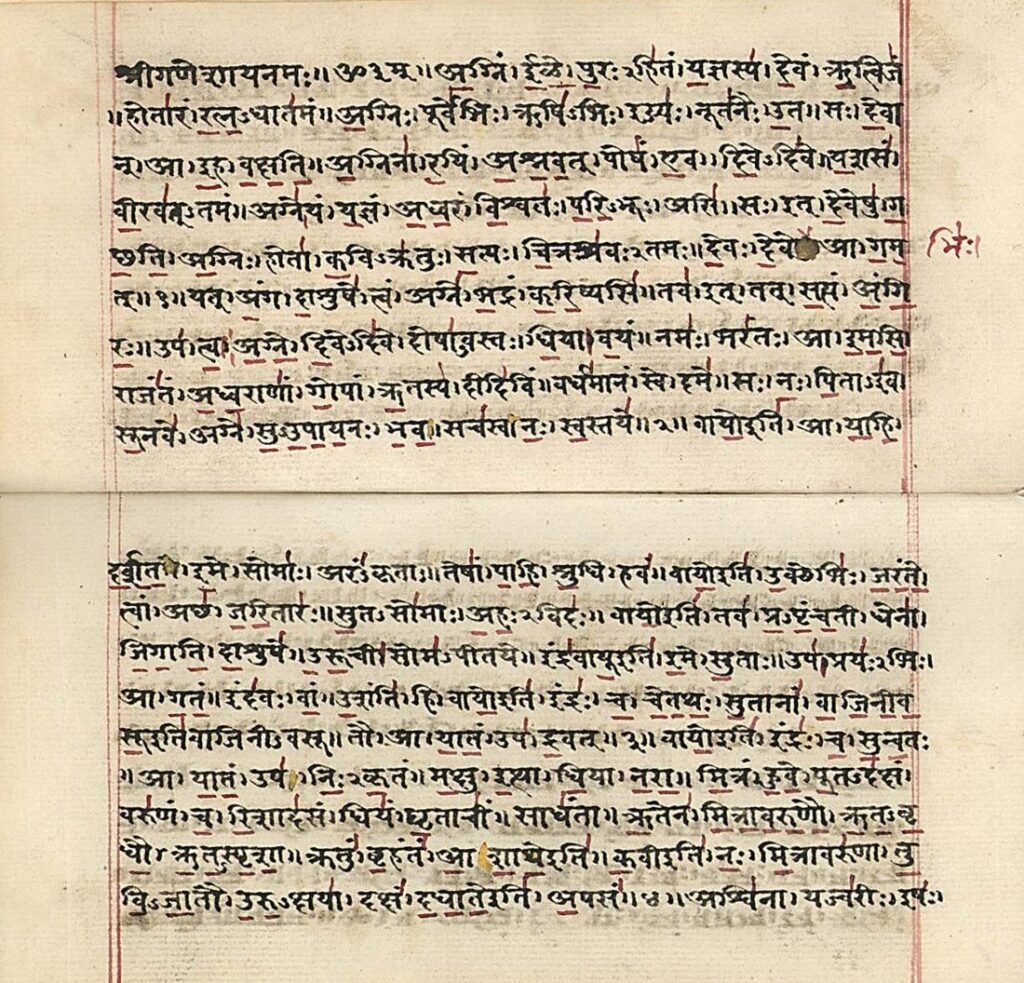
Overview
The Vedas form the oldest body of sacred literature in Hinduism, composed in archaic Vedic Sanskrit and transmitted for many generations through highly disciplined oral recitation before being written down. They are regarded by Hindu tradition as revealed knowledge, foundational to later religious and philosophical development across the subcontinent.
The Four Vedas
The corpus consists of four principal collections. The Rigveda, the oldest and most studied, contains hymns of praise addressed to various deities. The Yajurveda provides liturgical formulas for ritual sacrifice. The Samaveda arranges verses, largely drawn from the Rigveda, for melodic chanting during ceremonies. The Atharvaveda includes spells, charms, and practical knowledge alongside more conventional hymns.
Textual Layers
Each Veda contains several layers composed at different periods: the core hymns called Samhitas, ritual explanation texts called Brahmanas, forest texts called Aranyakas associated with contemplative practice, and philosophical dialogues called Upanishads exploring the nature of reality and the self. These layers together trace a gradual shift from ritual concern toward speculative philosophy.
Oral Transmission
Vedic reciters developed remarkably precise memorization techniques, including methods of reciting words in altered sequences to safeguard against error, allowing the texts to be preserved with extraordinary fidelity across many centuries before writing became common for this material. This oral tradition remains a point of considerable scholarly interest.
Ritual and Philosophical Significance
Early Vedic material centers on sacrificial ritual intended to maintain cosmic order and secure favor from various deities, while later material, especially the Upanishads, shifts toward introspective inquiry into consciousness, ultimate reality, and liberation. This philosophical material profoundly shaped the subsequent development of Hindu thought.
Role Today
The Vedas continue to inform Hindu ritual practice, particularly in traditional ceremonies performed by trained priests, while their philosophical sections remain central to Hindu theology and to broader academic study of South Asian religious history. They are widely regarded as the foundational layer of the Hindu textual tradition.
Ritual Function in Detail
Vedic ritual practice centered on fire sacrifice conducted by specially trained priests, each specializing in a particular Veda and its associated liturgical role. A full ceremonial sacrifice might involve priests drawn from multiple specializations working in coordinated sequence, chanting designated hymns at precise moments believed necessary to secure the intended ritual outcome for the sponsoring patron or community.
Elaborate royal sacrifices, documented in later ritual texts, could extend over many days and involve substantial resources, reflecting both the religious and political significance attached to properly executed Vedic ceremony. These large-scale rituals reinforced the authority of rulers who sponsored them while reaffirming cosmic and social order understood to depend on correctly performed sacrifice.
Philosophical Legacy
The Upanishads, composed as a later layer within the broader Vedic corpus, introduced concepts such as Brahman, the ultimate underlying reality, and Atman, the inner self, along with early articulation of ideas about karma and rebirth that would become foundational across later Indian religious and philosophical traditions, including those outside orthodox Vedic ritual practice itself.
Transmission Schools
Different regional schools, called shakhas, preserved their own particular recensions of Vedic text, each with slightly different readings and associated ritual procedures. Only a fraction of these historical schools survive in continuous practice today, though manuscript and inscriptional evidence attests to a once much wider diversity of transmission lineages across ancient India.
Modern Study
Comparative linguists have long used Vedic Sanskrit as key evidence in reconstructing the broader Indo-European language family, since its relatively early attestation and careful preservation offer unusually clear evidence of archaic linguistic features shared with other ancient languages descended from a common distant ancestor.
This linguistic significance adds a further dimension of scholarly interest to the Vedas beyond their religious and philosophical content.
Connection to Later Practice
Many Hindu rituals performed today, including domestic ceremonies and major life-cycle rites, retain elements traceable to Vedic precedent, even as their specific form has evolved considerably over the many centuries separating contemporary practice from the original ritual context documented in the ancient texts.
This continuity links contemporary Hindu religious life to one of the oldest continuously maintained textual traditions in the world.
Preservation Technique
Beyond simple memorization, reciters employed techniques such as reciting words in reverse pairs or inserted sequences specifically designed to make any corruption of the text immediately detectable, an achievement widely regarded among linguists as among the most rigorous oral preservation systems documented anywhere in the ancient world.
Linguists and historians continue to study this preservation method as a remarkable achievement of ancient oral culture and discipline.
Few other ancient literatures offer comparably well-documented evidence of how oral tradition can preserve text with such precision.
Closing Note
Study of this preservation method continues to inform broader research into memory, language, and the transmission of knowledge across generations in societies without widespread writing.
That broader research continues today across several related academic fields.
Regional Schools in Detail
Surviving shakhas today are concentrated in particular regions of India, each maintaining its own ritual specialists trained from childhood in the precise recitation required for ceremonial use, a living tradition that connects contemporary practice directly back toward these ancient methods of transmission.
These living lineages remain a direct and valued link to an ancient chapter of Indian religious and linguistic history.
They remain a touchstone for anyone studying the deep roots of Indian religious and intellectual history.
Their influence continues to shape scholarship today.
New generations of scholars keep building on this foundation.
Interest in the subject keeps growing steadily worldwide.
Interest shows no sign of fading anytime soon among specialists and general readers alike.
It remains foundational to the study of Indian religious history as a whole.
Key facts
- Array
Quick checkHow many Vedas make up the core Vedic corpus?Show answer
Four: the Rigveda, Yajurveda, Samaveda, and Atharvaveda, each associated with particular ritual and liturgical functions.
Sources
- Array
Editorially reviewed by Specialty Digest Editorial TeamLast reviewed November 4, 2026Researched and drafted with AI assistanceReport an issue