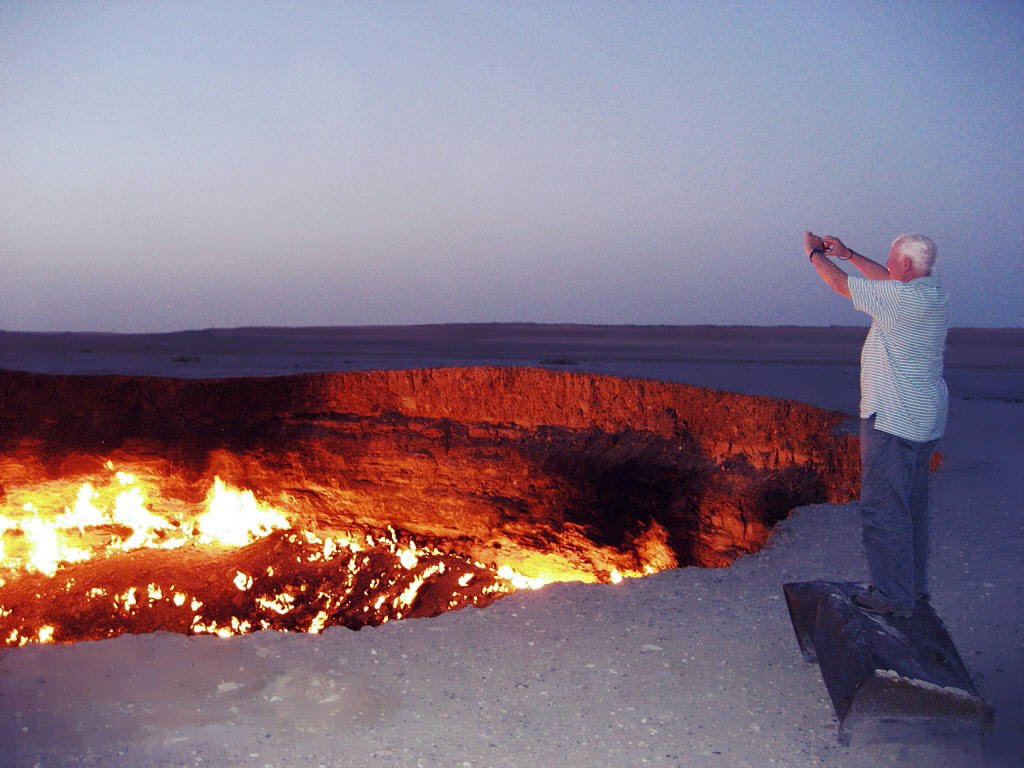
Turkmenistan is a landlocked country in Central Asia, bordered by the Caspian Sea to the west, Kazakhstan and Uzbekistan to the north and east, Afghanistan to the southeast, and Iran to the south. Much of its territory lies within the Karakum Desert, and the country is best known internationally for its vast natural gas reserves and for the Darvaza gas crater, a continuously burning pit in the desert widely nicknamed the Door to Hell.
Where Is Turkmenistan Located?
Turkmenistan sits between the Caspian Sea and the mountains of Afghanistan and Iran, at the southern edge of Central Asia’s steppe and desert belt. It shares borders with Kazakhstan and Uzbekistan to the north and east, Afghanistan to the southeast, and Iran to the south, and its Caspian coastline gives it a maritime link toward the Caucasus and beyond.
Geography of Turkmenistan
Roughly 80 percent of Turkmenistan is covered by the Karakum, or Black Sand, Desert, one of the largest sandy deserts in the world. The Kopet Dag mountain range runs along the southern border with Iran, and the Amu Darya river crosses the country’s northeast, feeding the Karakum Canal, one of the longest irrigation canals on Earth, which supplies water to the country’s cotton and agricultural land. The climate is extreme, with very hot, dry summers and cold winters.
A Brief History of Turkmenistan
The region has been inhabited since antiquity and lay along branches of the Silk Road connecting Persia, Central Asia, and China. Turkmen tribal confederations controlled much of the territory before it was absorbed into the Russian Empire in the late nineteenth century. It became a Soviet republic, the Turkmen Soviet Socialist Republic, in 1924, and gained independence as the Soviet Union dissolved, on October 27, 1991. The country’s first post-independence president, Saparmurat Niyazov, built a highly centralized state and an extensive personality cult that shaped Turkmenistan’s politics for the following decade and a half.
Government and Economy
Turkmenistan is a presidential republic in which a single party has dominated political life since independence; independent media and most forms of organized political opposition are not permitted to operate in the country. Economically, it is classified by the World Bank as an upper middle income country with a gross domestic product of approximately $68.7 billion and a GDP per capita of roughly $9,166 as of 2024.[1] Turkmenistan holds the world’s fourth largest proven natural gas reserves and the 44th largest proven oil reserves, and gas exports, chiefly to China, are the backbone of the economy.[1] State owned enterprises dominate economic activity, accounting for 59.2 percent of total business turnover in 2023, and agriculture employs 42.5 percent of the labor force despite low productivity and growing water scarcity.[1]
Culture and People
Turkmenistan’s population was estimated at about 7.5 million in 2024.[1] Ethnic Turkmen form the large majority, with smaller Uzbek and Russian minorities, and the Turkmen language, a member of the Oghuz branch of the Turkic language family closely related to Turkish and Azerbaijani, is the official language. Turkmen culture places strong emphasis on carpet weaving, horsemanship, particularly the Akhal Teke horse breed native to the country, and clan and tribal identity, which remains an important part of social life.
What Is Turkmenistan Known For?
Turkmenistan is best known for the Darvaza gas crater, a roughly 70 meter wide pit in the Karakum Desert that has burned continuously for decades. According to widely repeated accounts, the crater formed after a Soviet gas drilling operation caused a collapse and the resulting methane leak was deliberately set alight to prevent it from poisoning the surrounding area, with 1971 the date most commonly cited, though independent verification of the exact year is limited and some researchers place the ignition later. Turkmenistan is also known for its capital, Ashgabat, which was almost entirely rebuilt after a devastating 1948 earthquake and now holds a Guinness World Record for the highest concentration of white marble clad buildings in a single city, including the gold domed Independence Monument.
Why Turkmenistan Matters
Turkmenistan’s enormous natural gas reserves make it a significant, if underutilized, player in global energy markets, and its position between the Caspian Sea, Iran, Afghanistan, and the rest of Central Asia gives it strategic relevance for regional pipeline routes and trade corridors. Its status as one of the world’s most closed and tightly controlled states also makes it a frequently cited case study in discussions of authoritarian governance and state control of the economy.
Key Takeaways
- Turkmenistan is a landlocked Central Asian country where roughly 80 percent of the land is covered by the Karakum Desert.
- It holds the world’s fourth largest proven natural gas reserves, which anchor an economy still dominated by state owned enterprises.
- The country’s best known feature is the Darvaza gas crater, a continuously burning pit nicknamed the Door to Hell.
- Turkmenistan became independent from the Soviet Union on October 27, 1991, and has been governed by a highly centralized, single party dominated state ever since.
- Its capital, Ashgabat, holds a Guinness World Record for its concentration of white marble buildings.
Sources
- World Bank, “Turkmenistan Overview” (accessed October 5, 2026)
- Encyclopaedia Britannica, “Turkmenistan” (accessed October 5, 2026, used as a tertiary reference for uncontroversial chronology)
Key facts
Quick checkWhat is the Darvaza gas crater, and where is it located?Show answer
It is a continuously burning pit in the Karakum Desert of Turkmenistan, nicknamed the Door to Hell, widely believed to have resulted from a Soviet era drilling accident.
Sources
- World Bank. Turkmenistan Overview. Undated (accessed Accessed October 5, 2026)
- Encyclopaedia Britannica. Turkmenistan. Undated (accessed Accessed October 5, 2026)
Editorially reviewed by Specialty Digest Editorial TeamLast reviewed October 5, 2026Researched and drafted with AI assistanceReport an issue