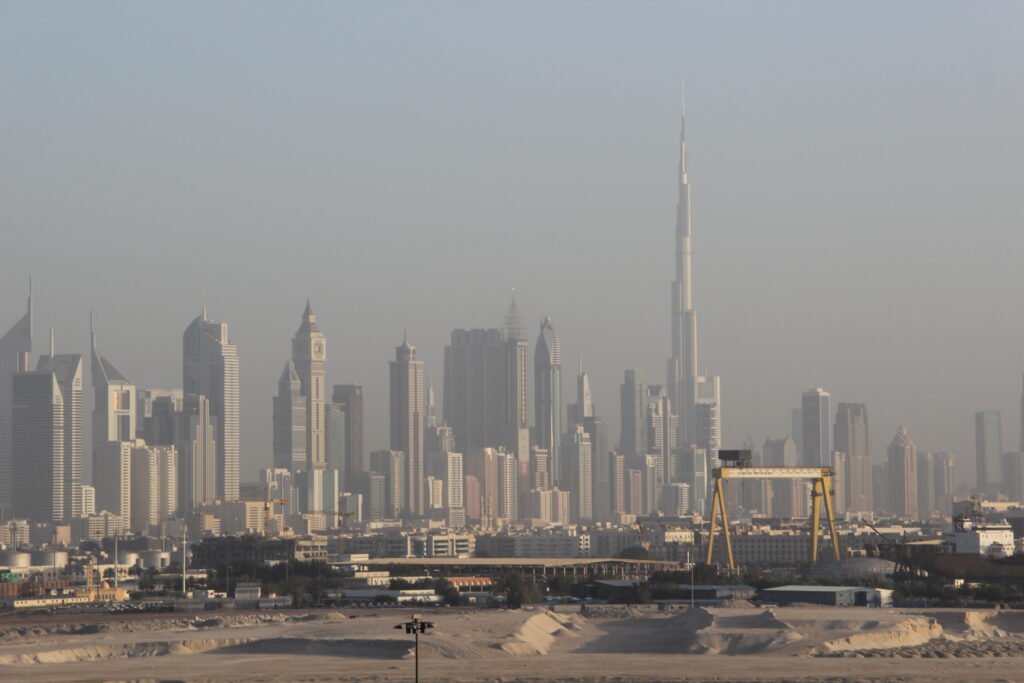
The United Arab Emirates is a federation of seven emirates on the Arabian Peninsula, known for transforming in little more than two generations from a region of pearling and fishing settlements into one of the world’s leading centers for oil wealth, aviation, trade, and tourism, symbolized today by Dubai’s Burj Khalifa, the tallest building on Earth.
Where Is the United Arab Emirates Located?
The UAE sits on the southeastern Arabian Peninsula, bordering Saudi Arabia to the south and west and Oman to the east, with coastlines on the Persian Gulf to the north and a short stretch of the Gulf of Oman in the east. It lies across the Strait of Hormuz from Iran, one of the world’s most important routes for oil shipping.
Geography of the United Arab Emirates
Much of the UAE’s interior is desert, including part of the Rub al Khali, or Empty Quarter, one of the largest continuous sand deserts in the world, while the Hajar Mountains rise along the border with Oman in the east. The country has little naturally arable land or fresh water, and its cities, Abu Dhabi and Dubai chief among them, have relied heavily on desalination and, more recently, extensive land reclamation along the coast.
A Brief History of the United Arab Emirates
The area has been inhabited since at least 6000 BCE and was historically home to Bedouin tribes, fishing and pearling communities, and trading ports along the Persian Gulf.[1] From the nineteenth century, Britain signed a series of treaties with the local rulers, and the emirates became known collectively as the Trucial States under British protection. Following the discovery of oil in the 1950s and 1960s and Britain’s withdrawal from the Gulf, the rulers of Abu Dhabi, Dubai, Sharjah, Ajman, Umm Al Quwain, and Fujairah formed the United Arab Emirates on December 2, 1971, with Ras Al Khaimah joining shortly after.
Government and Economy
The UAE is a federation of seven emirates, each retaining significant autonomy, governed at the federal level by a Supreme Council of Rulers and a Council of Ministers, with Abu Dhabi as the federal capital.[1] Arabic is the official language and Islam the official religion, and the national currency, the UAE dirham, is pegged to the United States dollar.[1] Although the UAE’s modern economy was built on oil and gas exports, Abu Dhabi and especially Dubai have diversified heavily into aviation, logistics, tourism, finance, and real estate, and the UAE passport is ranked among the most powerful in the world for visa free travel.[1]
Culture and People
Emirati nationals form a minority of the UAE’s resident population, with a large majority of residents made up of foreign workers from South Asia, Southeast Asia, the wider Arab world, and beyond, drawn by the country’s labor market. Emirati culture draws on Bedouin, maritime, and Islamic traditions, including falconry, poetry, and traditional dhow boat building, while the country’s major cities have become notably cosmopolitan, hosting large expatriate communities and a wide range of international cuisine, retail, and entertainment.
What Is the United Arab Emirates Known For?
The UAE is most widely known for Dubai’s Burj Khalifa, which opened in 2010 at a height of 828 meters to become the tallest structure in the world, a title it still holds. Designed by the Chicago firm Skidmore, Owings and Merrill, the tower anchors a wider Downtown Dubai district built around the Dubai Fountain and one of the world’s largest shopping malls. The UAE is also known more broadly for Dubai and Abu Dhabi’s rapid skyline growth, man made islands such as Palm Jumeirah, and its position as a major global aviation and logistics hub.
Why the United Arab Emirates Matters
The UAE’s position on the Strait of Hormuz and its role as a major oil and gas exporter give it continuing importance to global energy markets, while its successful economic diversification into aviation, trade, and finance has made it a model frequently studied by other resource rich states seeking to reduce their dependence on oil revenue. Its airlines and airports also make it one of the most important connecting hubs between Europe, Asia, and Africa.
Key Takeaways
- The United Arab Emirates is a federation of seven emirates on the Arabian Peninsula, formed on December 2, 1971.
- Abu Dhabi is the federal capital, while Dubai has become the country’s best known global city.
- The UAE’s economy, originally built on oil and gas, has diversified heavily into aviation, trade, finance, and tourism.
- Dubai’s Burj Khalifa, completed in 2010 at 828 meters, is the tallest building in the world.
- The UAE passport is ranked among the most powerful in the world for visa free international travel.[1]
Sources
- The Official Portal of the UAE Government, “About the UAE” (accessed October 5, 2026)
- Encyclopaedia Britannica, “United Arab Emirates” (accessed October 5, 2026, used as a tertiary reference for uncontroversial chronology)
Key facts
Quick checkWhat is the Burj Khalifa, and why is it significant?Show answer
The Burj Khalifa is a skyscraper in Dubai, UAE, that opened in 2010 at 828 meters to become, and remain, the tallest building in the world.
Sources
- The Official Portal of the UAE Government. About the UAE. Undated (accessed Accessed October 5, 2026)
- Encyclopaedia Britannica. United Arab Emirates. Undated (accessed Accessed October 5, 2026)
Editorially reviewed by Specialty Digest Editorial TeamLast reviewed October 5, 2026Researched and drafted with AI assistanceReport an issue