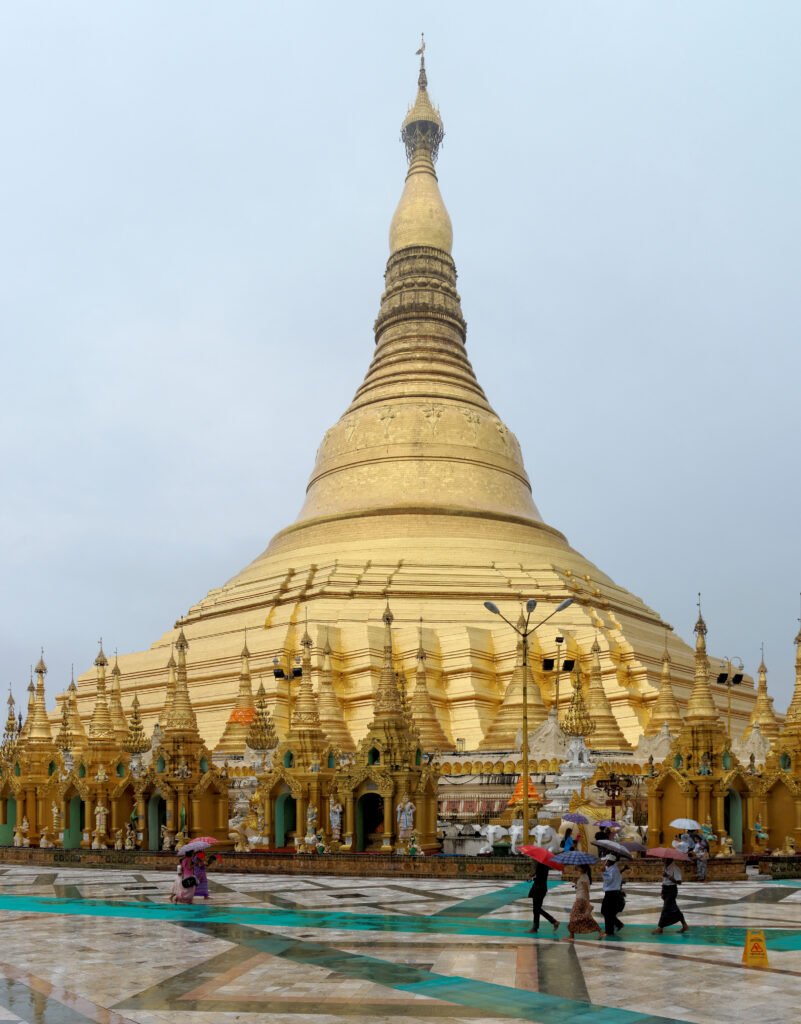
Yangon, formerly known as Rangoon, is the largest city in Myanmar and its commercial capital, though the country’s administrative capital moved to Naypyidaw in 2005.
Where Is Yangon Located?
Yangon sits on the Yangon River near where it meets the Andaman Sea in southern Myanmar, giving the city a long history as the country’s principal port. The downtown area retains a grid of colonial-era streets close to the riverfront, while the Shwedagon Pagoda stands on raised ground to the north, visible across much of the city.
A Brief History of Yangon
A settlement existed at the site for centuries before the British, having annexed Lower Burma, rebuilt the town after a fire in 1841 and developed it into the colonial port city of Rangoon, making it the capital of British Burma in 1852. Rangoon grew into one of colonial Asia’s major ports and a cosmopolitan trading city before the Second World War, during which it was occupied by Japan from 1942 to 1945. It became the capital of independent Burma in 1948 and remained the country’s capital, under the name Yangon after a government-led renaming in 1989, until the ruling military government shifted the administrative capital to the newly built city of Naypyidaw in 2005.
Culture, Economy and Daily Life in Yangon
According to the World Bank, Myanmar’s economy has suffered significant reversals in recent years amid multiple overlapping crises, including political upheaval since 2021, and growth has remained subdued. Yangon nonetheless remains Myanmar’s commercial center, home to most of the country’s banking, trade and manufacturing activity, as well as its busiest port and airport. The city’s culture is built around Theravada Buddhist practice, visible in its many pagodas, alongside a multiethnic population that includes Bamar, Chinese and South Asian communities whose presence dates largely to the colonial era.
Yangon’s Most Famous Landmarks
The Shwedagon Pagoda is Yangon’s defining landmark and one of the most important Buddhist sites in the world: a gilded stupa rising more than 100 meters, which, according to Buddhist tradition, enshrines relics of the Buddha and dates back more than a thousand years, though its current form reflects many centuries of rebuilding and regilding. Downtown, the colonial-era Secretariat Building and Sule Pagoda, along with the Strand Hotel, remain prominent landmarks of the Rangoon era.
What Is Yangon Known For?
Yangon is known internationally for the Shwedagon Pagoda, for its large stock of well-preserved British colonial architecture, unusually extensive for a Southeast Asian city, and for its status as Myanmar’s commercial and former political capital.
Why Yangon Matters
Yangon matters as Myanmar’s economic center and its principal connection to global trade and travel, even though political administration has shifted to Naypyidaw. The Shwedagon Pagoda’s standing as a major pilgrimage site, combined with the city’s colonial architectural heritage, makes Yangon central to both the religious and historical identity of the country.
Key Takeaways
- Britain rebuilt the city as colonial Rangoon and made it capital of British Burma in 1852.
- Rangoon became capital of independent Burma in 1948.
- The city was renamed Yangon in 1989.
- Myanmar’s administrative capital moved to Naypyidaw in 2005, but Yangon remains the commercial capital.
- The Shwedagon Pagoda, over 100 meters tall, is Yangon’s defining landmark and a major Buddhist pilgrimage site.
Sources
- World Bank Group, “Myanmar Overview”, 2026, https://www.worldbank.org/en/country/myanmar/overview
- Encyclopaedia Britannica, “Yangon”, undated, https://www.britannica.com/place/Yangon
Key facts
Quick checkWhen did Myanmar's administrative capital move from Yangon to Naypyidaw?Show answer
2005.
Sources
- World Bank Group. Myanmar Overview. 2026 (accessed 2026-10-06)
- Encyclopaedia Britannica. Yangon. Undated (accessed 2026-10-06)
Editorially reviewed by Specialty Digest Editorial TeamLast reviewed October 6, 2026Researched and drafted with AI assistanceReport an issue