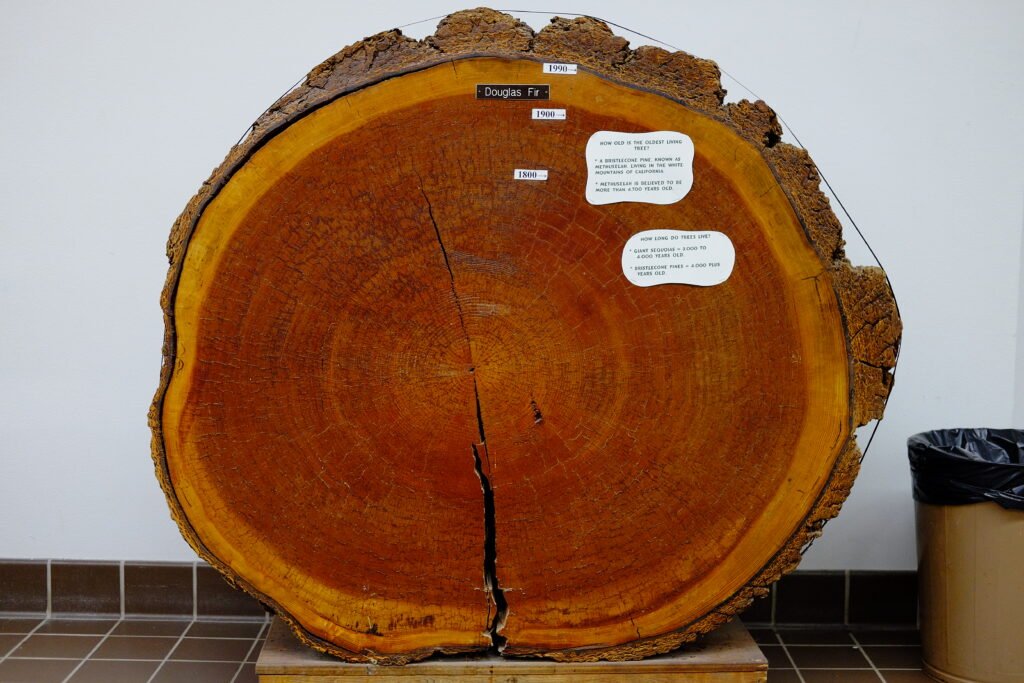
Cut a cross-section through a Douglas fir trunk and you are looking at a machine that has been moving and banking energy, without pumping, for a century or more. Materials scientists have started looking at that machine less as a metaphor and more as a blueprint.
ONE IDEA
A tree’s vascular system solves a problem that looks, on paper, almost identical to the one battery engineers are stuck on: how do you move a lot of material through a solid structure, over and over, for years, without the pathways clogging, cracking, or wearing unevenly? Xylem carries water and dissolved minerals upward from root to crown through a branching network of vessels; phloem, running alongside it, moves sugars produced in the leaves down to the roots and back up again as needed, largely by the pressure-flow mechanism first proposed by the German plant physiologist Ernst Münch in 1930 — sugar concentration differences between “source” and “sink” tissues create an internal pressure gradient that pushes fluid through the phloem’s living sieve tubes without any external pump. Both systems share a structural trait engineers have a specific word for: low tortuosity, meaning the internal paths are nearly straight and evenly distributed rather than tangled and bottlenecked.
That trait turns out to matter enormously in a lithium-metal battery, where the central failure mode is dendrites — needle-like lithium deposits that grow unevenly across a flat anode surface during charging, eventually piercing the separator and shorting the cell. In 2017, materials scientist Liangbing Hu and then-doctoral student Ying Zhang, at the University of Maryland, published a paper in the Proceedings of the National Academy of Sciences showing they could carbonize a block of ordinary wood — preserving its natural channel structure, the same channels that once carried water and nutrients — and use those thousands of parallel low-tortuosity channels to host lithium metal directly. Spreading the metal across many straight, separate paths instead of one flat surface suppressed dendrite formation and let the anode run safely at practical current densities. A 2024 review in the Royal Society of Chemistry’s Green Chemistry, by Stefano Tagliaferri, Cecilia Mattevi and colleagues at Imperial College London and Queen Mary University of London, surveys related follow-on work — including delignified balsa wood coated with carbon nanotubes to manage gas-and-ion transport in lithium-oxygen batteries, echoing how a leaf’s vein network moves fluid and load at once.
None of this means chemistry stops mattering — it doesn’t. What it means is that some of the hardest remaining problems in energy storage may be architectural rather than elemental, and that plants solved the architecture problem first, under a much longer set of design constraints than any battery lab has had to work with. Evidence strength: moderate. The underlying wood-channel and vein-network experiments are real, peer-reviewed, and have been independently extended by multiple labs — but they remain laboratory demonstrations on small cells, not evidence that a grid-scale battery built this way is imminent or economical.
ONE METHOD
The Maryland approach is concrete enough to describe as a repeatable technique, even though it lives in a lab rather than a factory:
1. Start with a natural channel structure, not a flat sheet. Hu and Zhang used basswood specifically because its vessels run in long, straight, parallel lines with minimal branching interference — the wood equivalent of a low-tortuosity network.
2. Carbonize, don’t discard, the structure. Heating the wood in a controlled, low-oxygen furnace burns away everything except a conductive carbon scaffold, while preserving the channel geometry that took the tree years to grow.
3. Distribute the load instead of concentrating it. Hosting lithium metal inside the channels, rather than depositing it on one flat surface, spreads the electrochemical work across thousands of independent paths — directly suppressing the uneven local current density that produces dendrites.
4. Test against a flat control, under a real current load. The Maryland team validated the design at a practical 3 milliamps per square centimeter — the step that turns “the structure looks promising” into a checkable claim.
Evidence strength: moderate. The wood-anode method has been replicated and extended in the peer-reviewed literature since 2017, including in the broader biomimetic-electrode work summarized by Tagliaferri and colleagues in 2024. It has not yet appeared in a commercial battery, and scaling any biological-template process to factory volumes remains a real, unresolved manufacturing question — so treat this as a validated laboratory technique, not a finished product.
ONE ACTION
This week, find one real cross-section of wood you can look at — a cut stump at a park, a slab at a lumber yard, a piece of furniture with visible end-grain — and spend five uninterrupted minutes tracing its channels and rings rather than glancing past it. Then read just the abstract of Zhang and Hu’s 2017 study (searchable as “High Capacity, Low Tortuosity and Channel-Guided Lithium Metal Anode,” PNAS), and write one sentence connecting a structural feature you noticed to a problem it might solve. The goal isn’t to become a materials scientist by Friday — it’s to practice noticing structure as a design source, on one object, on a deadline.
ONE SHIFT
Before: a “materials breakthrough” sounds like a new chemical element, compound, or additive — something you’d need a chemistry degree to evaluate. After: you start asking a second question alongside it — not just “what is this made of,” but “how is it shaped, and what natural structure, if any, already solved a version of this shaping problem.” The observable shift is in your own reading habits: the next energy-storage headline you see, you’ll notice whether it’s describing a new material or a new architecture, and those call for different kinds of skepticism.
ONE QUESTION
Where in your own work have you been trying to solve a “materials problem” — more resources, a different tool, a different person — when the real bottleneck was actually about structure: how something is routed, distributed, or shaped, rather than what it’s made of?
ONE SENTENCE
A Douglas fir’s tree rings and vascular channels are a century-long record of a transport-and-storage problem already solved, and materials scientists are now carbonizing that same wood, channels intact, to build battery anodes that resist the failure mode — dendrite growth — that has limited lithium-metal batteries for decades.
ONE SCENARIO
Consider a graduate researcher two years into a materials-science PhD, tasked with improving the cycle life of a lithium-metal battery for grid storage. The conventional approach on the table is a new electrolyte additive — incremental, well-trodden, likely to yield a few percentage points of improvement. Reading Zhang and Hu’s 2017 paper, she notices that the persistent failure mode in her own cells — localized dendrite growth at specific hot spots on the anode surface — looks structurally identical to the problem a tree’s vascular system evolved to avoid: uneven flow concentrating stress at a small number of points instead of spreading it across a distributed network.
She doesn’t abandon the electrolyte work; the evidence doesn’t support treating biomimetic anode architecture as a guaranteed fix, only a promising direction with real precedent. Instead she runs a side-by-side test — a carbonized-wood-channel anode against her lab’s flat-foil control, under identical current loads — as one additional variable, not a silver bullet. That is the honest version of borrowing from biology: not “nature solved it, so we’re done,” but “nature solved a structurally similar problem, so it’s worth a controlled test” against a real baseline before anyone calls it a breakthrough.
Explore more from Specialty Digest’s Big Ideas series, or subscribe to Specialty Digest Weekly for the ideas shaping how we think.
- Münch, E. (1930). Die Stoffbewegungen in der Pflanze — original formulation of the pressure-flow hypothesis of phloem transport; modern overview via background reading.
- Zhang, Y. & Hu, L., et al. “High Capacity, Low Tortuosity and Channel-Guided Lithium Metal Anode.” Proceedings of the National Academy of Sciences, March 2017. Summary via University of Maryland, Dept. of Materials Science and Engineering.
- Tagliaferri, S., Mattevi, C., et al. “Nature-inspired batteries: from biomaterials to biomimetic design strategies.” Green Chemistry, Royal Society of Chemistry, 2024. Full text.
- Gomez, C.V., et al. “Biomimetic Wood-Inspired Batteries: Fabrication, Electrochemical Performance, and Sustainability within a Circular Perspective.” Advanced Sustainable Systems, Wiley, 2021. Journal record.
- Berggren, M., Linköping University, research on cellulose- and lignin-based energy storage materials, as reported by Science News Explores.
- National Park Service / dendrochronology overview on earlywood, latewood, and annual tree-ring formation as a record of seasonal growth allocation. PDF.