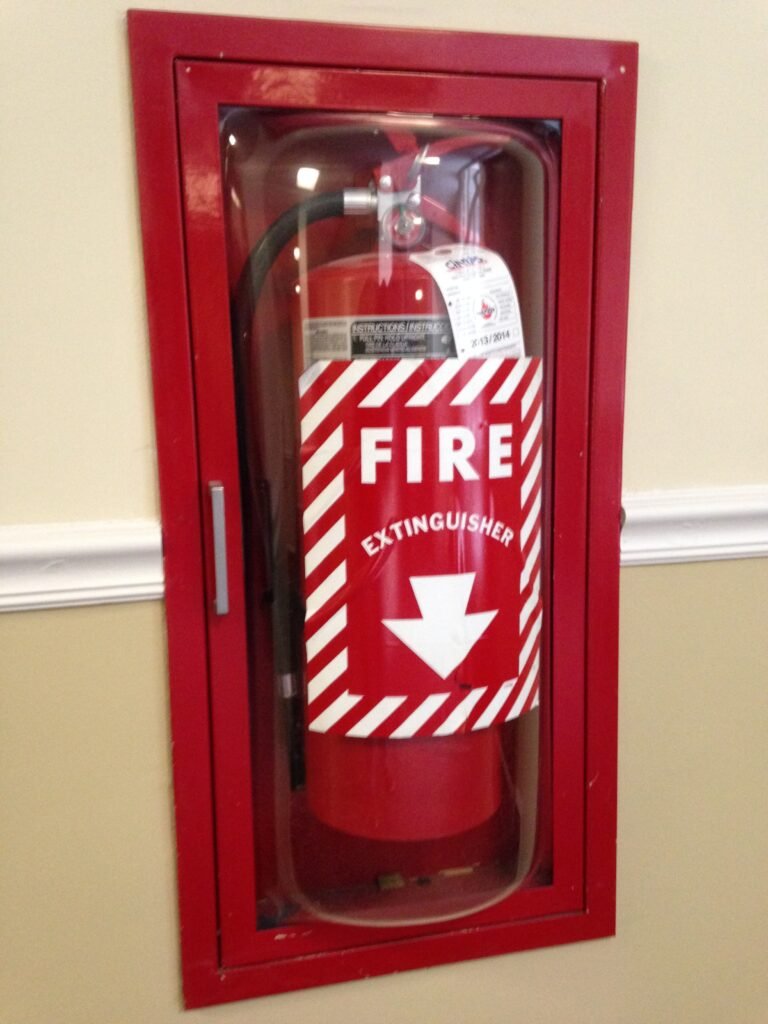
A fire extinguisher is a portable device designed to allow a single person to control or extinguish a small fire in its early stages, before it grows large enough to require evacuation and fire department response. Extinguishers are a cornerstone of occupational and residential fire safety precisely because they allow rapid intervention at the moment a fire is most easily controlled.
n
Classification System
n
Extinguishers are classified according to the type of fire they are designed to combat. Class A extinguishers address ordinary combustible materials such as wood, paper, and cloth. Class B extinguishers target flammable liquids and gases. Class C extinguishers are rated safe for use on fires involving live electrical equipment, since they use a non-conductive agent. Class D extinguishers are specialized for combustible metal fires, and Class K extinguishers are designed for the high-temperature cooking oil and grease fires typical of commercial kitchens. Many extinguishers carry multiple ratings, such as ABC, indicating effectiveness against several fire classes at once.
n
Proper Use Technique
n
Correct extinguisher use is commonly taught using the acronym PASS, standing for pull the safety pin, aim the nozzle at the base of the fire rather than the flames themselves, squeeze the handle to release the agent, and sweep the nozzle from side to side across the base of the fire. Training in this technique, along with recognizing when a fire is too large for extinguisher use and immediate evacuation is the safer choice, forms a standard part of workplace fire safety training.
n
Placement and Accessibility Requirements
n
Fire codes typically specify requirements for extinguisher placement, including maximum travel distance from any point in a space to the nearest extinguisher, mounting height to ensure accessibility, and clear signage marking extinguisher locations. These requirements aim to ensure that an extinguisher is always within reasonable reach when a small fire is first noticed, since delay in locating an extinguisher can allow a manageable fire to grow beyond the point where portable equipment remains effective.
n
Inspection and Maintenance
n
Extinguishers require regular visual inspection to confirm proper pressure, an unobstructed nozzle, and an intact safety pin and tamper seal, along with periodic professional maintenance and hydrostatic testing at intervals specified by the extinguisher type and applicable standards. An extinguisher that has lost pressure, suffered physical damage, or exceeded its service interval cannot be relied upon to function correctly, making routine inspection a critical but sometimes overlooked part of maintaining genuine fire readiness.
n
Training and Human Factors
n
Even a properly maintained and correctly placed extinguisher provides limited value if building occupants have not been trained in its use, since unfamiliarity under the stress of an actual fire can lead to hesitation, improper technique, or complete failure to attempt extinguishment. Many workplaces conduct periodic hands-on fire extinguisher training, often using controlled live-fire exercises, specifically because reading instructions on an extinguisher label differs considerably from successfully operating one under the adrenaline and limited visibility of a real fire event.
n
Limitations of Portable Extinguishers
n
Fire safety training consistently emphasizes that portable extinguishers are intended only for small, incipient-stage fires, and that attempting to fight a fire that has grown beyond this stage, or that blocks the only available escape route, is extremely dangerous. Standard guidance instructs occupants to always ensure a clear path of retreat before attempting to use an extinguisher, to call for help regardless of whether the attempt succeeds, and to abandon the attempt and evacuate immediately if the fire does not respond quickly to the extinguishing agent.
n
Summary of Protective Role
n
Taken together, correct classification, proper placement, routine maintenance, and adequate training determine whether a fire extinguisher actually functions as intended during the narrow window when it can make a meaningful difference in a developing fire. Because that window closes quickly as a fire grows, the extinguisher value depends entirely on all of these elements being addressed well before an emergency occurs, rather than assumed only once a fire has already started.
n
Extinguisher Agents in Detail
n
Common extinguishing agents each work through a distinct mechanism: water absorbs heat as it vaporizes, dry chemical powder interrupts the chemical chain reaction of combustion, carbon dioxide displaces oxygen around the fire, and wet chemical agents used in Class K extinguishers both cool and form a soap-like barrier over burning cooking oil to prevent reignition. Understanding these mechanisms helps explain why substituting one agent type for another can sometimes worsen rather than control a fire.
n
Workplace Program Requirements
n
Occupational safety regulations in many jurisdictions require employers to provide portable fire extinguishers appropriate to the hazards present, ensure they remain accessible and properly maintained, and either train employees in their use or establish clear policies directing employees to evacuate immediately rather than attempt firefighting. These requirements reflect a broader recognition that extinguisher availability alone is insufficient without corresponding attention to training and clear expectations about when extinguisher use is and is not appropriate.
n
Across all of these considerations, the fire extinguisher remains a valuable but narrowly scoped tool, one whose benefit depends entirely on correct selection, maintenance, and judgment about when to use it rather than evacuate.
n
Final Considerations
n
Because fire extinguishers place direct responsibility on an individual bystander in the critical early moments of a fire, ensuring that responsibility is matched with adequate equipment, training, and clear limits remains an essential, ongoing commitment rather than a one-time purchase.
n
A workplace that treats extinguisher readiness as a routine, recurring task rather than an afterthought is far better positioned to benefit from the equipment when a genuine emergency finally tests it.
Key facts
- Array
Sources
- Array
Editorially reviewed by Specialty Digest Editorial TeamLast reviewed November 3, 2026Researched and drafted with AI assistanceReport an issue