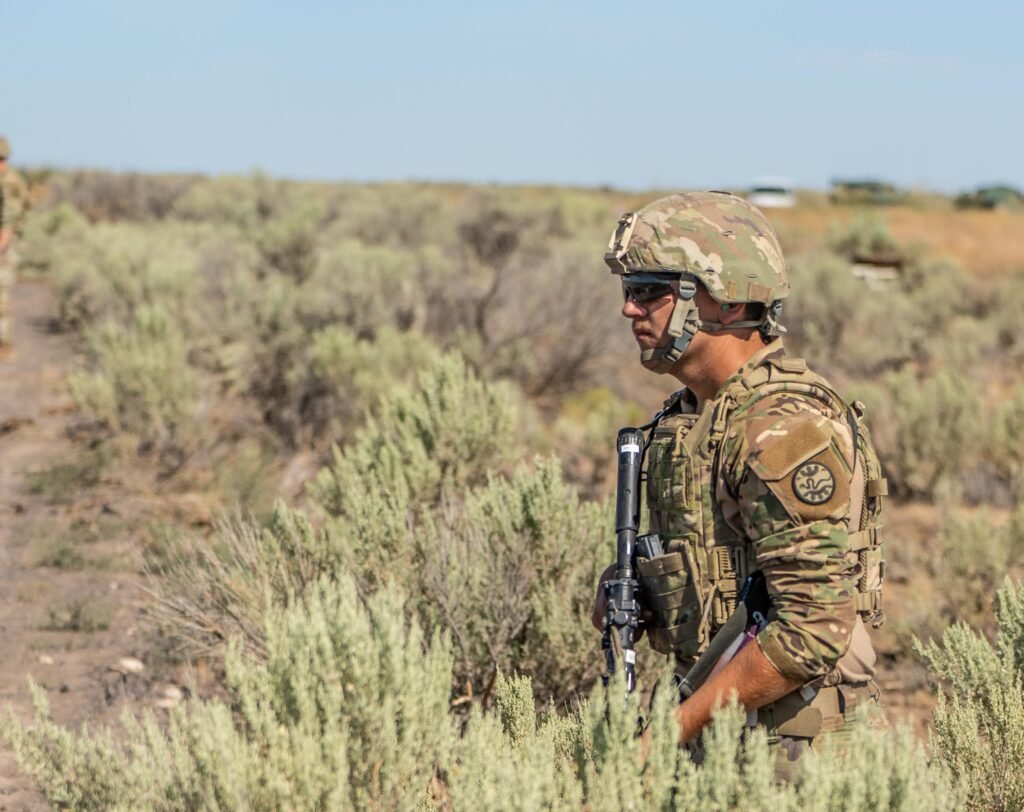
Overview
Combined arms warfare refers to the deliberate integration of different types of military forces and equipment on the battlefield so that their respective strengths offset each others weaknesses. Rather than committing infantry, tanks, artillery, or aircraft in isolation, commanders coordinate these elements so they act together toward a shared objective.
Origins and development
Although elements of combined arms thinking appear throughout military history, the concept took its modern form during the twentieth century, particularly as tanks, aircraft, and motorized infantry became widely available. The German concept often referred to in English as blitzkrieg relied heavily on tight coordination between armor, infantry, artillery, and close air support to achieve rapid breakthroughs.
Core components
A typical combined arms force draws on several elements: infantry to hold and clear ground, armor to provide protected firepower and shock, artillery to deliver indirect fire support, and air assets to strike targets beyond the reach of ground forces or to provide reconnaissance. Logistics and communications units, while less visible, are equally essential to keeping these elements synchronized.
Modern applications
Contemporary militaries continue to refine combined arms doctrine, incorporating newer capabilities such as unmanned aerial vehicles, electronic warfare, and precision guided munitions. Training exercises place heavy emphasis on joint planning and communication across branches, since the effectiveness of combined arms operations depends less on any single weapon system and more on how well different units can be synchronized in time and space.
Role of communication and training
Successful combined arms operations depend heavily on reliable communication between units from different branches, since infantry, armor, and artillery often operate on different timelines and from different vantage points on the battlefield. Military organizations invest heavily in joint training exercises specifically designed to practice this coordination, since units that have never trained together often struggle to synchronize effectively under the stress and confusion of actual combat.
Combined arms at different scales
Combined arms principles apply at multiple scales, from small infantry units supported by a handful of vehicles to large multinational coalitions coordinating land, sea, air, and space forces across an entire theater. At the smallest scale, a single infantry platoon might coordinate with an attached tank section, while at the largest scale, a major military campaign might integrate satellite reconnaissance, long range airstrikes, naval gunfire, and ground maneuver into a single coordinated plan.
Limitations and risks
Despite its advantages, combined arms warfare introduces its own risks, including the danger of friendly fire when different units operate in close proximity, and the logistical burden of sustaining multiple types of equipment and ammunition simultaneously. Commanders must also guard against overreliance on any single supporting arm, since an enemy that disrupts communications or air superiority can quickly unravel the coordination that combined arms operations depend upon.
Air and naval integration
Combined arms thinking has expanded well beyond its original land warfare origins to encompass close integration between land, air, and naval forces. Amphibious operations, for example, require careful synchronization between naval gunfire, carrier based or land based aircraft, and ground forces landing on a contested shore, each phase depending heavily on the successful execution of the others to avoid exposing vulnerable troops during the most dangerous stages of an assault.
Simulation and wargaming
Because live training with full combined arms forces is expensive and logistically demanding, militaries increasingly rely on computer simulation and wargaming to practice coordination between different branches at lower cost. These exercises allow commanders and staff to rehearse complex combined arms plans repeatedly, identifying coordination problems and communication failures before they occur in an actual, far less forgiving combat environment.
Future directions
Emerging technologies such as autonomous drones, robotic ground vehicles, and artificial intelligence assisted targeting are beginning to add new elements to combined arms formations, raising questions about how traditional coordination challenges between branches will translate to forces that increasingly include unmanned and semi autonomous systems operating alongside human controlled units.
Case study considerations
Historical case studies remain central to how combined arms doctrine is taught and refined, since written theory alone rarely captures the full complexity of synchronizing multiple branches under real combat conditions. Detailed after action analysis of past campaigns, including both notable successes and costly failures of coordination, allows military planners to identify recurring patterns, such as the consequences of inadequate communication between advancing armor and following infantry, that pure doctrine manuals might otherwise understate.
Enduring principle
Despite continual changes in weapons and technology, the underlying logic of combined arms warfare, that different capabilities applied together outperform the same capabilities applied in isolation, has remained a consistent feature of effective military organization across more than a century of dramatic technological change.
Economic and industrial dimensions
Sustaining genuine combined arms capability requires a substantial industrial and economic base capable of producing and maintaining diverse types of equipment simultaneously, from armored vehicles and artillery pieces to aircraft and their associated munitions, which is one reason combined arms warfare at scale has historically been most closely associated with major industrialized powers rather than smaller or less developed military establishments.
Closing note
These coordination challenges are expected to persist as new domains and technologies are added to the combined arms framework in the years ahead.
Training programs across most modern militaries continue to place heavy emphasis on these coordination skills as a core professional competency for officers at every level of command.
This remains a foundational concept taught early in most officer training programs around the world.
Its basic logic has outlasted many generations of equipment and technology.
It is taught, tested, and refined continuously across virtually every modern armed force.
Key facts
- Array
Quick checkWhy is combined arms warfare considered more effective than relying on a single branch of the military?Show answer
Each branch has particular strengths and vulnerabilities, and coordinating them together allows weaknesses in one, such as infantry exposure to enemy fire, to be offset by the strengths of another, such as armor or artillery support.
Sources
- Array
Editorially reviewed by Specialty Digest Editorial TeamLast reviewed November 4, 2026Researched and drafted with AI assistanceReport an issue