Belize is a small country on the eastern coast of Central America, bordered by Mexico to the north, Guatemala to the west and south, and the Caribbean Sea to the east. It is the only country in Central America where English is the official language, a legacy of nearly two centuries of British colonial rule that ended when Belize became fully independent on September 21, 1981. Its population was estimated at 418,982 in mid-2026, making it one of the least densely populated countries in the region.
Key Takeaways
- Belize sits on the eastern coast of Central America, bordered by Mexico, Guatemala, and the Caribbean Sea, and is the only country in the region with English as its official language.
- It became fully independent from the United Kingdom on September 21, 1981, after operating for more than a century as the colony of British Honduras.
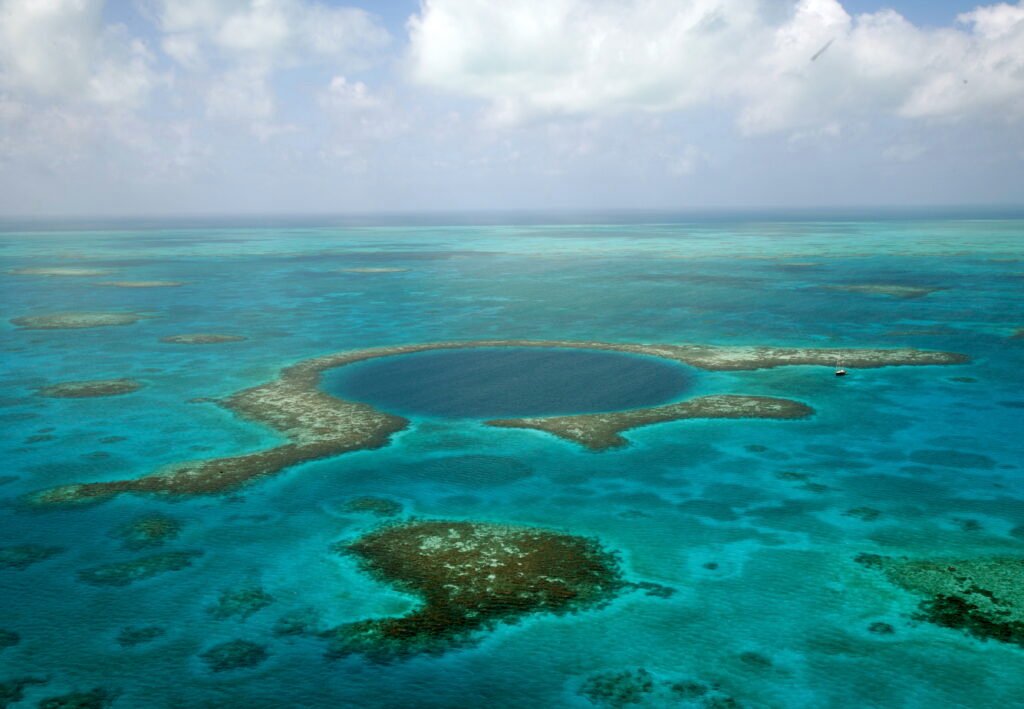
- The Belize Barrier Reef Reserve System, a UNESCO World Heritage Site since 1996, contains the largest reef complex in the Atlantic-Caribbean region and includes the Great Blue Hole, Belize’s best known natural landmark.
- The Statistical Institute of Belize estimated the country’s population at 418,982 in mid-2026, in an economy built largely on tourism, agriculture, and remittances.
- Guatemala maintains a long-standing territorial claim over Belizean land, a dispute now before the International Court of Justice following referenda held in both countries.
- Belize’s population reflects a mix of Mestizo, Creole, Maya, Garifuna, and other communities, and the language, dance, and music of the Garifuna are recognized by UNESCO as part of humanity’s intangible cultural heritage.
Where Is Belize Located?
Belize occupies a narrow strip of the Central American isthmus along the western Caribbean Sea. It shares its northern border with Mexico and its western and southern borders with Guatemala. [INTERNAL LINK NEEDED: Guatemala] [INTERNAL LINK NEEDED: Mexico] To the east, a long coastline and hundreds of small islands, known locally as cayes, face the Caribbean Sea. Belize is a parliamentary democracy and a constitutional monarchy within the Commonwealth, with King Charles III as head of state and an elected government that runs the country’s day-to-day affairs.
Geography and Natural Landscape
Belize covers close to 23,000 square kilometers, making it one of the smaller countries in Central America by land area. Its terrain divides broadly into a low, marshy coastal plain in the north and center and the granite peaks of the Maya Mountains inland in the south. Much of the interior remains covered in tropical broadleaf forest, with large areas set aside as forest reserves and national parks.
The Belize Barrier Reef Reserve System
Offshore, Belize is best known for the Belize Barrier Reef Reserve System, a chain of coral reefs, atolls, sand cays, mangrove forests, and lagoons that UNESCO inscribed as a World Heritage Site in 1996. According to UNESCO, the system’s seven protected areas, including Bacalar Chico National Park and Marine Reserve, the Blue Hole Natural Monument, Half Moon Caye Natural Monument, South Water Caye Marine Reserve, Glover’s Reef Marine Reserve, Laughing Bird Caye National Park, and Sapodilla Cayes Marine Reserve, together make up about 12 percent of Belize’s full reef complex, which UNESCO describes as the largest reef complex in the Atlantic-Caribbean region and the second largest reef system in the world.
Within this system lies the Great Blue Hole, a circular marine sinkhole in Lighthouse Reef Atoll estimated to be roughly 300 meters across and more than 100 meters deep. It formed as a limestone cave system that collapsed and flooded as sea levels rose after the last ice age, and it is protected today as the Blue Hole Natural Monument.
A Brief History of Belize
Maya Civilization and Early Settlement
The area now called Belize was home to Maya communities for well over a thousand years before European contact, with major centers such as Caracol and Xunantunich reflecting a civilization that reached its height during the Classic Maya period. Spanish explorers reached the coast in the sixteenth century, but Spain never established permanent settlements there, leaving an opening for English and Scottish log-cutters, known as Baymen, to begin settling along the coast from the seventeenth century onward in search of logwood and, later, mahogany.
From British Honduras to Independence
Britain formalized its control over the settlement in 1862, when it declared the territory the colony of British Honduras. Guatemala has long argued that Britain’s claim to the territory rested on a flawed reading of an 1859 boundary treaty, a dispute that persists today. The colony gained internal self-government in 1964, was renamed Belize in 1973, and became fully independent within the Commonwealth on September 21, 1981.
Government and Economy in Brief
Belize is a parliamentary democracy modeled on the Westminster system. A bicameral National Assembly, made up of an elected House of Representatives and an appointed Senate, passes laws, while a prime minister drawn from the majority party in the House leads the government. King Charles III remains head of state as a constitutional monarch, represented locally by a governor-general.
The World Bank classifies Belize as an upper-middle-income country whose economy leans heavily on tourism, agriculture, and remittances, and is closely tied to the United States, which accounts for more than half of Belize’s exports and most of its tourist arrivals. The World Bank reports that Belize’s economy grew by an estimated 3.5 percent in 2024, up from 0.5 percent in 2023, driven largely by tourism, trade, and transport, while public debt fell to 68.1 percent of GDP in 2023 from 71.8 percent the year before. The same source found that 17 percent of Belize’s population lived on less than 8.30 US dollars a day in 2024, the poverty line the World Bank uses for upper-middle-income countries. The Statistical Institute of Belize put the national unemployment rate at 1.9 percent in April 2026.
Culture and People
Belize’s population, estimated at 418,982 in mid-2026 by the Statistical Institute of Belize, reflects a mix of Mestizo, Creole (Kriol), Maya, Garifuna, Mennonite, and East Indian communities, among others, a diversity uncommon for so small a country. English is the sole official language, used in government, schools, and courts, but Spanish, Belizean Kriol, Garifuna, and several Maya languages are all widely spoken in daily life.
The Garifuna Language, Dance, and Music
Among Belize’s cultural traditions, the language, dance, and music of the Garifuna people, descendants of West African and Indigenous Caribbean communities who settled on the Central American coast in the eighteenth and nineteenth centuries, hold formal international recognition. UNESCO proclaimed this heritage a Masterpiece of the Oral and Intangible Heritage of Humanity in 2001 and formally inscribed it on the Representative List of the Intangible Cultural Heritage of Humanity in 2008, an honor Belize shares with Guatemala, Honduras, and Nicaragua.
The Belize-Guatemala Territorial Dispute
Guatemala has, since the nineteenth century, claimed some or all of Belizean territory, arguing that the 1859 treaty defining the boundary with British Honduras was never fully honored. Belize rejects this claim and maintains that its full, internationally recognized territory has been settled since independence. In 2008, the two countries signed a special agreement to submit the dispute to the International Court of Justice, and simultaneous referenda held in Guatemala in 2018 and in Belize in 2019 authorized each government to proceed with the case. The case, formally titled Guatemala’s Territorial, Insular and Maritime Claim (Guatemala/Belize), remains before the International Court of Justice, which most recently set new deadlines for written pleadings in 2022. No ruling has been issued, and both governments continue to administer their respective sides of the boundary while the case proceeds.
What Is Belize Best Known For?
Belize is most widely known for the Belize Barrier Reef Reserve System and, within it, the Great Blue Hole, a landmark recognizable enough to have become the country’s defining image internationally. Along with its Maya archaeological sites and extensive protected rainforest, the reef system underpins a tourism industry that the World Bank identifies as one of the main drivers of the economy’s recent growth. Within Central America, Belize is also known for standing apart as the region’s only English-speaking, Commonwealth nation.
Why Belize Matters
Belize matters beyond what its small population alone would suggest. The reef system it protects forms part of the wider Mesoamerican Reef, one of the most extensive coral reef systems in the Western Hemisphere, and its seven marine protected areas make it a significant site for reef and marine-species conservation efforts that extend well past its own coastline. [INTERNAL LINK NEEDED: Central America] Its unresolved boundary dispute with Guatemala, now before the International Court of Justice, also makes it a live example of how international law can be used to manage a territorial dispute without resort to force.
Sources
- World Bank, “Belize Overview,” worldbank.org, accessed September 22, 2026
- UNESCO World Heritage Centre, “Belize Barrier Reef Reserve System,” inscribed 1996, accessed September 22, 2026
- Statistical Institute of Belize, national statistics, accessed September 22, 2026
- UNESCO Intangible Cultural Heritage, “Language, Dance and Music of the Garifuna,” inscribed 2008, accessed September 22, 2026
- International Court of Justice, “Guatemala’s Territorial, Insular and Maritime Claim (Guatemala/Belize),” accessed September 22, 2026
Key facts
- Belize's mid-2026 population was estimated at 418,982 by the Statistical Institute of Belize.3
- The Belize Barrier Reef Reserve System became a UNESCO World Heritage Site in 1996 and includes the Great Blue Hole.2
- Belize's economy grew an estimated 3.5 percent in 2024, driven largely by tourism, trade, and transport, according to the World Bank.1
- The Garifuna language, dance, and music were inscribed on UNESCO's Representative List of Intangible Cultural Heritage in 2008.4
- Guatemala's territorial claim over Belizean land is currently before the International Court of Justice.5
Quick checkWhat UNESCO World Heritage Site is home to Belize's most iconic natural landmark, the Great Blue Hole?Show answer
The Belize Barrier Reef Reserve System, inscribed by UNESCO as a World Heritage Site in 1996.
Sources
- World Bank. Belize Overview. Undated, page current as of 2026 (accessed 2026-09-22)
- UNESCO World Heritage Centre. Belize Barrier Reef Reserve System. Inscribed 1996 (accessed 2026-09-22)
- Statistical Institute of Belize. Belize at a Glance (national statistics). Updated July 2026 (accessed 2026-09-22)
- UNESCO Intangible Cultural Heritage. Language, Dance and Music of the Garifuna. Inscribed 2008, proclaimed 2001 (accessed 2026-09-22)
- International Court of Justice. Guatemala's Territorial, Insular and Maritime Claim (Guatemala/Belize). Ongoing case, latest order 2022 (accessed 2026-09-22)
Editorially reviewed by Specialty Digest Editorial TeamLast reviewed September 22, 2026Researched and drafted with AI assistanceReport an issue