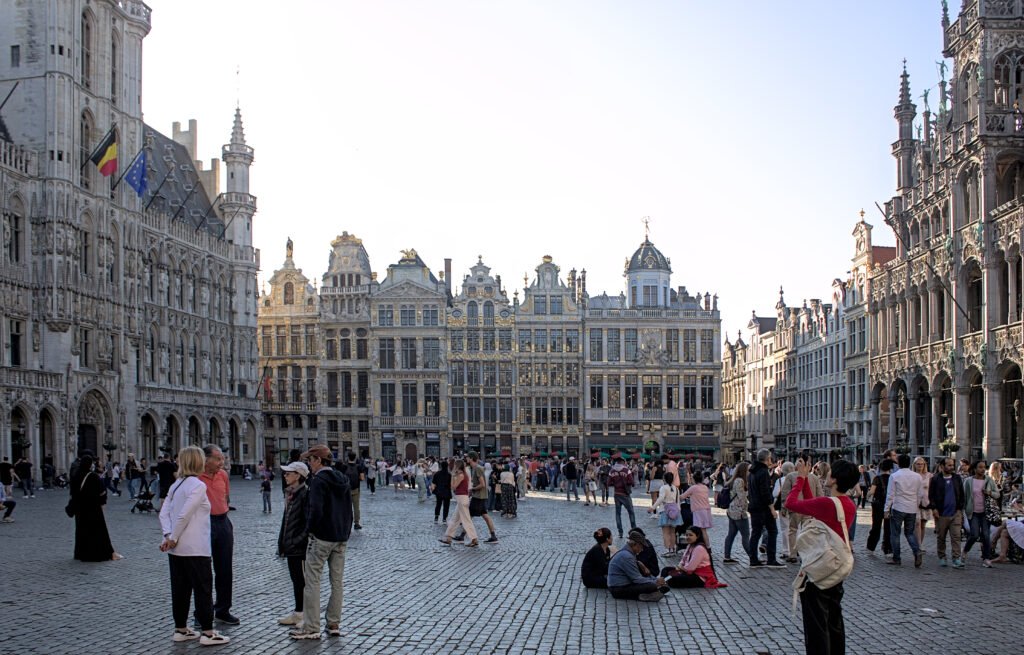
Belgium is a small, densely populated country in western Europe best known for hosting the headquarters of the European Union and NATO, its medieval city centers, and its traditions of chocolate, beer and comic strip art. A federal constitutional monarchy, it sits at a historic crossroads between Germanic and Latin Europe, with Dutch, French and German all recognized as official languages. Despite its modest size, Belgium has played an outsized role in the political integration of postwar Europe.
Where Is Belgium Located?
Belgium lies in western Europe, bordered by the Netherlands to the north, Germany and Luxembourg to the east, and France to the south and west, with a short North Sea coastline in the northwest (Belgium.be). The country covers roughly 30,700 square kilometers, making it one of Europe’s smaller states, though its central position has long made it a commercial and transport crossroads for the region (Belgium.be).
Belgium’s terrain rises gradually from the flat coastal polders and sandy lowlands in the north through a fertile central plateau to the wooded hills of the Ardennes in the southeast, where elevations exceed 500 meters (Belgium.be).
A Brief History of Belgium
For centuries, the territory that is now Belgium formed part of the Low Countries, passing through Burgundian, Habsburg and French rule before being joined to the Netherlands as the United Kingdom of the Netherlands following the Congress of Vienna in 1815. Belgium declared its independence in 1830, forming its own kingdom the following year (Belgium.be). Despite its declared neutrality, Belgium was invaded and occupied by Germany in both the First World War, beginning in 1914, and the Second World War, from 1940 to 1944, experiences that shaped its postwar foreign policy.
In the decades that followed, Belgium became a founding member of NATO in 1949 and one of the six founding members of the European Economic Community, the forerunner of the European Union, becoming a member state when the founding treaty took effect on January 1, 1958 (European Union).
Government and Economy Today
Belgium is a federal constitutional monarchy in which the king serves as head of state while an elected prime minister leads the government (European Union).
Belgium’s Layered Federal System
Governing power is divided among the federal government, three regions, Flanders, the Brussels-Capital Region and Wallonia, and three language-based communities, the Flemish, French and German-speaking communities, each holding its own areas of legislative authority, alongside a further layer of provinces and communes (Belgium.be).
Belgium is a founding member of the World Bank Group and today functions mainly as a shareholder and donor rather than a borrower, represented at the institution by an Executive Director within a multi-country constituency (World Bank). Its economy, among the most trade-dependent in Europe, is built on services, manufacturing and logistics, including the Port of Antwerp, one of Europe’s largest seaports. According to Eurostat figures reported by the European Union, Belgium’s gross domestic product per capita reached about 44,800 euros in 2023, the sixth-highest in the EU and well above the bloc’s average of about 38,100 euros, with the country accounting for roughly 3.5 percent of the EU’s total economic output (European Union). Belgium has used the euro since the currency’s introduction in 1999 and has been part of the Schengen passport-free travel area since 1995 (European Union).
Culture and People
Belgium recognizes three official languages, Dutch, French and German, corresponding to its three language communities: Flemish speakers concentrated in Flanders to the north, French speakers concentrated in Wallonia to the south, and a small German-speaking community near the eastern border, while the capital, Brussels, is officially bilingual in French and Dutch (European Union). This linguistic divide has long shaped Belgian politics and regional identity.
The country’s medieval trading cities left it with an unusually dense concentration of historic architecture. Belgium is home to ten UNESCO World Heritage sites, including La Grand-Place in Brussels, a central square of ornate guild houses inscribed in 1998, and the historic center of Bruges, recognized in 2000 as the birthplace of the Flemish Primitives school of medieval painting (UNESCO World Heritage Centre). That painting tradition, carried forward by artists such as Jan van Eyck and Pieter Bruegel the Elder, remains central to Belgium’s cultural identity, alongside a modern legacy of comic strip art that produced globally recognized characters including Tintin and the Smurfs.
What Is Belgium Known For?
Belgium is internationally recognized as the political heart of the European Union: Brussels hosts the European Commission and the Council of the European Union and is, alongside Luxembourg City and Strasbourg, one of the Union’s three official seats, while also serving as the headquarters of NATO (European Union). Beyond its institutional role, Belgium is closely associated worldwide with its chocolate and beer-brewing traditions, its dense network of medieval town centers in cities such as Bruges, Ghent and Antwerp, and the diamond trade historically centered in Antwerp.
Key Takeaways
- Belgium is a small, densely populated country in western Europe, bordered by the Netherlands, Germany, Luxembourg and France, with Brussels as its capital.
- It declared independence in 1830 after centuries under Burgundian, Habsburg, French and Dutch rule, and was invaded by Germany in both world wars despite its declared neutrality.
- Belgium is a federal constitutional monarchy whose governing powers are shared among a federal government, three regions and three language communities, with Dutch, French and German as official languages.
- It was a founding member of NATO in 1949 and of the European Economic Community in 1958, and Brussels now serves as one of the European Union’s three official seats and as NATO’s headquarters.
- Belgium’s economy ranks among the wealthiest per capita in the EU, built on services, manufacturing and trade through hubs such as the Port of Antwerp.
- Belgium is home to ten UNESCO World Heritage sites, including La Grand-Place in Brussels, and its cultural identity is closely tied to Flemish painting, chocolate and beer traditions, and the birthplace of European comic strip art.
Key facts
- Belgium is a federal constitutional monarchy in western Europe, bordered by the Netherlands, Germany, Luxembourg and France.1
- Independence was declared in 1830, ending centuries of Burgundian, Habsburg, French and Dutch rule.2
- Belgium has been an EU member state since January 1, 1958, and Brussels hosts NATO headquarters and key EU institutions.3
- Official languages are Dutch, French and German, reflecting the country's three linguistic communities.3
- Belgium has ten UNESCO World Heritage sites, including La Grand-Place in Brussels, inscribed in 1998.4
Quick checkWhat are Belgium's three official languages?Show answer
Dutch, French and German, reflecting the country's three linguistic communities: Flemish, French and German-speaking.
Sources
- Belgian Federal Government (Belgium.be). Geographical description of Belgium. Undated (accessed 2026-09-22)
- Belgian Federal Government (Belgium.be). History. Undated (accessed 2026-09-22)
- Belgian Federal Government (Belgium.be). Government. Undated (accessed 2026-09-22)
- European Union. Belgium, EU country profile. Undated, 2025 Eurostat figures (accessed 2026-09-22)
- World Bank. Belgium Overview. Undated (accessed 2026-09-22)
- UNESCO World Heritage Centre. World Heritage List, Belgium. Undated (accessed 2026-09-22)
- NATO. NATO Member Countries. Undated (accessed 2026-09-22)
Editorially reviewed by Specialty Digest Editorial TeamLast reviewed September 22, 2026Researched and drafted with AI assistanceReport an issue