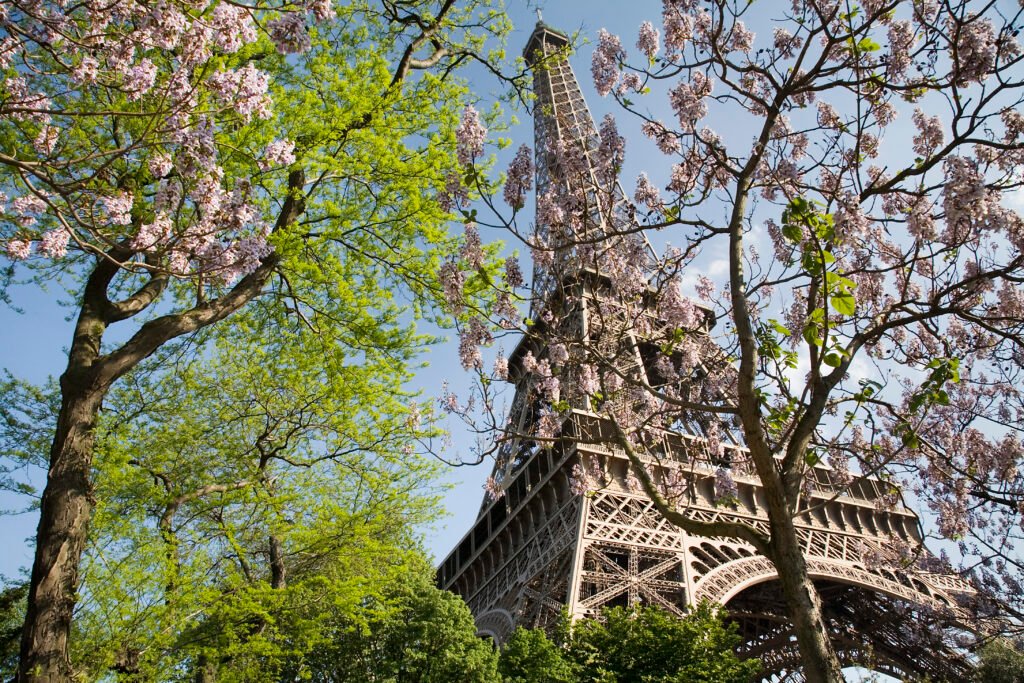
France is a Western European nation whose capital, Paris, is home to the Eiffel Tower, arguably the single most recognizable structure in the world and the enduring symbol of the country itself. Beyond Paris, France ranges from Atlantic and Mediterranean coastlines to the Alps and Pyrenees, and its language, cuisine, and art have shaped global culture for centuries.
Where Is France Located?
Metropolitan France sits in Western Europe, bordered by Belgium, Luxembourg, and Germany to the northeast, Switzerland and Italy to the east, and Spain and Andorra to the south, with coastlines on the English Channel, the Atlantic Ocean, and the Mediterranean Sea. France also administers overseas territories and departments around the world, including French Guiana in South America and Reunion in the Indian Ocean, giving it a global territorial footprint well beyond continental Europe.
Geography of France
France’s terrain includes the Alps along its border with Italy and Switzerland, home to Mont Blanc, Western Europe’s highest peak, and the Pyrenees along the Spanish border, with extensive lowland plains and river basins, including the Seine, Loire, Rhone, and Garonne, in between. This geographic diversity, combined with a largely temperate climate, supports one of Europe’s largest agricultural sectors alongside its industrial and service economies.
A Brief History of France
The region that is now France was part of Roman Gaul before the Frankish kingdoms that followed the fall of Rome gave the country its name. The medieval French monarchy consolidated over centuries into one of Europe’s dominant powers before the French Revolution of 1789 ended absolute monarchy and established the First Republic, ushering in more than two centuries of alternating republics, empires under Napoleon Bonaparte and later Napoleon III, and constitutional changes. The current Fifth Republic was established in 1958 under Charles de Gaulle, replacing a weaker parliamentary system with a stronger executive presidency.
Government and Economy
France is a semi-presidential republic in which power is shared between an elected president and a prime minister accountable to parliament. It is a founding member of the European Union and one of the world’s largest economies, with major industries spanning aerospace, automobiles, luxury goods, and agriculture, alongside a heavy reliance on nuclear power for electricity generation. France is consistently the world’s most visited country by international tourist arrivals, drawing visitors above all to Paris and its historic landmarks.
Culture and People
French, a Romance language descended from Latin, is the official language and one of the most widely taught second languages in the world. French cuisine, fashion, and art, from the Renaissance through Impressionism and beyond, have had a defining influence on global culture, and the country’s network of museums, including the Louvre in Paris, the most visited art museum in the world, reflects that legacy.
What Is France Known For?
France is known globally for Paris and, within it, the Eiffel Tower, an iron lattice structure built by engineer Gustave Eiffel for the 1889 World’s Fair. Originally intended as a temporary installation, it was kept in part for its usefulness as a radio transmission tower and has since become the most-visited paid monument in the world and the definitive symbol of both Paris and France as a whole.
Why France Matters
As a founding EU member, a permanent member of the United Nations Security Council, and a major global economic and cultural power, France plays an outsized role in European and world affairs, while Paris remains one of the most influential cultural capitals on Earth, a status the Eiffel Tower has come to visually represent more than any other single structure.
Key Takeaways
- France borders Belgium, Luxembourg, Germany, Switzerland, Italy, Spain, and Andorra, with coasts on the Atlantic, Channel, and Mediterranean.
- The French Revolution of 1789 ended absolute monarchy; the current Fifth Republic dates to 1958.
- France is a founding member of the European Union and a permanent UN Security Council member.
- The Eiffel Tower, built in 1889 for the World’s Fair, is France’s most iconic landmark.
- France is the world’s most visited country by international tourist arrivals.
Sources
Key facts
- Founding member of the European Union and a permanent UN Security Council member2
- The Fifth Republic, France's current constitutional system, dates to 19582
- The Eiffel Tower was built in 1889 by Gustave Eiffel for the World's Fair2
- The Louvre, in Paris, is the most visited art museum in the world2
- France is the world's most visited country by international tourist arrivals2
Quick checkWhen was the Eiffel Tower built and why?Show answer
It was built in 1889 by engineer Gustave Eiffel as the entrance arch for that year's World's Fair in Paris.
Sources
- World Bank. France Overview. Undated (accessed 2026-09-23)
- Encyclopaedia Britannica. France. Undated (accessed 2026-09-23)
Editorially reviewed by Specialty Digest Editorial TeamLast reviewed September 23, 2026Researched and drafted with AI assistanceReport an issue