In simple terms
A ground stop is an instruction from air traffic control that holds aircraft at their departure airports. Flights that meet the stated criteria are not allowed to take off.
It is a blunt tool. Controllers reach for it when an airport or a stretch of airspace suddenly cannot take the traffic already heading toward it.
How it works
In the United States the Federal Aviation Administration sets the rules in its air traffic order. A ground stop is defined there as a process that requires aircraft meeting specific criteria to remain on the ground.
The criteria can be tied to a destination airport, to a block of airspace, or to equipment. A local traffic management unit can order a narrow one. A national one comes from the Air Traffic Control System Command Center.
The order also ranks it. Ground stops override all other traffic management initiatives, so controllers must evaluate less restrictive measures first. Listed triggers include severely reduced capacity, the risk of long airborne holding, sectors nearing saturation, and severe weather or catastrophic events that close routes.
Europe manages the same problem with a different instrument. The EUROCONTROL Network Manager issues each flight a calculated time of take off when demand exceeds declared capacity, and crews must depart within five minutes before or ten minutes after it.
Why it matters
Holding aircraft at the gate is safer and cheaper than stacking them in the air. EUROCONTROL states the reasoning plainly: waiting on the ground beats burning fuel unnecessarily aloft.
For passengers the effect is sharp. A stop at one busy hub strands crews and aircraft that were due to fly elsewhere, and the backlog can outlast the stop by many hours.
Where you will see it
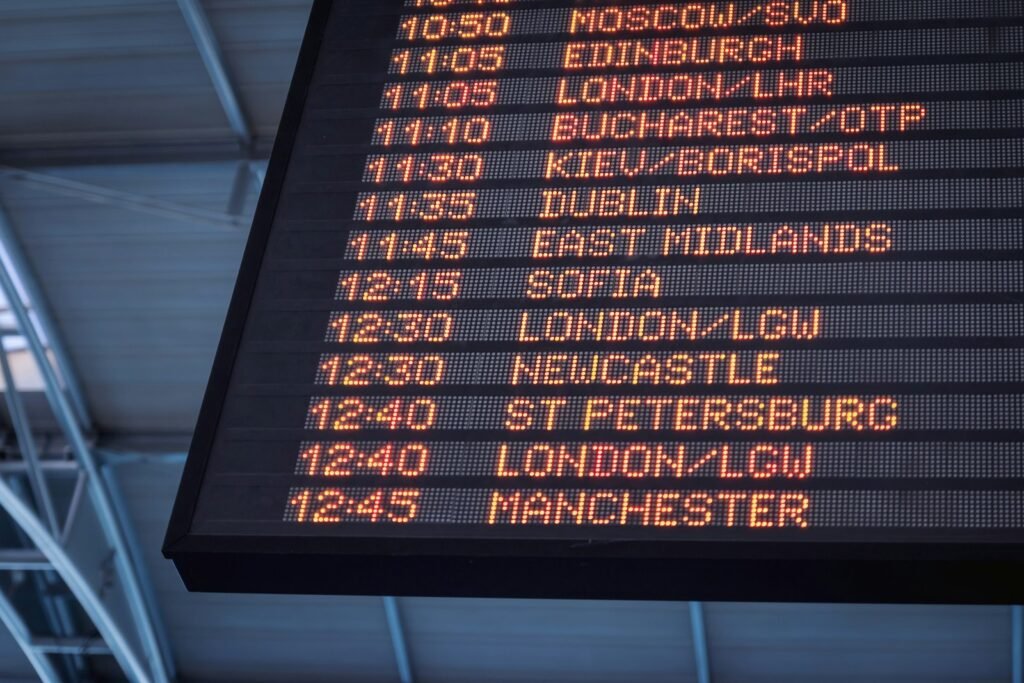
- Airline apps and airport boards, when departures to one city freeze while arrivals continue.
- News coverage of storms, runway closures or equipment failures at major hubs.
- Official air traffic advisories listing restrictions in force.
- Flight tracking sites, which show departures from affected airports flatten to nothing.
Example
When thunderstorms close the approach paths into a major hub, controllers may order a ground stop for flights bound there. Aircraft already airborne continue; the rest wait at their gates.
Often confused with
A ground delay program assigns later departure times rather than halting departures outright. The FAA order treats a ground stop as the most restrictive option, to be used only after less restrictive measures have been considered.
Key facts
- The FAA defines a ground stop as a process that requires aircraft meeting specific criteria to remain on the ground.1
- Ground stop criteria can be airport specific, airspace specific or equipment specific.1
- Ground stops override all other traffic management initiatives, so less restrictive measures must be evaluated first.1
- A local traffic management unit can issue a ground stop, while national ones come from the Air Traffic Control System Command Center.1
- In Europe the EUROCONTROL Network Manager instead issues a calculated time of take off, and aircraft must depart within five minutes before or ten minutes after it.2
In the news
Quick checkWhat is the difference between a ground stop and a ground delay program?Show answer
A ground stop keeps qualifying flights on the ground entirely. A ground delay program lets them fly but assigns later departure times.
Sources
- Federal Aviation Administration. Order JO 7210.3, Chapter 17: Traffic Management National, Center, and Terminal. Undated (accessed 23 September 2026)
- EUROCONTROL. What is a slot?. Undated (accessed 23 September 2026)
Editorially reviewed by Specialty Digest Editorial TeamLast reviewed September 23, 2026Researched and drafted with AI assistanceReport an issue