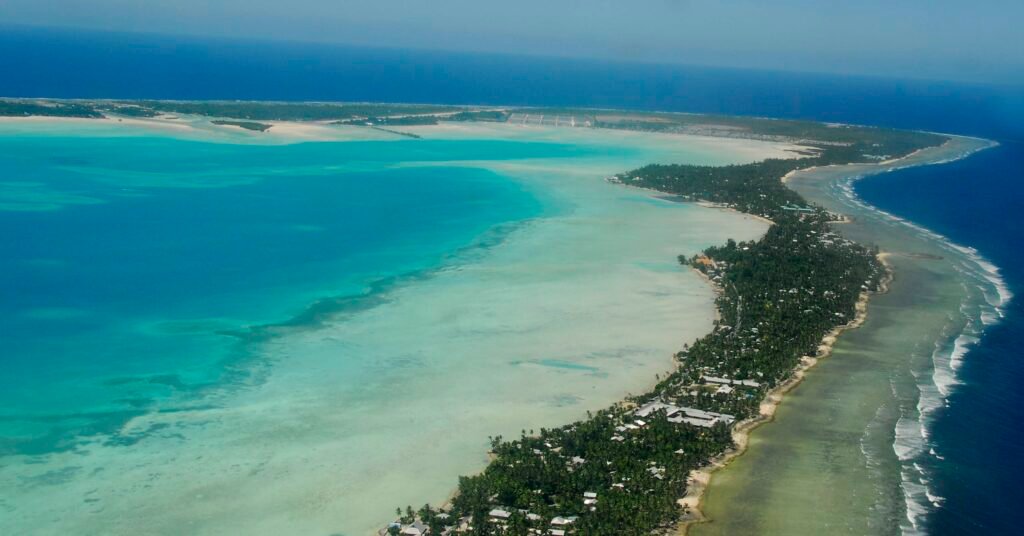
Kiribati is a small island nation in the central Pacific Ocean, made up of 33 atolls and reef islands scattered across a vast expanse of ocean. It is the only country in the world to lie in all four hemispheres, and it has become one of the most cited examples of a nation threatened by rising sea levels.
Where Is Kiribati Located?
Kiribati straddles the equator and the International Date Line in the central Pacific Ocean, its 33 low-lying atolls and coral islands grouped into the Gilbert Islands, the Phoenix Islands and the Line Islands, spread across an ocean area roughly the size of the continental United States despite a total land area of only about 811 square kilometers. Almost all of this territory is ocean; no point in the country rises more than a few meters above sea level, apart from Banaba, a raised coral island. South Tarawa, part of Tarawa Atoll in the Gilbert Islands, serves as the capital and is home to most of the population.
A Brief History
The Gilbert Islands, as much of present-day Kiribati was known, were settled by Micronesian peoples many centuries before European contact. Britain established a protectorate over the Gilbert Islands in 1892 and later a colony that also included the Ellice Islands, now Tuvalu, and other Pacific island groups. Tarawa saw intense fighting between American and Japanese forces during the Second World War, most notably the Battle of Tarawa in 1943. The Gilbert Islands separated from the Ellice Islands in 1975, and Kiribati became fully independent from the United Kingdom in 1979, adopting a name derived from the local pronunciation of “Gilberts.”
Government and Economy Today
Kiribati is a republic in which the president serves as both head of state and head of government, elected alongside members of a unicameral House of Assembly. The World Bank classifies Kiribati as a lower-middle-income economy. No World Bank country overview page exists for Kiribati, reflecting its position among the smallest economies the institution tracks; the country’s finances depend heavily on fishing license revenue from its vast exclusive economic zone, remittances, and a sovereign wealth fund built from historical phosphate mining on Banaba.
Culture and People
Kiribati’s population was approximately 136,000 in 2025, according to the World Bank, making it one of the world’s smallest sovereign states by population. The i-Kiribati people speak Gilbertese alongside English, and traditional customs including the maneaba, a communal meeting house central to village life, remain important. Because the population is concentrated on a few atolls, South Tarawa is among the most densely populated small areas on Earth.
What Is Kiribati Known For?
Kiribati is best known internationally as one of the countries most immediately threatened by climate change and sea level rise, given its low elevation and narrow land area; its government has been outspoken in international forums on this issue. Its most recognizable feature is Tarawa Atoll, home to the capital South Tarawa, whose narrow strips of land surrounded by lagoon and open ocean have become a widely used visual symbol of the vulnerability facing low-lying island nations.
Key Takeaways
- Kiribati is made up of 33 atolls and reef islands spread across the central Pacific, straddling the equator and the International Date Line.
- It became independent from the United Kingdom in 1979, after decades as part of the Gilbert and Ellice Islands colony.
- Kiribati is a lower-middle-income economy dependent on fishing license revenue, remittances and a sovereign wealth fund from historical phosphate mining.
- With a population of about 136,000, it is one of the world’s smallest sovereign states.
- Tarawa Atoll, home to the capital, is Kiribati’s most recognizable feature and a widely used symbol of climate vulnerability.
Key facts
Quick checkWhy is Kiribati frequently cited in discussions of climate change?Show answer
Its atolls sit only a few meters above sea level at most, making Kiribati one of the countries most immediately threatened by rising sea levels.
Sources
- World Bank. Kiribati, Population total. 2025 (accessed Accessed 2026)
Editorially reviewed by Specialty Digest Editorial TeamLast reviewed September 27, 2026Researched and drafted with AI assistanceReport an issue