Sweden is a Nordic country in Northern Europe, occupying the eastern and southern portion of the Scandinavian Peninsula. Its capital and largest city is Stockholm. A constitutional monarchy with a long history of military non-alignment, Sweden is known today for its high living standards, strong social welfare system, design and engineering industries, and global cultural exports from pop music to the Nobel Prize itself.
Where Is Sweden Located?
Sweden stretches roughly 1,570 kilometers from its southern tip to its Arctic north, making it one of the largest countries in the European Union by area despite a relatively small population. It shares a long land border with Norway to the west and a shorter one with Finland to the northeast, faces Denmark across the narrow Oresund strait in the south, and lies along the Baltic Sea and Gulf of Bothnia to the east.
A Brief History of Sweden
Viking Age and Early Kingdom
Sweden’s recorded history traces back to the Viking Age, when Swedish Vikings traded and raided along rivers stretching east into present-day Russia and beyond. The Kingdom of Sweden consolidated gradually over the medieval period and, under the House of Vasa from the sixteenth century, became a major regional power, briefly controlling territory around much of the Baltic Sea during the seventeenth century.
Neutrality and the Welfare State
Sweden avoided direct participation in both World Wars, a policy of military non-alignment that shaped its twentieth-century identity. In the postwar decades, the country built one of the world’s most extensive social welfare systems, funded by high taxation, alongside a highly export-oriented industrial economy built around firms in engineering, automobiles, and telecommunications.
European Integration and Changing Alliances
Sweden joined the European Union in 1995 after decades of formal neutrality, and in 2024 it joined NATO, ending more than two centuries of military non-alignment in response to shifting regional security concerns following Russia’s invasion of Ukraine.
Government and Economy
Sweden is a constitutional monarchy with a parliamentary system of government: the monarch serves a ceremonial role, while the Riksdag, Sweden’s national legislature, and a prime minister hold governing authority. The World Bank classifies Sweden as a high-income economy, with a population of approximately 10.57 million as of 2024 and a gross national income per capita of about $58,510 that same year.[1] Sweden has been a member of the World Bank since 1951 and today functions mainly as a shareholder and development partner rather than a borrowing country.[2]
Culture and People
Swedish is the official language, and the country is closely associated with a design aesthetic built around simplicity and function, visible in furniture, fashion, and architecture exported worldwide through companies such as IKEA. Sweden also has an outsized footprint in global pop music and is the home of the Nobel Prize, which, except for the Peace Prize awarded in Norway, is presented each December in Stockholm.
What Is Sweden Known For?
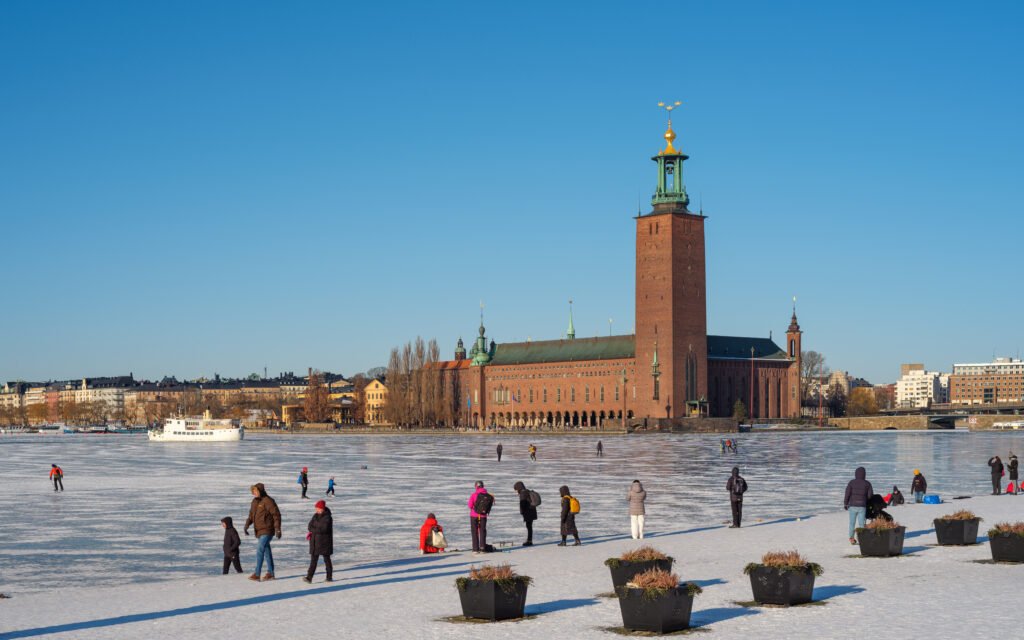
Stockholm City Hall, the redbrick, tower-topped building on the shore of Riddarfjarden, is Sweden’s single most iconic landmark and the annual venue for the Nobel Prize banquet. Beyond the City Hall, Sweden is widely known for its design and furniture industry, its pop music exports, its welfare model, and its vast northern wilderness, including the Arctic region around Kiruna and the midnight sun of the far north.
Why Sweden Matters
Sweden’s combination of a small population and outsized global influence, through design, music, engineering, and diplomacy, makes it a frequent reference point in debates over how open economies and generous welfare states can coexist. Its 2024 decision to join NATO marked one of the most significant shifts in European security policy in decades, ending a stance of military non-alignment that had defined the country since the nineteenth century.
Key Takeaways
- Sweden occupies the eastern and southern Scandinavian Peninsula, bordered by Norway and Finland and facing Denmark across the Oresund strait.
- Its capital is Stockholm, and its population was approximately 10.57 million as of 2024.[1]
- Gross national income per capita was about $58,510 in 2024, and the World Bank classifies Sweden as high income.[1]
- Sweden joined the European Union in 1995 and joined NATO in 2024, ending more than two centuries of military non-alignment.
- Stockholm City Hall, the venue for the annual Nobel Prize banquet, is Sweden’s most iconic landmark.
Sources
- World Bank Open Data (World Development Indicators), population, GNI per capita, and country classification for Sweden, data.worldbank.org/country/sweden, 2024 data, accessed October 4, 2026
- World Bank, “Sweden Overview,” worldbank.org/en/country/sweden/overview, accessed October 4, 2026
- Sweden.se, official website of Sweden, Swedish Institute, sweden.se, accessed October 4, 2026
Key facts
- Population: approximately 10.57 million as of 2024.1
- Gross national income per capita: approximately $58,510 in 2024; classified high income by the World Bank.1
- Capital: Stockholm.1
- Member of the World Bank since 1951, functioning today mainly as a shareholder and development partner.2
- Joined the European Union in 1995 and NATO in 2024.
Quick checkWhat building hosts the annual Nobel Prize banquet?Show answer
Stockholm City Hall.
Sources
- World Bank Open Data. Population, total, GNI per capita, and country classification, Sweden. 2024 data (accessed 2026-10-04)
- World Bank. Sweden Overview. 2026 (accessed 2026-10-04)
- Sweden.se (Swedish Institute). Official website of Sweden. Undated (accessed 2026-10-04)
Editorially reviewed by Specialty Digest Editorial TeamLast reviewed October 4, 2026Researched and drafted with AI assistanceReport an issue