Denmark is a Nordic country in northern Europe made up of the Jutland peninsula and more than 400 islands, with a population of roughly 6.03 million people, according to Statistics Denmark. It is a constitutional monarchy and a founding member of NATO, a member of the European Union without adopting the euro, and the metropolitan core of the Kingdom of Denmark, which also includes the autonomous territories of Greenland and the Faroe Islands.
Key Takeaways
- Denmark’s population is approximately 6.03 million, concentrated heavily around Copenhagen, its capital and only major city.
- The country consists of the Jutland peninsula and over 400 islands, bordering only Germany by land, with coastline on the North Sea and Baltic Sea.
- Denmark has been a constitutional monarchy since 1849; King Frederik X has reigned since January 2024, following his mother Queen Margrethe II’s abdication.
- Denmark joined the European Economic Community in 1973 but negotiated a permanent opt-out from the euro, keeping its own currency, the krone.
- The Kingdom of Denmark is a political union of three parts: Denmark proper, Greenland, and the Faroe Islands, the latter two of which govern most domestic affairs autonomously and each send two members to the national parliament.
- Denmark holds 13 UNESCO World Heritage sites across the kingdom, including Roskilde Cathedral, Kronborg Castle, and the Wadden Sea in Denmark proper, and Ilulissat Icefjord in Greenland.
Where Denmark Is and How It Is Shaped
Denmark sits at the meeting point of the North Sea and the Baltic Sea, occupying the Jutland peninsula, which juts north from continental Europe, along with an archipelago of more than 400 islands to its east, the largest and most populous being Zealand, home to Copenhagen. Germany is Denmark’s only land neighbor, to the south; Norway and Sweden lie across narrow straits to the north and east, close enough that a bridge and tunnel system, the Øresund Link, connects Copenhagen directly to the Swedish city of Malmö.
The terrain is low and largely glacially shaped: rolling farmland, heath, and beech forest, with no point in the country rising much above 170 meters, according to Encyclopaedia Britannica. This flatness, combined with a long, indented coastline, has made the sea a defining feature of Danish life for centuries, from Viking Age trade and raiding to today’s offshore wind industry and container shipping.
Politically and constitutionally, “Denmark” can mean two different things. Denmark proper, the subject of most of this article, is the peninsula and islands described above. The Kingdom of Denmark, however, is a wider political union, known in Danish as Rigsfællesskabet, that also includes Greenland, a mostly ice-covered Arctic territory, and the Faroe Islands, a North Atlantic archipelago. Both territories have held home rule since the twentieth century and have expanded self-government since, controlling most domestic policy while Copenhagen retains authority over matters such as foreign affairs and defense for the kingdom as a whole.
A Brief History
Denmark’s recorded history begins in earnest with the Viking Age, when Danish seafarers raided, traded, and settled across the British Isles, the Frankish coast, and beyond. The country’s unification into a single kingdom is conventionally dated to the tenth century, commemorated by the runic Jelling Stones raised by King Harald Bluetooth, who declared that he had made the Danes Christian and united Denmark and Norway.
Medieval Denmark expanded its reach through the Kalmar Union, a personal union under Queen Margrete I that briefly joined Denmark, Norway, and Sweden under one crown starting in 1397. Sweden broke away in the sixteenth century, and Denmark lost Norway to Sweden in 1814 under the Treaty of Kiel, a consequence of choosing the losing side in the Napoleonic Wars. Greenland, Iceland, and the Faroe Islands, previously governed alongside Norway, remained tied to the Danish crown.
Absolute monarchy, established in 1660, gave way to constitutional government in 1849, when King Frederik VII signed the June Constitution establishing a parliament and limiting royal power. Iceland became fully independent in 1944. Denmark was occupied by Nazi Germany from 1940 to 1945 despite its neutrality, an experience that shaped its postwar embrace of collective security: it became a founding member of NATO in 1949 and later joined the European Economic Community, the forerunner of the European Union, in 1973.
Government and Economy
Denmark is a parliamentary constitutional monarchy. The monarch, King Frederik X, who acceded to the throne in January 2024 upon the abdication of his mother, Queen Margrethe II, holds a largely ceremonial role, while executive power rests with a prime minister and cabinet accountable to the Folketing, Denmark’s unicameral parliament of up to 179 members, two of whom represent Greenland and two the Faroe Islands, according to Britannica. Governments are typically coalitions, since proportional representation makes single-party majorities rare. The judiciary runs from district courts up through two High Courts to the Supreme Court in Copenhagen.
Denmark is a member of the European Union but is not part of the eurozone. Following the rejection of the Maastricht Treaty in a 1992 referendum, Denmark secured a formal opt-out from adopting the euro under the Edinburgh Agreement, an arrangement still recognized in European Union law. Denmark retains its own currency, the krone, which is pegged closely to the euro through the European Exchange Rate Mechanism.
The Danish economy is a high-income, open economy built on a large welfare state financed through some of the world’s highest tax rates, paired with flexible labor market rules known as “flexicurity.” Denmark has been a member of the World Bank Group since 1946, among the first countries to receive a postwar reconstruction loan, and today participates in all five World Bank Group institutions while contributing to development financing and hosting, jointly with the UN refugee agency, the Joint Data Center on Forced Displacement. Key industries include shipping, led by the global carrier Maersk; pharmaceuticals; agriculture and food processing; and renewable energy, particularly offshore wind, an area where Danish firms and technology hold an outsized global role.
Culture and People
Danish society is highly urbanized, with roughly a third of the population living in and around the capital, Copenhagen. Danish is the official language, closely related to Norwegian and Swedish, and English is widely spoken as a second language. The Evangelical Lutheran Church of Denmark remains the state church, though religious observance is low and Danish society is broadly secular in practice.
Denmark consistently ranks among the world’s happiest and least corrupt countries in international surveys, a reputation often linked to high social trust, a strong social safety net, and relatively low income inequality. Danish design, from furniture to architecture, and a strong cycling culture, especially in Copenhagen, are widely recognized markers of everyday Danish life. The concept of “hygge,” a sense of cozy contentment, has become one of Denmark’s best-known cultural exports, though it is best understood as a description of an everyday value rather than a marketing invention.
What Denmark Is Known For
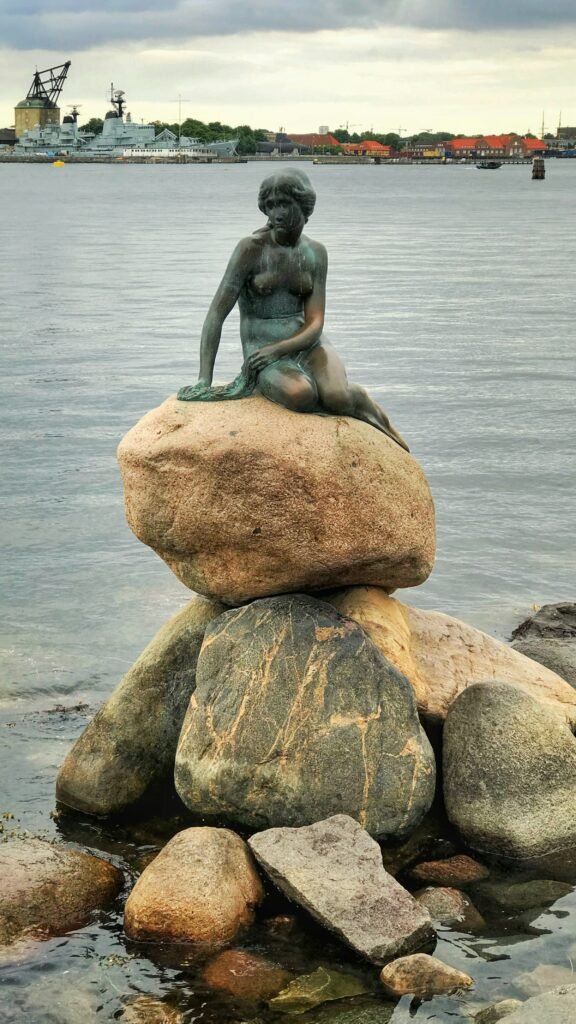
Internationally, Denmark is closely associated with the Little Mermaid statue in Copenhagen’s harbor, unveiled in 1913 and inspired by Hans Christian Andersen’s fairy tale, along with the colorful waterfront houses of Nyhavn nearby. The country’s UNESCO World Heritage list spans both Denmark proper and its Arctic territory: Roskilde Cathedral, the burial place of Danish monarchs; Kronborg Castle, the real-world setting of Shakespeare’s Hamlet; the Jelling Mounds and runic stones marking the birth of the Danish kingdom; the Wadden Sea, a vast tidal ecosystem shared with Germany and the Netherlands; and, in Greenland, the Ilulissat Icefjord, one of the most productive glaciers outside Antarctica.
Denmark is also known for Lego, invented by Danish carpenter Ole Kirk Christiansen in the 1930s and still headquartered in Billund; for the fairy tales of Hans Christian Andersen; and for its leading position in wind power, where it was an early mover in turbine technology and remains a major exporter of wind energy expertise.
Why Denmark Matters
Denmark’s relevance extends well beyond its modest size. As a small, open economy that has combined a large welfare state with high growth and low unemployment, it is frequently studied as a model for balancing social protection with economic flexibility. Its early and sustained investment in wind energy has made it a reference point in the global transition toward renewable power. Through the Kingdom of Denmark, it also occupies a distinct position in Arctic affairs: Greenland’s location and resources have made the wider kingdom a participant in Arctic governance and, at times, a subject of geopolitical attention from larger powers, even as Greenland and the Faroe Islands continue to manage their own domestic affairs under arrangements agreed with Copenhagen.
Denmark is also a founding member of the Nordic Council, the inter-parliamentary body coordinating cooperation among the Nordic countries since the 1950s, underscoring its long-standing role in regional diplomacy beyond the EU.
Sources
- Statistics Denmark | Population figures | Undated | https://www.dst.dk/en/Statistik/emner/borgere/befolkning/befolkningstal | Accessed 2026-09-22
- UNESCO World Heritage Centre | Denmark: States Parties | Undated | https://whc.unesco.org/en/statesparties/dk | Accessed 2026-09-22
- The World Bank | Denmark Overview | Undated | https://www.worldbank.org/en/country/denmark/overview | Accessed 2026-09-22
- EUR-Lex, European Union | Denmark: EMU opt-out clause | Undated | https://eur-lex.europa.eu/EN/legal-content/summary/denmark-emu-opt-out-clause.html | Accessed 2026-09-22
- Encyclopaedia Britannica | Denmark | Undated | https://www.britannica.com/place/Denmark | Accessed 2026-09-22
- Nordic Council | The history of Nordic co-operation | Undated | https://www.norden.org/en/information/history-nordic-co-operation | Accessed 2026-09-22
- The Royal House of Denmark (Kongehuset) | HM The King | Undated | https://www.kongehuset.dk/en/the-royal-family/hm-the-king/ | Accessed 2026-09-22
Key facts
- Denmark's population reached approximately 6.03 million in August 2026, according to Statistics Denmark1
- Denmark holds 13 UNESCO World Heritage sites across the Kingdom of Denmark, including Roskilde Cathedral and Kronborg Castle in Denmark proper and the Ilulissat Icefjord in Greenland2
- Denmark has been a World Bank Group member since 1946, among the first countries to receive a postwar reconstruction loan, and today participates in all five World Bank Group institutions3
- Denmark joined the European Economic Community in 1973 but secured a permanent opt-out from adopting the euro under the Edinburgh Agreement, an arrangement still recognized in EU law4
- King Frederik X has reigned as Denmark's constitutional monarch since January 14, 2024, following the abdication of his mother, Queen Margrethe II7
Quick checkWhat permanent opt-out did Denmark secure when it joined the European Economic Community, and under what agreement?Show answer
Denmark secured a permanent opt-out from adopting the euro, formalized under the Edinburgh Agreement following the 1992 Maastricht referendum, so it keeps its own currency, the krone, while remaining an EU member.
Sources
- Statistics Denmark. Population figures. Undated (accessed 2026-09-22)
- UNESCO World Heritage Centre. Denmark: States Parties. Undated (accessed 2026-09-22)
- The World Bank. Denmark Overview. Undated (accessed 2026-09-22)
- EUR-Lex, European Union. Denmark: EMU opt-out clause. Undated (accessed 2026-09-22)
- Encyclopaedia Britannica. Denmark. Undated (accessed 2026-09-22)
- Nordic Council. The history of Nordic co-operation. Undated (accessed 2026-09-22)
- The Royal House of Denmark (Kongehuset). HM The King. Undated (accessed 2026-09-22)
Editorially reviewed by Specialty Digest Editorial TeamLast reviewed September 22, 2026Researched and drafted with AI assistanceReport an issue