New York City is the largest city in the United States by population, located in the state of New York at the mouth of the Hudson River where it meets New York Harbor and the Atlantic Ocean. The city is made up of five boroughs, Manhattan, Brooklyn, Queens, the Bronx, and Staten Island, each of which is also a county of New York State. As of the U.S. Census Bureau’s mid-2025 estimate, the city’s population stood at 8,584,629 people across roughly 300 square miles of land, making it by far the most densely populated major city in the United States.
Where Is New York City Located?
New York City sits on the Atlantic coast of the northeastern United States, at the point where the Hudson River empties into a natural harbor. Manhattan is an island; Brooklyn and Queens occupy the western end of Long Island; the Bronx is the only borough attached to the North American mainland; and Staten Island lies across the harbor to the south. This harbor geography shaped the city from its earliest days, giving it one of the best natural ports on the Eastern Seaboard and making it a natural gateway between Europe and the interior of North America.
Historical Origins and Development
The site was inhabited by Lenape communities before European contact. Dutch colonists established a trading settlement on the southern tip of Manhattan in the 1620s, naming it New Amsterdam and governing it as part of the colony of New Netherland under the Dutch West India Company. In 1664, English forces took control of the settlement without a fight, and it was renamed New York in honor of the Duke of York, later King James II. Traces of this period persist in the city’s street grid and names: Wall Street, for instance, takes its name from a defensive wall that once marked the settlement’s northern edge.
Under English and later American rule, the city grew from a small port town into the country’s leading commercial center. Its deep harbor, the completion of the Erie Canal in 1825 linking it to the Great Lakes, and waves of immigration through the 19th and early 20th centuries combined to make it the busiest port and the largest city in the United States by the mid-1800s. Manhattan, Brooklyn, Queens, Staten Island, and the Bronx were consolidated into a single city government in 1898, creating the five-borough structure that exists today.
Government and the Five Boroughs
New York City operates under a strong-mayor system of municipal government. An elected mayor serves as chief executive, overseeing city agencies, proposing the budget, and signing legislation. A 51-member City Council, with members elected from individual districts, approves the budget, holds public hearings, and passes local laws. An elected comptroller audits city spending and manages city bonds and pensions, while an elected public advocate investigates complaints about city services. Each of the five boroughs has its own borough president, and 59 local community boards weigh in on neighborhood land-use and budget matters.
Economy and Culture
New York City’s economy is one of the largest of any city in the world, with gross domestic product estimated at 1.286 trillion dollars in 2023. It remains the leading financial center of the United States, anchored by the Wall Street district in Lower Manhattan, home to the New York Stock Exchange and Nasdaq. The city’s economic base has broadened well beyond finance: professional and business services, education and health care, and a growing technology sector now employ more people than the financial sector alone. New York is also a leading center for publishing, advertising, fashion, law, and the performing arts, including Broadway theater.
The city’s population reflects sustained immigration from nearly every part of the world; more than a third of residents are foreign-born, and the city’s neighborhoods include some of the largest communities of several immigrant groups found anywhere outside their countries of origin. This mix of cultures and languages, rather than any single dominant tradition, is central to how the city is usually described by demographers and historians.
Famous Landmarks and Districts
Manhattan contains many of the city’s best-known landmarks, including the Empire State Building, Times Square, Central Park, and the United Nations headquarters. Lower Manhattan’s Wall Street district gives its name to American finance generally. Brooklyn, Queens, the Bronx, and Staten Island each have their own distinct neighborhoods, cultural institutions, and historic districts.
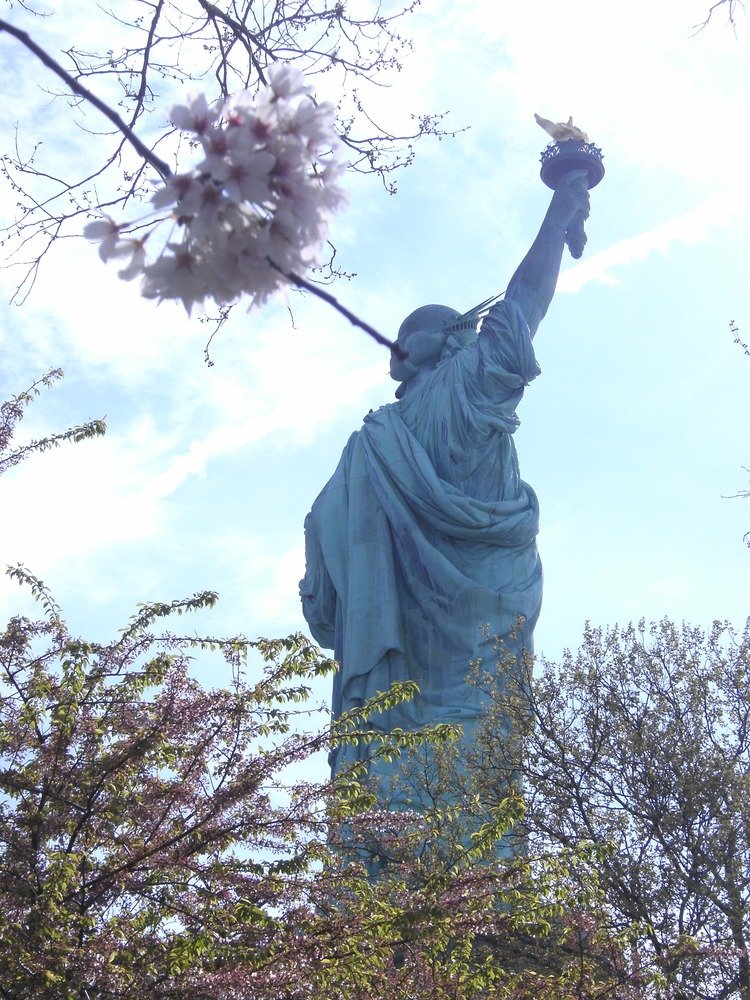
In New York Harbor, on Liberty Island, stands the Statue of Liberty, a copper statue designed by French sculptor Frederic-Auguste Bartholdi with structural engineering by Gustave Eiffel’s firm and a pedestal designed by architect Richard Morris Hunt. The statue was a gift from the people of France and was dedicated by President Grover Cleveland on October 28, 1886. It stands 305 feet 1 inch from ground to torch and depicts a robed female figure holding a torch and a tablet inscribed with the date of the Declaration of Independence, with broken shackles at her feet. The National Park Service has administered the site since 1933, and UNESCO inscribed the Statue of Liberty on its World Heritage List in 1984, citing it as a masterpiece of the human spirit and a shared symbol of French-American friendship and of freedom and democracy more broadly. Nearby Ellis Island, also managed by the National Park Service, served for decades as the primary immigration processing station for the country and is closely linked in public memory with the statue.
What New York City Is Best Known For
New York City is most widely recognized as the financial and cultural capital of the United States and as a global symbol of immigration and opportunity, a reputation embodied in the Statue of Liberty. It is also known for its skyline of high-rise towers, its extensive subway system, its role as a world center for theater, publishing, and the arts, and its status as the most populous and most densely built city in the country.
Why New York City Matters
As the largest U.S. city and one of the world’s leading financial centers, New York City has an outsized influence on American commerce, media, and culture that extends well beyond its own population. Its harbor and its history as a point of entry for millions of immigrants have made it a lasting reference point in American history for questions of trade, government, and national identity, a role formalized in the Statue of Liberty’s UNESCO recognition as a shared monument to those ideals.
Key Takeaways
- New York City is the most populous city in the United States, with an estimated 8,584,629 residents as of mid-2025, spread across five boroughs on New York Harbor.
- The city originated as the Dutch trading settlement of New Amsterdam in the 1620s and was renamed New York after the English took control in 1664.
- It operates under a mayor-council government, with an elected mayor, a 51-member City Council, a comptroller, a public advocate, and five borough presidents.
- New York City’s economy, estimated at 1.286 trillion dollars in GDP in 2023, remains the leading U.S. financial center while diversifying into technology, health care, and professional services.
- The Statue of Liberty, dedicated in 1886 and a UNESCO World Heritage Site since 1984, is the city’s most widely recognized symbol of freedom and immigration.
Key facts
Quick checkIn what year was the Statue of Liberty dedicated, and who gave it to the United States?Show answer
It was dedicated on October 28, 1886; it was a gift from the people of France.
Sources
- U.S. Census Bureau. QuickFacts: New York city, New York (Vintage 2025). Vintage 2025 (accessed 2026-10-05)
- National Park Service. Statue of Liberty National Monument. Undated (accessed 2026-10-05)
- National Park Service. Statue of Liberty Facts. Undated (accessed 2026-10-05)
- UNESCO World Heritage Centre. Statue of Liberty. Inscribed 1984 (accessed 2026-10-05)
- NYC.gov. Understanding Local Government in NYC. Undated (accessed 2026-10-05)
- Federal Reserve Bank of New York. New York City Economic Indicators. 2025 data (accessed 2026-10-05)
- Library of Congress. Exploration and Settlement. Undated (accessed 2026-10-05)
Editorially reviewed by Specialty Digest Editorial TeamLast reviewed October 5, 2026Researched and drafted with AI assistanceReport an issue