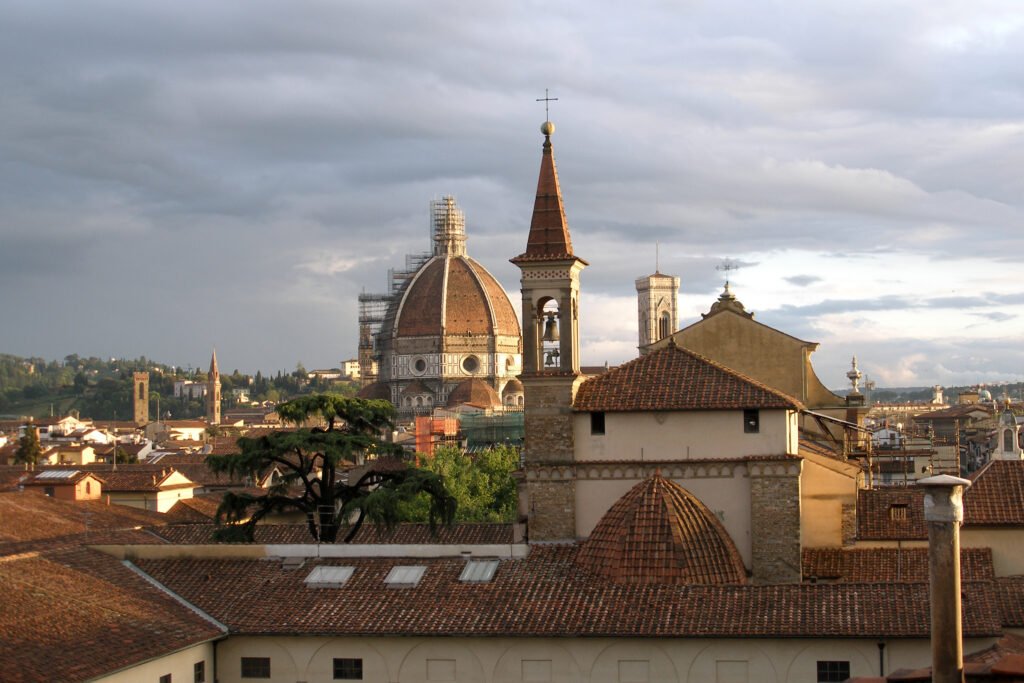
Florence is a city in the Tuscany region of central Italy, built along the Arno River. It rose from a Roman military colony into the city where the Renaissance began, and its historic center still holds one of the densest concentrations of Renaissance art and architecture anywhere in the world.
Where Is Florence Located?
Florence sits in a basin along the Arno River in central Italy, roughly 170 miles northwest of Rome, and serves as the capital of the Tuscany region. The historic center is compact enough to cross on foot in under an hour, which is part of why its concentration of churches, palaces, and museums feels so immediate to visitors.
The Origins and History of Florence
Florence began around 59 BCE as Florentia, a settlement for Roman army veterans laid out on the classic Roman grid plan that still shapes parts of the modern street layout. It grew through the Middle Ages as a center of the wool and textile trade, and by the thirteenth and fourteenth centuries its guild-based economy and banking houses had made it one of the wealthiest cities in Europe.
Florence’s defining period began in the fourteenth century, when the Medici family built a banking fortune and used it to dominate the city’s politics and patronize its artists for roughly three centuries, with a few interruptions, until the family line ended in 1737. Under Medici patronage, Florence became the city most closely associated with the Renaissance, the cultural movement that revived classical learning and transformed European art, with figures such as Dante Alighieri, Michelangelo, Leonardo da Vinci, Sandro Botticelli, and Galileo Galilei all connected to the city.
Government and Economy
Medieval Florence was nominally a republic governed by its major guilds, but real power increasingly concentrated in the Medici family from the 1400s onward, first as leading citizens and later, from 1569, as Grand Dukes of Tuscany. The city’s historic wealth came from wool processing, textile finishing, and banking, including the Medici bank’s dealings with popes and monarchs across Europe. Today Florence’s economy centers on tourism, leather and fashion manufacturing, and a textile and design industry that traces its roots directly to its medieval guilds.
Culture and Daily Life in Florence
Florence functions as a working university and regional capital as well as a heritage site, with a resident population living inside and around a historic core visited by millions of people each year. The city gave the Italian language much of its literary foundation through Dante’s Tuscan-dialect writing, and it remains closely associated with Italian craft traditions in leather goods, textiles, and artisan workshops that still operate in the same neighborhoods where Renaissance guilds once worked.
Florence’s Most Famous Landmarks
The Florence Cathedral, formally the Cattedrale di Santa Maria del Fiore, dominates the skyline with its dome, engineered by Filippo Brunelleschi and completed in 1436. At the time it was the largest dome built since antiquity, and it was constructed without the wooden scaffolding typically used for such projects. Nearby stand the Baptistery, with its celebrated bronze doors, and Giotto’s bell tower. The Uffizi Gallery, originally built as Medici administrative offices and converted into a public museum in 1765, holds one of the world’s most important collections of Renaissance painting. The Ponte Vecchio, a medieval stone bridge lined with shops, has crossed the Arno since the fourteenth century. UNESCO inscribed the Historic Centre of Florence as a World Heritage Site in 1982.
What Is Florence Known For?
Florence is known first as the birthplace of the Renaissance, the city where Brunelleschi, Michelangelo, Leonardo, and Botticelli worked, and where Medici patronage reshaped European art and architecture. It is also known for its cathedral dome, for the Uffizi’s collection, and for a historic center that functions today much as it did five centuries ago.
Why Florence Matters
Florence matters because of how concentrated and well-preserved its contribution to Western art and architecture remains. Few cities anywhere hold as dense a record of a single transformative cultural movement within a walkable historic core, which is why Florence continues to serve as a primary reference point for understanding how the Renaissance began and spread across Europe.
Key facts
- Founded around 59 BCE as the Roman colony of Florentia1
- Historic Centre of Florence inscribed as a UNESCO World Heritage Site in 19822
- Brunelleschi's dome on Florence Cathedral was completed in 14362
- Governed for roughly three centuries by the Medici banking family1
- The Uffizi Gallery opened to the public in 17651
Quick checkWhy is Florence called the birthplace of the Renaissance?Show answer
Under Medici patronage, Florence became the center where Renaissance art and architecture, led by figures like Brunelleschi, Michelangelo, and Leonardo, first flourished.
Sources
- UNESCO World Heritage Centre. Historic Centre of Florence. Undated (accessed Accessed 2026-10-06)
- Encyclopaedia Britannica. Florence. Undated (accessed Accessed 2026-10-06)
Editorially reviewed by Specialty Digest Editorial TeamLast reviewed October 6, 2026Researched and drafted with AI assistanceReport an issue