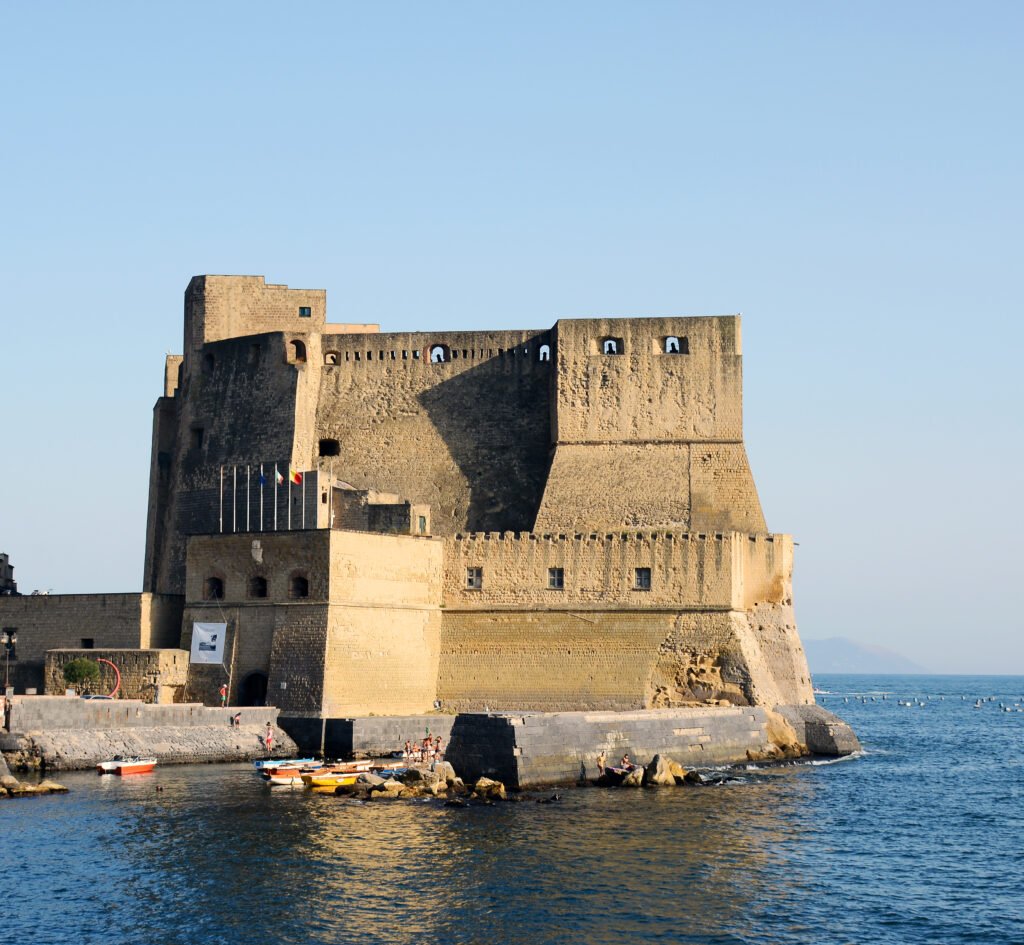
Naples is a port city in southern Italy on the Bay of Naples, overlooked by the active volcano Mount Vesuvius. One of the oldest continuously inhabited urban areas in Western Europe, it has been a Greek colony, a Roman city, and the capital of its own kingdom, and it is widely credited as the birthplace of pizza.
Where Is Naples Located?
Naples sits on Italy’s western coast in the Campania region, on the north side of the Bay of Naples. Mount Vesuvius, the volcano that destroyed the Roman towns of Pompeii and Herculaneum in 79 CE, rises a short distance to the southeast and remains active today, monitored closely because of the dense population living around its base.
The Origins and History of Naples
Greek settlers from the nearby colony of Cumae founded a city on the site in roughly the sixth century BCE, naming it Neapolis, meaning new city, to distinguish it from an earlier Greek settlement called Parthenope. Rome absorbed Naples in the fourth century BCE, and the city continued as a center of Greek language and culture even under Roman rule.
Naples later became the capital of its own kingdom for centuries, ruled in turn by Norman, Hohenstaufen, Angevin, Aragonese, and Spanish Bourbon dynasties as the Kingdom of Naples and, after a merger with Sicily, the Kingdom of the Two Sicilies. It was one of the largest cities in Europe by population through much of the early modern period. The kingdom ended in 1861 when Naples and southern Italy were absorbed into the newly unified Kingdom of Italy.
Government and Economy
As a royal capital for roughly seven centuries, Naples developed an extensive court bureaucracy, a large aristocracy, and a dense urban population supported by trade through its port. After unification with Italy, the city’s economy shifted toward manufacturing, shipping, and later tourism, while the wider Campania region remained one of Italy’s most densely populated areas. The Port of Naples continues to serve as a major Mediterranean shipping and ferry hub.
Culture and Daily Life in Naples
Naples has a distinct culinary identity built around its port city history, most famously as the home of Neapolitan pizza, including the Margherita, said to have been created in the city in the late nineteenth century. The city’s historic center remains one of the most densely populated urban areas in Europe, with narrow streets, street-level shrines, and a long tradition of street life that visitors and residents both describe as central to the city’s character. Naples is also the home of the Camorra, one of Italy’s organized crime networks, whose presence has shaped the city’s modern reputation alongside its cultural wealth.
Naples’s Most Famous Landmarks
Castel dell’Ovo, built on a small rocky island connected to the shore by a causeway, is the oldest standing fortification in Naples, with its present structure dating largely from the Norman period in the twelfth century on the site of earlier Roman and Byzantine strongholds. The historic center, with its Greek and Roman street grid still visible beneath later layers of building, was inscribed by UNESCO as a World Heritage Site in 1995. The nearby ruins of Pompeii and Herculaneum, buried by the 79 CE eruption of Vesuvius, remain among the most visited archaeological sites in Italy and draw directly on Naples as a gateway city.
What Is Naples Known For?
Naples is known as the birthplace of pizza, for its position on the Bay of Naples beneath Vesuvius, and for a historic center that preserves more than two thousand years of continuous urban life. It is also known as the gateway to Pompeii and Herculaneum, the Roman towns Vesuvius destroyed in 79 CE.
Why Naples Matters
Naples matters as one of the longest continuously inhabited cities in Europe, with an urban core that layers Greek, Roman, medieval, and early modern history on top of one another. Its position beneath an active volcano also makes it a long-studied case for understanding the risks dense cities face when they grow around major geological hazards.
Key facts
- Founded by Greek colonists as Neapolis around the sixth century BCE1
- Capital of the Kingdom of Naples and later the Kingdom of the Two Sicilies for centuries2
- Historic Centre of Naples inscribed as a UNESCO World Heritage Site in 19951
- Mount Vesuvius, the volcano that destroyed Pompeii and Herculaneum in 79 CE, overlooks the city2
- Joined the unified Kingdom of Italy in 18612
Quick checkWhat volcano overlooks Naples?Show answer
Mount Vesuvius, the volcano that destroyed Pompeii and Herculaneum in 79 CE, rises just southeast of Naples.
Sources
- UNESCO World Heritage Centre. Historic Centre of Naples. Undated (accessed Accessed 2026-10-06)
- Encyclopaedia Britannica. Naples. Undated (accessed Accessed 2026-10-06)
Editorially reviewed by Specialty Digest Editorial TeamLast reviewed October 6, 2026Researched and drafted with AI assistanceReport an issue