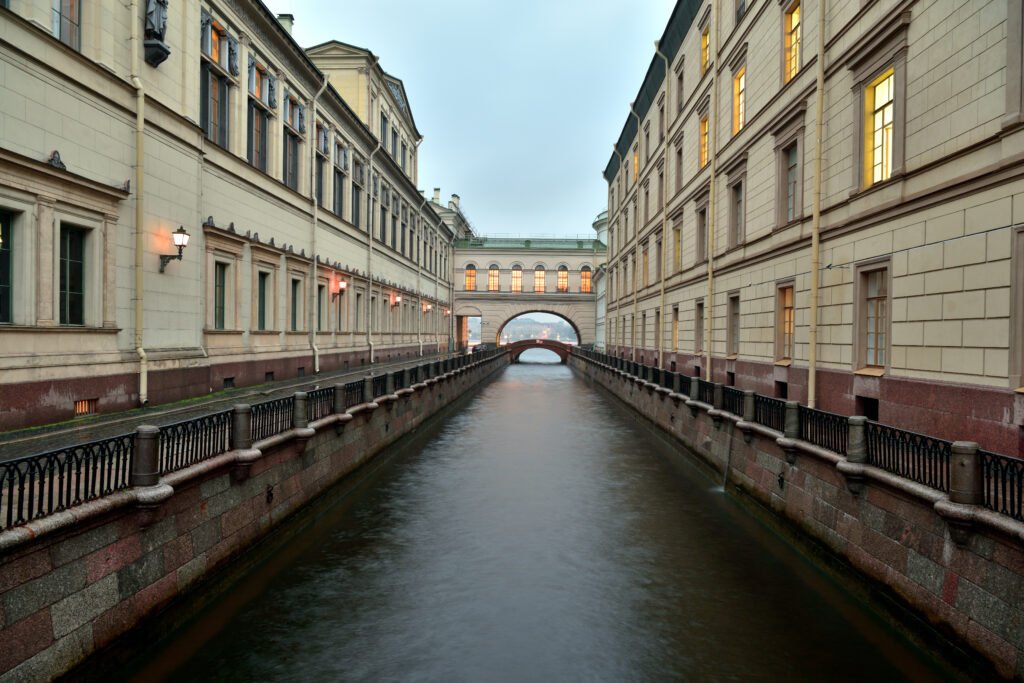
Saint Petersburg is a city in northwestern Russia founded in 1703 by Peter the Great as a deliberate opening to Western Europe. It served as the capital of the Russian Empire for more than two centuries and remains Russia’s cultural capital, home to the Hermitage Museum and the Winter Palace.
Where Is Saint Petersburg Located?
Saint Petersburg sits at the mouth of the Neva River on the Gulf of Finland, in Russia’s far northwest, close to the country’s borders with Finland and Estonia. Its network of canals and islands, built on marshland Peter the Great chose specifically for its sea access, has earned it comparisons to Venice and Amsterdam.
The Origins and History of Saint Petersburg
Peter the Great founded the city in 1703 on land taken from Sweden during the Great Northern War, intending it as Russia’s window to the West, a port and capital that would give the country direct access to European trade and ideas. He moved the Russian capital there from Moscow in 1712, and Saint Petersburg remained the seat of the Russian Empire, with a brief interruption, until 1918.
The city’s name changed repeatedly in the twentieth century, becoming Petrograd in 1914 amid anti-German sentiment during the First World War, then Leningrad in 1924 after the death of Vladimir Lenin. During the Second World War, the city endured the Siege of Leningrad, a blockade by German and Finnish forces lasting approximately 872 days between 1941 and 1944 that caused immense civilian suffering and loss of life. The original name was restored by popular vote in 1991 following the collapse of the Soviet Union.
Government and Economy
Saint Petersburg functions today as a federal city within the Russian Federation, Russia’s second-largest city after Moscow, with its own regional government distinct from the national capital. Its economy centers on shipping through its Baltic Sea port, manufacturing, and a tourism sector built heavily around its imperial-era architecture and museums.
Culture and Daily Life in Saint Petersburg
Saint Petersburg has long been considered Russia’s cultural capital, closely associated with writers including Fyodor Dostoevsky and Alexander Pushkin, both of whom lived and worked in the city. The Mariinsky Theatre, home to one of Russia’s leading ballet and opera companies, and a dense concentration of imperial-era palaces and cathedrals give the historic center a character distinct from Moscow’s.
Saint Petersburg’s Most Famous Landmarks
The Winter Palace, built as the official residence of the Russian tsars and completed in 1762, today forms the core of the State Hermitage Museum, founded in 1764 and one of the largest and oldest museums in the world, holding millions of items across its collection. In 1990, UNESCO inscribed the Historic Centre of Saint Petersburg and its related groups of monuments as a World Heritage Site, covering the Winter Palace, the network of canals, and the surrounding imperial architecture.
What Is Saint Petersburg Known For?
Saint Petersburg is known as Russia’s imperial capital for more than two centuries, for the Hermitage Museum housed in the Winter Palace, and for its canals and Baltic port setting. It is also known for the Siege of Leningrad during the Second World War and for its close association with major figures of Russian literature.
Why Saint Petersburg Matters
Saint Petersburg matters as the clearest physical expression of Peter the Great’s attempt to reorient Russia toward Europe, a purpose-built capital that shaped Russian art, literature, and governance for more than two centuries. Its survival of the Siege of Leningrad also makes it a central site in the history and memory of the Second World War in Russia.
Key facts
- Founded by Peter the Great in 17031
- Served as the capital of the Russian Empire from 1712 to 19181
- Historic Centre of Saint Petersburg inscribed as a UNESCO World Heritage Site in 19902
- Endured the roughly 872-day Siege of Leningrad during the Second World War1
- The State Hermitage Museum, housed in the Winter Palace, was founded in 17641
Quick checkWhy did Peter the Great found Saint Petersburg?Show answer
He wanted a port city that would give Russia direct access to European trade and ideas, calling it Russia's window to the West.
Sources
- UNESCO World Heritage Centre. Historic Centre of Saint Petersburg and Related Groups of Monuments. Undated (accessed Accessed 2026-10-06)
- Encyclopaedia Britannica. St. Petersburg. Undated (accessed Accessed 2026-10-06)
Editorially reviewed by Specialty Digest Editorial TeamLast reviewed October 6, 2026Researched and drafted with AI assistanceReport an issue