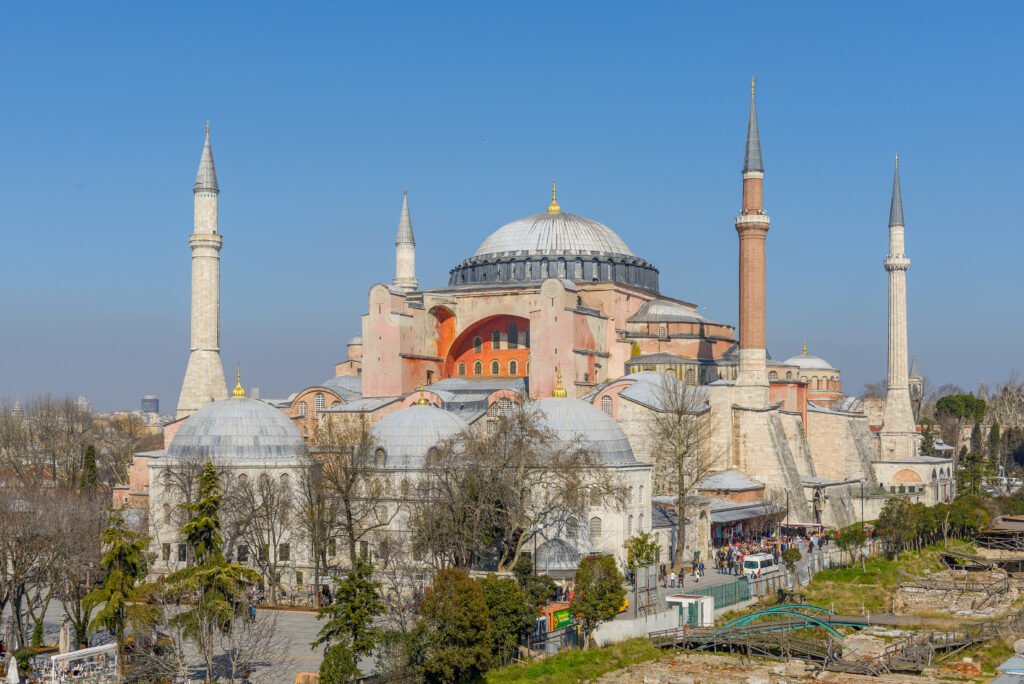
Istanbul is Turkey’s largest city and the only major city in the world built across two continents, straddling the Bosphorus Strait between Europe and Asia. Founded nearly 2,700 years ago as the Greek colony of Byzantion, it later ruled as Constantinople, capital of the Byzantine Empire, before becoming the Ottoman capital in 1453.
Where Is Istanbul Located?
Istanbul sits on both sides of the Bosphorus Strait, the narrow waterway connecting the Black Sea to the Sea of Marmara, with one part of the city in Europe and the other in Asia. This position has made it a strategic crossing point between continents for nearly three thousand years, controlling trade and military movement between the Mediterranean and Black Sea worlds.
The Origins and History of Istanbul
Greek colonists founded a city called Byzantion on the site around the seventh century BCE. Its importance grew enormously in 330 CE, when the Roman emperor Constantine I made it the new capital of the Roman Empire and renamed it Constantinople. After the Western Roman Empire fell, Constantinople remained the capital of the Byzantine Empire for roughly a thousand more years, surviving as one of the largest and wealthiest cities in the medieval world.
In 1453, Ottoman forces under Sultan Mehmed II captured Constantinople after a lengthy siege, ending the Byzantine Empire and making the city the capital of the Ottoman Empire. It remained the Ottoman capital until the empire’s dissolution after the First World War. When the Republic of Turkey was founded in 1923, the new government made Ankara its capital instead, and the city’s name was officially changed to Istanbul in the 1930s, though the name had been in common use for centuries before that.
Government and Economy Today
Although Istanbul is no longer Turkey’s capital, it remains the country’s largest city and its leading center of finance, trade, and industry, governed by the Istanbul Metropolitan Municipality. Its position on the Bosphorus continues to make it one of the busiest maritime chokepoints in the world for shipping traffic between the Mediterranean and Black Sea regions.
Culture and Daily Life in Istanbul
Istanbul’s culture reflects its layered history as a Greek, Roman, Byzantine, and Ottoman capital, visible in its architecture, cuisine, and religious life. The city remains a major center of Turkish cultural and intellectual life, and its position straddling two continents has long made it a meeting point of European and Middle Eastern influences in trade, art, and daily life.
Istanbul’s Most Famous Landmarks
Hagia Sophia, built in 537 CE under the Byzantine emperor Justinian I as a cathedral, is the city’s most historically layered landmark. It was converted into a mosque after the Ottoman conquest in 1453, became a secular museum in 1935, and was reconverted into a mosque in 2020. Nearby stand the Topkapi Palace, the primary residence of Ottoman sultans for roughly four centuries, and the Sultan Ahmed Mosque, commonly known as the Blue Mosque for its interior tilework. In 1985, UNESCO inscribed the Historic Areas of Istanbul as a World Heritage Site, covering these and other sites across the old city.
What Is Istanbul Known For?
Istanbul is known as the only major city spanning two continents, for Hagia Sophia’s layered history as cathedral, mosque, museum, and mosque again, and for having served as the capital of both the Byzantine and Ottoman Empires across roughly 1,600 years combined. It is also known for the Bosphorus Strait that divides and connects its two halves.
Why Istanbul Matters
Istanbul matters as a city whose history runs almost continuously through the Roman, Byzantine, and Ottoman worlds, making it one of the clearest physical records anywhere of how political and religious power shifted across the eastern Mediterranean over nearly two millennia. Its position on the Bosphorus also keeps it strategically significant for global shipping and trade today.
Key facts
- Founded as the Greek colony of Byzantion around the seventh century BCE1
- Renamed Constantinople in 330 CE and served as Byzantine capital for roughly a thousand years1
- Captured by the Ottomans under Sultan Mehmed II in 14531
- Historic Areas of Istanbul inscribed as a UNESCO World Heritage Site in 19852
- Hagia Sophia was built in 537 CE1
In the news
Quick checkWhy is Istanbul unique among major world cities?Show answer
Istanbul is the only major city in the world built across two continents, straddling the Bosphorus Strait between Europe and Asia.
Sources
- UNESCO World Heritage Centre. Historic Areas of Istanbul. Undated (accessed Accessed 2026-10-06)
- Encyclopaedia Britannica. Istanbul. Undated (accessed Accessed 2026-10-06)
Editorially reviewed by Specialty Digest Editorial TeamLast reviewed October 6, 2026Researched and drafted with AI assistanceReport an issue