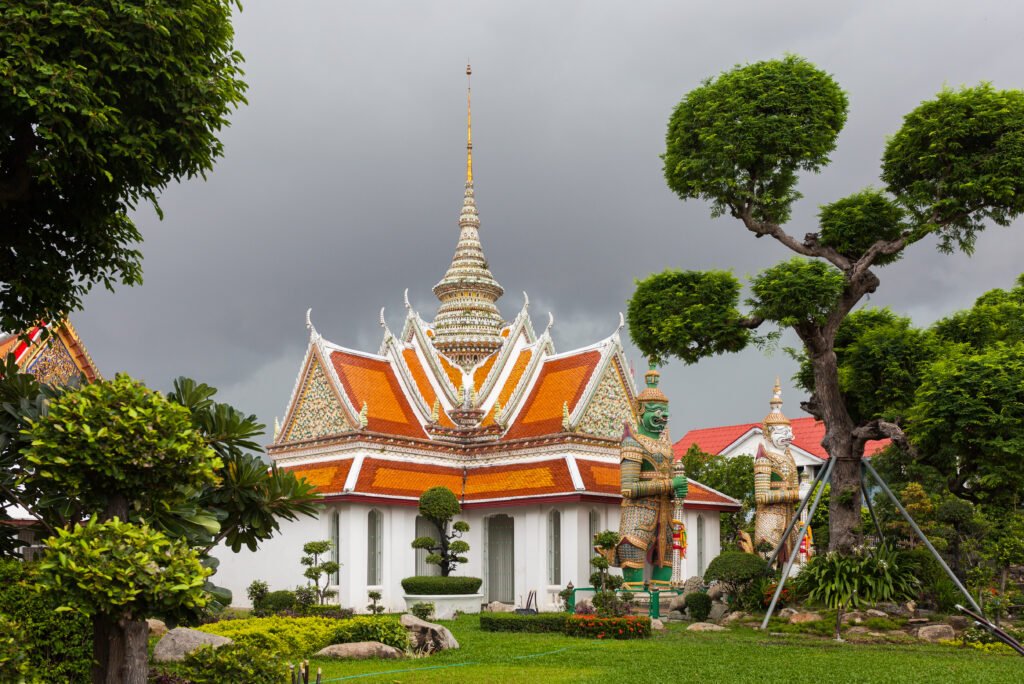
Bangkok is the capital and largest city of Thailand, a sprawling, low-lying metropolis on the Chao Phraya River that serves as the country’s center of government, commerce, culture and transport.
Where Is Bangkok Located?
Bangkok sits on the Chao Phraya River near the Gulf of Thailand, on a flat alluvial plain in central Thailand. The river splits the city, with the older royal and temple district on its eastern bank and the quieter Thonburi side to the west. The metropolitan area, officially the Bangkok Metropolis, extends far beyond the historic core into a dense urban region that dominates Thailand’s population and economy.
A Brief History of Bangkok
Bangkok became Thailand’s capital in 1782, when King Rama I founded the Chakri dynasty and moved the royal seat across the river from Thonburi, which had briefly served as capital after the fall of the earlier capital, Ayutthaya, in 1767. Rama I built the Grand Palace and modeled much of the new capital’s layout on Ayutthaya’s lost royal city. Through the 19th and early 20th centuries, Bangkok modernized under successive Chakri kings, who built canals, then roads and rail lines, while Thailand avoided the formal colonization that reshaped most of the rest of Southeast Asia.
According to the World Bank, Bangkok grew from a city of about 5 million people in 1991 to a megacity of nearly 18 million people today, a transformation that tracked Thailand’s broader shift from an agricultural economy to an export-driven, industrialized one over the same period.
Culture, Economy and Daily Life in Bangkok
Bangkok is Thailand’s commercial and financial hub, home to its stock exchange, most corporate headquarters, and a large share of its manufacturing, logistics and tourism revenue. The city’s culture blends Theravada Buddhist tradition, visible in its thousands of temples, with a famously dense, informal street-food scene and a modern skyline of malls and high-rises connected by elevated rail. Traffic congestion and seasonal flooding, a consequence of the city’s low elevation and rapid unplanned growth, remain persistent challenges that Thai authorities and urban planners have worked for decades to manage.
Bangkok’s Most Famous Landmarks
Wat Arun, the Temple of Dawn, is Bangkok’s most recognized single landmark: a Buddhist temple on the Thonburi riverbank whose central spire, encrusted with colored porcelain and seashell fragments, has symbolized the city in paintings, photographs and tourism imagery for generations. Just across the river, the Grand Palace complex and its temple, Wat Phra Kaew, housing the revered Emerald Buddha, form the ceremonial heart of the monarchy. Other major landmarks include Wat Pho, home to a vast reclining Buddha statue, and Chinatown’s Yaowarat Road.
What Is Bangkok Known For?
Bangkok is best known internationally for its ornate Buddhist temples, especially Wat Arun and the Grand Palace, its street food, its canals and river life, and its role as one of the world’s most visited cities. It is equally known within Thailand and the region as the country’s undisputed political and economic center.
Why Bangkok Matters
Bangkok matters as the seat of Thailand’s government and monarchy and as the economic engine of one of Southeast Asia’s largest economies. Its growth from a riverside royal capital into an 18-million-person megacity illustrates the speed of Southeast Asian urbanization over the past three decades, and its continuing struggle to manage congestion and flooding is closely watched as a test case for how low-lying, fast-growing Asian cities adapt to both rapid development and climate pressure.
Key Takeaways
- Bangkok has been Thailand’s capital since 1782, when Rama I founded the Chakri dynasty.
- The city grew from about 5 million people in 1991 to nearly 18 million today, according to the World Bank.
- Wat Arun, the Temple of Dawn, is Bangkok’s single most iconic landmark.
- The Grand Palace and the Emerald Buddha remain the ceremonial center of the Thai monarchy.
- Bangkok is Thailand’s undisputed economic and political center, and one of the world’s most visited cities.
Sources
- World Bank Group, “Thailand Overview”, 2026, https://www.worldbank.org/en/country/thailand/overview
- Encyclopaedia Britannica, “Bangkok”, undated, https://www.britannica.com/place/Bangkok
Key facts
Quick checkWhat year did Bangkok become the capital of Thailand?Show answer
1782, when King Rama I founded the Chakri dynasty.
Sources
- World Bank Group. Thailand Overview. 2026 (accessed 2026-10-06)
- Encyclopaedia Britannica. Bangkok. Undated (accessed 2026-10-06)
Editorially reviewed by Specialty Digest Editorial TeamLast reviewed October 6, 2026Researched and drafted with AI assistanceReport an issue