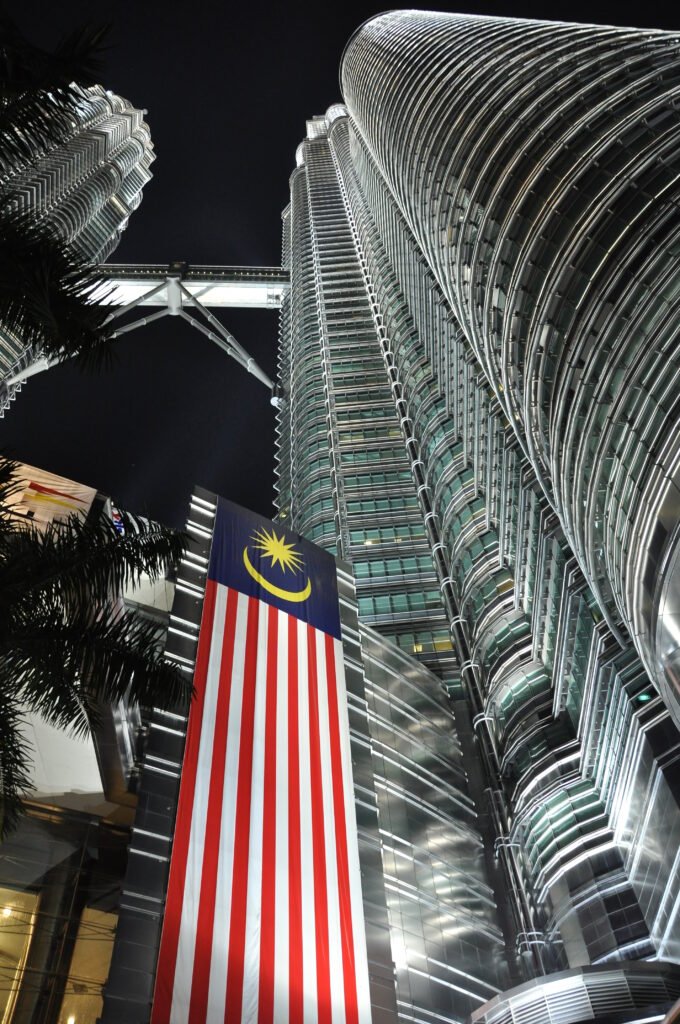
Kuala Lumpur is the capital and largest city of Malaysia, a fast-growing Southeast Asian metropolis best known for the twin Petronas Towers that anchor its modern skyline.
Where Is Kuala Lumpur Located?
Kuala Lumpur sits in west-central Peninsular Malaysia at the confluence of the Klang and Gombak rivers, a meeting point reflected in its name, which translates roughly as “muddy confluence.” The city forms the core of the Klang Valley conurbation and is a Federal Territory administered separately from the surrounding state of Selangor. Malaysia’s administrative capital, Putrajaya, lies a short distance to the south, but Kuala Lumpur remains the country’s commercial capital, its legislative seat, and the residence of Malaysia’s head of state.
A Brief History of Kuala Lumpur
Kuala Lumpur began in the 1850s as a tin-mining settlement where Chinese miners and Malay traders congregated at the river confluence. It grew quickly as tin exports boomed, and in 1880 the British colonial administration made it the capital of the state of Selangor, later extending its administrative importance across British Malaya. Much of the city’s colonial-era architecture, including the Sultan Abdul Samad Building, dates from this period of rapid, tin-funded growth. Malaysia gained independence from Britain in 1957, and Kuala Lumpur became the new nation’s capital, a role it has kept even after Putrajaya assumed most federal administrative functions beginning in the late 1990s.
Culture, Economy and Daily Life in Kuala Lumpur
Kuala Lumpur’s population and economy reflect Malaysia’s multiethnic character, with Malay, Chinese and Indian communities each shaping the city’s languages, religions and cuisine. The city is Malaysia’s financial and corporate center, home to Bursa Malaysia (the national stock exchange) and the headquarters of most major Malaysian companies, alongside a large services, retail and tourism sector. Street food culture, from hawker centers to Indian banana-leaf rice and Chinese noodle stalls, is central to daily life, as is a dense network of shopping malls connected to the city’s rail system.
Kuala Lumpur’s Most Famous Landmarks
The Petronas Towers dominate any list of the city’s landmarks. Completed in 1998 and designed by architect César Pelli, the 88-story twin towers held the title of the world’s tallest buildings until 2004 and remain the tallest twin towers in the world, linked by a skybridge between the 41st and 42nd floors. Other notable sites include the Sultan Abdul Samad Building, the Batu Caves temple complex on the city’s outskirts, and the colonial-era Merdeka Square, where Malaysia’s flag was first raised at independence in 1957.
What Is Kuala Lumpur Known For?
Internationally, Kuala Lumpur is known above all for the Petronas Towers, and more broadly for its multicultural food scene, its mix of colonial and ultramodern architecture, and its role as a regional business and transit hub for Southeast Asia.
Why Kuala Lumpur Matters
Kuala Lumpur matters as the commercial engine of Malaysia’s economy and a symbol of the country’s rapid post-independence development, from a 19th-century tin-mining camp to a global skyline landmark in under 150 years. Its multiethnic population and governance also make it a frequently cited example of how a Southeast Asian city manages religious and ethnic diversity within a single urban center.
Key Takeaways
- Kuala Lumpur began as a tin-mining settlement in the 1850s at the confluence of the Klang and Gombak rivers.
- It became capital of Selangor state under British colonial rule in 1880, and Malaysia’s national capital at independence in 1957.
- The Petronas Towers, completed in 1998, were the world’s tallest buildings until 2004.
- Kuala Lumpur remains Malaysia’s commercial capital even though Putrajaya has taken over most federal administrative functions.
- The city’s Malay, Chinese and Indian communities give it a distinctly multiethnic culture and cuisine.
Sources
- World Bank Group, “Malaysia Overview”, 2026, https://www.worldbank.org/en/country/malaysia/overview
- Encyclopaedia Britannica, “Kuala Lumpur”, undated, https://www.britannica.com/place/Kuala-Lumpur
Key facts
- Kuala Lumpur began as a tin-mining settlement in the 1850s.2
- It became Malaysia's capital at independence in 1957.2
- The Petronas Towers, completed in 1998, were the world's tallest buildings until 2004.2
- Putrajaya took over most federal administrative functions in the late 1990s, but KL remains the commercial capital.2
Quick checkWhat were the Petronas Towers the world's tallest buildings until?Show answer
2004, when Taipei 101 surpassed them.
Sources
- World Bank Group. Malaysia Overview. 2026 (accessed 2026-10-06)
- Encyclopaedia Britannica. Kuala Lumpur. Undated (accessed 2026-10-06)
Editorially reviewed by Specialty Digest Editorial TeamLast reviewed October 6, 2026Researched and drafted with AI assistanceReport an issue