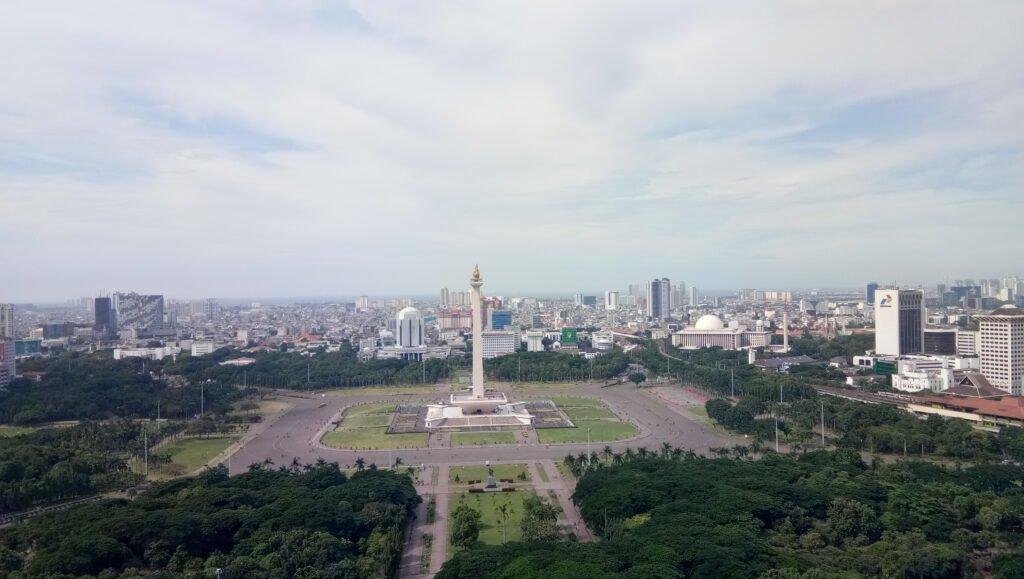
Jakarta is the former capital and largest city of Indonesia, a vast, low-lying port metropolis on the northwest coast of Java that remains the country’s economic and cultural center even as the government relocates its administrative capital elsewhere.
Where Is Jakarta Located?
Jakarta sits on the northwest coast of Java at the mouth of the Ciliwung River, on Jakarta Bay facing the Java Sea. Much of the city occupies low, flat, partly reclaimed land, and large sections have historically been prone to flooding and, in recent decades, to land subsidence, a combination that has driven Indonesia’s decision to build a new national capital, Nusantara, on the island of Borneo.
A Brief History of Jakarta
The site has been a trading port for centuries, known in different eras as Sunda Kelapa, then Jayakarta after a local sultanate took control in 1527. The Dutch East India Company seized the port in 1619 and rebuilt it as Batavia, the headquarters of Dutch colonial rule in the East Indies for more than three centuries. The city was renamed Jakarta after Indonesian independence, declared in 1945 and recognized by the Netherlands in 1949, and it served as the capital of the new republic. Indonesia is now in the process of shifting many government functions to the new planned capital of Nusantara in East Kalimantan, a move announced in 2019 and underway through the 2020s, though Jakarta continues to function as Indonesia’s largest city and its commercial core.
Culture, Economy and Daily Life in Jakarta
Jakarta is Indonesia’s financial and corporate center, home to the Indonesia Stock Exchange and the headquarters of most major domestic and multinational companies operating in the country. According to the World Bank, Indonesia is Southeast Asia’s largest economy and the world’s fourth most populous country, and Jakarta anchors much of that economic weight within a single metropolitan area. The city’s culture reflects migration from across Indonesia’s many islands and ethnic groups, producing a diverse culinary and religious landscape alongside a traffic-heavy, mall-centered urban daily life.
Jakarta’s Most Famous Landmarks
The National Monument, known locally as Monas, is Jakarta’s defining structure: a 132-meter marble obelisk topped with a bronze flame sheathed in gold leaf, built in the early 1960s under President Sukarno to commemorate Indonesia’s struggle for independence, standing at the center of Merdeka Square. Other notable sites include the Istiqlal Mosque, one of the largest mosques in Southeast Asia, the Jakarta Cathedral facing it across the square, and the old town of Kota Tua, built during the Batavia era.
What Is Jakarta Known For?
Jakarta is known internationally for the Monas monument, for its sheer scale as one of the world’s largest urban agglomerations, and for its combination of colonial Dutch heritage and modern Indonesian political life. It is also increasingly known for the environmental pressures, flooding and subsidence, that are driving the relocation of national government functions elsewhere.
Why Jakarta Matters
Jakarta matters as the economic heart of Indonesia, the world’s fourth most populous country and Southeast Asia’s largest economy, and as a case study in the risks facing low-lying coastal megacities. Even as Indonesia builds a new administrative capital, Jakarta is expected to remain the country’s principal commercial, financial and cultural city for the foreseeable future.
Key Takeaways
- Jakarta began as the trading port of Sunda Kelapa and was rebuilt as Batavia by the Dutch East India Company starting in 1619.
- It became the capital of independent Indonesia after 1945 and was renamed Jakarta.
- The National Monument (Monas), built in the early 1960s, is the city’s most iconic landmark.
- Indonesia is relocating its administrative capital to Nusantara in East Kalimantan, a process begun in 2019.
- Jakarta remains Indonesia’s largest city and commercial center regardless of the capital relocation.
Sources
- World Bank Group, “Indonesia Overview”, 2026, https://www.worldbank.org/en/country/indonesia/overview
- Encyclopaedia Britannica, “Jakarta”, undated, https://www.britannica.com/place/Jakarta
Key facts
- The Dutch East India Company rebuilt the port as Batavia starting in 1619.2
- Jakarta became Indonesia's capital after independence in 1945.2
- Indonesia is Southeast Asia's largest economy and the world's fourth most populous country.1
- Indonesia began relocating administrative capital functions to Nusantara in East Kalimantan from 2019.2
Quick checkWhat was Jakarta called under Dutch colonial rule?Show answer
Batavia.
Sources
- World Bank Group. Indonesia Overview. 2026 (accessed 2026-10-06)
- Encyclopaedia Britannica. Jakarta. Undated (accessed 2026-10-06)
Editorially reviewed by Specialty Digest Editorial TeamLast reviewed October 6, 2026Researched and drafted with AI assistanceReport an issue