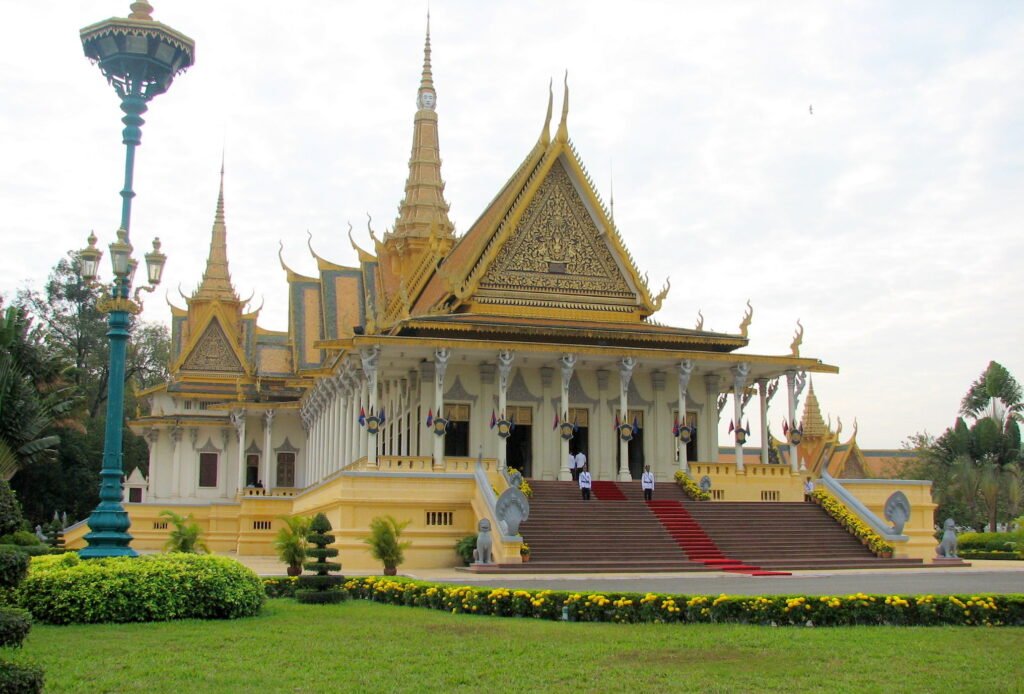
Phnom Penh is the capital of Cambodia, a riverside city at the confluence of the Mekong, Tonle Sap and Bassac rivers that serves as the country’s political, economic and cultural center.
Where Is Phnom Penh Located?
Phnom Penh sits at the point where the Tonle Sap River flows into the Mekong, joined there by the Bassac River, a meeting of waterways known locally as the Chattomukh, or “four faces.” This confluence has made the city a natural trading hub for centuries and still shapes its layout, with the Royal Palace and much of the historic city facing the riverfront.
A Brief History of Phnom Penh
According to tradition, Phnom Penh takes its name from a small hill where a woman is said to have found Buddha statues in a floating tree trunk in the 14th century, and the city became the Khmer capital intermittently from 1434, after the earlier capital of Angkor was abandoned. France made Cambodia a protectorate in 1863 and developed Phnom Penh through the colonial period into a planned city of broad boulevards. Cambodia gained independence in 1953. The Khmer Rouge forcibly emptied the city after taking power in 1975, and Phnom Penh’s population was driven into the countryside as part of a broader campaign that led to the deaths of an estimated 1.5 to 2 million Cambodians between 1975 and 1979, one of the deadliest episodes of mass violence of the twentieth century. The city was gradually repopulated after the Khmer Rouge was driven from power in 1979 and has since rebuilt into Cambodia’s primary political and commercial center.
Culture, Economy and Daily Life in Phnom Penh
According to the World Bank, Cambodia’s economy grew at an average of 8.2 percent a year between 2000 and 2019, making it one of the fastest-growing economies in the world over that period, driven largely by tourism, manufacturing exports, real estate and construction, much of it concentrated in and around Phnom Penh. The city today combines Buddhist religious life, centered on its many pagodas, with a garment and footwear manufacturing sector that is central to the national economy, alongside a growing middle class and a riverfront tourism and hospitality industry.
Phnom Penh’s Most Famous Landmarks
The Royal Palace, a walled complex on the riverfront that includes the Silver Pagoda, is Phnom Penh’s most recognized landmark, its gilded, multi-tiered roofs forming the city’s signature skyline feature and its grounds remaining the residence of the Cambodian monarch. Other major sites include the National Museum of Cambodia, which holds one of the world’s foremost collections of Khmer art, and the Tuol Sleng Genocide Museum and Choeung Ek memorial, which document the Khmer Rouge period.
What Is Phnom Penh Known For?
Phnom Penh is known internationally for the Royal Palace and Silver Pagoda, for its Khmer Rouge-era history, documented at Tuol Sleng and Choeung Ek, and for its riverside French colonial architecture. It also serves as the principal gateway for travel to Angkor, Cambodia’s ancient temple complex, though Angkor itself lies near the separate city of Siem Reap.
Why Phnom Penh Matters
Phnom Penh matters as the political and economic center of Cambodia and as a site where the country confronts one of the most severe instances of mass atrocity in modern history. Its rebuilding since 1979, from a nearly emptied city into a growing Southeast Asian capital, is closely tied to Cambodia’s broader postwar recovery and recent decades of rapid economic growth.
Key Takeaways
- Phnom Penh has served intermittently as the Khmer capital since 1434, after Angkor was abandoned.
- France developed the city during its colonial protectorate over Cambodia, beginning in 1863.
- The Khmer Rouge forcibly emptied the city after 1975, part of a campaign that killed an estimated 1.5 to 2 million Cambodians.
- The Royal Palace and Silver Pagoda form the city’s most recognized landmark.
- Cambodia’s economy grew at an average of 8.2 percent a year between 2000 and 2019, according to the World Bank.
Sources
- World Bank Group, “Cambodia Overview”, 2026, https://www.worldbank.org/en/country/cambodia/overview
- Encyclopaedia Britannica, “Phnom Penh”, undated, https://www.britannica.com/place/Phnom-Penh
Key facts
- Phnom Penh has served intermittently as Khmer capital since 1434.2
- France developed the city under its colonial protectorate from 1863.2
- The Khmer Rouge emptied the city after 1975, part of a campaign that killed an estimated 1.5 to 2 million Cambodians.2
- Cambodia's economy grew at an average 8.2 percent a year from 2000 to 2019.1
Quick checkWhat happened to Phnom Penh's population after the Khmer Rouge took power in 1975?Show answer
The city was forcibly emptied and its residents driven into the countryside.
Sources
- World Bank Group. Cambodia Overview. 2026 (accessed 2026-10-06)
- Encyclopaedia Britannica. Phnom Penh. Undated (accessed 2026-10-06)
Editorially reviewed by Specialty Digest Editorial TeamLast reviewed October 6, 2026Researched and drafted with AI assistanceReport an issue