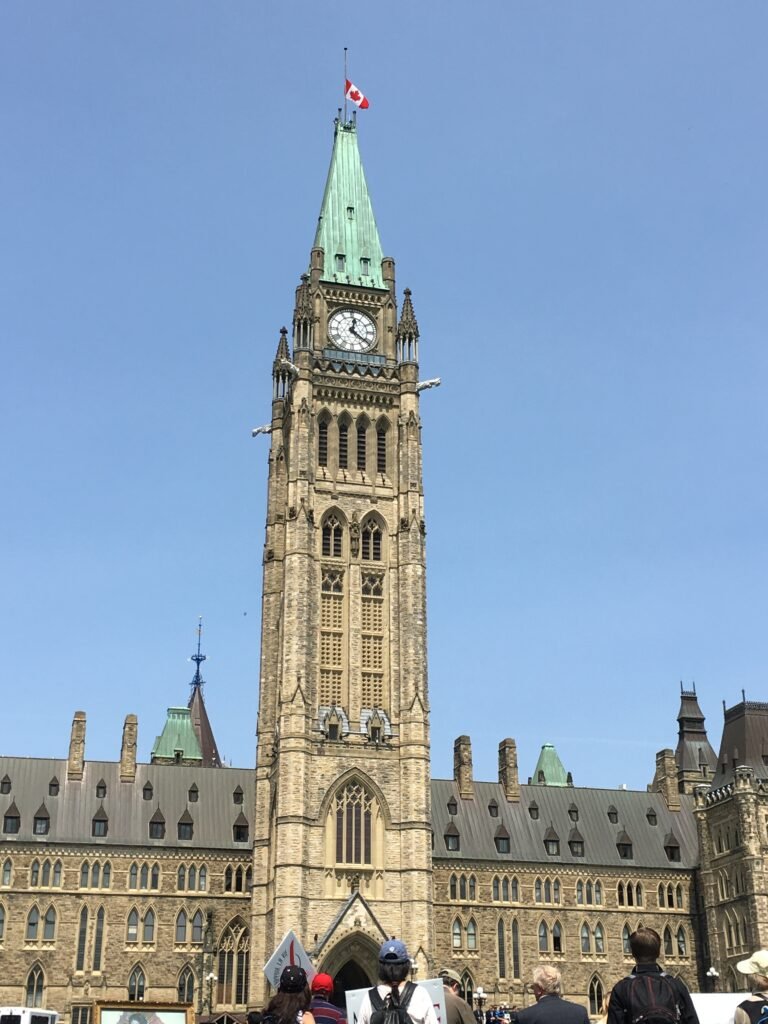
Ottawa is the capital of Canada, situated on the south bank of the Ottawa River in eastern Ontario, directly across the water from Gatineau, Quebec. Chosen as the seat of government in the mid-19th century partly for its position straddling the French and English halves of the colony, it is now home to Parliament Hill and the Rideau Canal, a UNESCO World Heritage Site.
Where Is Ottawa Located?
Ottawa sits where the Rideau and Ottawa Rivers meet, in eastern Ontario near the Quebec border. The Ottawa River forms the provincial boundary, and the twin city of Gatineau lies directly across the water in Quebec, making the National Capital Region a bilingual, cross-provincial urban area.
A Brief History of Ottawa
Becoming the Capital
Queen Victoria selected Ottawa, then a small lumber town known as Bytown, as the capital of the Province of Canada in 1857. The choice was influenced by Ottawa’s position on the linguistic and cultural border between predominantly French Lower Canada and predominantly English Upper Canada, as well as by its relative distance from the United States border compared with rival candidates such as Montreal, Toronto, Kingston, and Quebec City, all of which were considered more exposed to potential American attack. Ottawa went on to become the capital of the newly confederated Dominion of Canada in 1867.
Parliament Hill and the Peace Tower
The original Centre Block of the Parliament Buildings opened in 1866 but was almost entirely destroyed by fire in 1916. It was rebuilt and reopened in 1927 with a new central tower, the Peace Tower, dedicated as a memorial to Canadians killed in the First World War. The Peace Tower and the Gothic Revival Centre Block remain the most recognizable symbols of the federal government.
The Rideau Canal: A UNESCO World Heritage Site
Running 202 kilometres from Ottawa south to Kingston Harbour on Lake Ontario, the Rideau Canal was built between 1826 and 1832 under the direction of Lieutenant Colonel John By, primarily for military and strategic purposes at a time when Britain and the United States were competing for control of the region in the aftermath of the War of 1812. According to the UNESCO World Heritage Centre, it is the best-preserved example of a slackwater canal in North America and the only canal from the great early-19th-century North American canal-building era that remains operational along its original line with most of its structures intact. UNESCO inscribed the canal as a World Heritage Site in 2007. In winter, a stretch of the canal through downtown Ottawa is maintained as a skating rink, drawing visitors from across the country.
Why Ottawa Matters
As Canada’s seat of government, Ottawa is where federal legislation is debated and passed, and its deliberate selection as a compromise capital between French and English Canada reflects the delicate political balance that has shaped the country since Confederation. The Rideau Canal’s survival as a fully intact, functioning 19th-century waterway also makes Ottawa a rare example of a national capital built directly around a surviving work of pre-industrial military engineering.
Key Takeaways
- Ottawa was chosen as the capital of the Province of Canada in 1857 by Queen Victoria, partly for its position on the border between French and English Canada, and became the capital of the Dominion of Canada in 1867.
- Parliament Hill’s Centre Block was rebuilt after a 1916 fire, reopening in 1927 with the Peace Tower as a First World War memorial.
- The Rideau Canal, built 1826 to 1832, is a UNESCO World Heritage Site and the best-preserved slackwater canal in North America.
- Ottawa sits directly across the Ottawa River from Gatineau, Quebec, forming Canada’s bilingual National Capital Region.
Sources
Key facts
- Selected as capital of the Province of Canada by Queen Victoria in 1857; became capital of the Dominion of Canada in 1867.
- Parliament Hill's Centre Block was rebuilt after a 1916 fire and reopened in 1927 with the Peace Tower.
- The Rideau Canal (1826-1832) is a UNESCO World Heritage Site, inscribed in 2007.1
- Forms Canada's bilingual National Capital Region with Gatineau, Quebec, across the Ottawa River.
Quick checkWhy was the Rideau Canal originally built?Show answer
The Rideau Canal was built between 1826 and 1832 for primarily military and strategic reasons, giving Britain a supply route to Lake Ontario that avoided the St. Lawrence River border with the United States after the War of 1812.
Sources
- UNESCO World Heritage Centre. Rideau Canal. Undated (accessed 2026-10-21)
- World Bank Group. Canada country overview. Undated, accessed 2026 (accessed 2026-10-21)
Editorially reviewed by Specialty Digest Editorial TeamLast reviewed October 21, 2026Researched and drafted with AI assistanceReport an issue