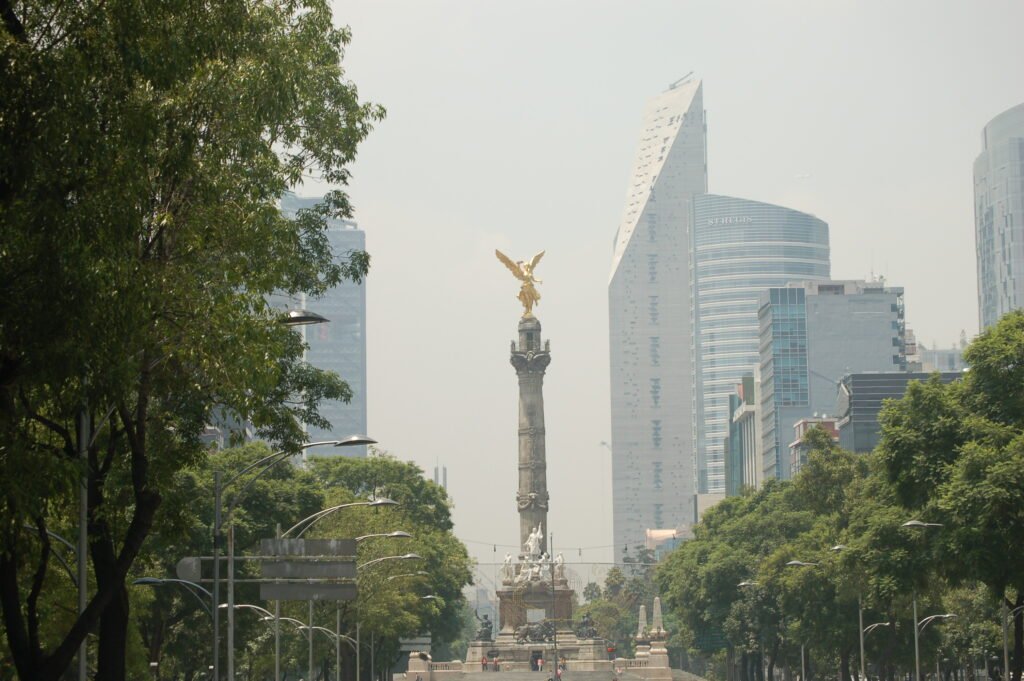
Mexico City is the capital of Mexico, built in a high mountain basin on the ruins of Tenochtitlan, the former capital of the Aztec Empire. One of the largest metropolitan areas in the Western Hemisphere, its historic core is recognized by UNESCO as a World Heritage Site.
Where Is Mexico City Located?
Mexico City sits in the Valley of Mexico, a highland basin roughly 2,240 metres above sea level, surrounded by mountains in the center of the country. The city occupies the former bed of Lake Texcoco, which was progressively drained following the Spanish conquest; because the city rests on soft former lakebed sediment, parts of it continue to subside gradually, a well-documented engineering challenge for the modern metropolis.
A Brief History of Mexico City
From Tenochtitlan to the Spanish Capital
According to the UNESCO World Heritage Centre, Mexico City was built in the 16th century by the Spanish directly on the ruins of Tenochtitlan, the old Aztec capital. Spanish conquistadors led by Hernán Cortés captured Tenochtitlan in 1521, and the colonial city that rose on its foundations became the seat of the Viceroyalty of New Spain. Several Aztec temples whose ruins have since been identified and excavated, including the Templo Mayor, still lie beneath and beside the colonial-era street grid.
Capital of an Independent Nation
Mexico City became the capital of an independent Mexico following the country’s war of independence in the early 19th century, and it has remained the seat of the federal government ever since, growing through the 20th century into one of the world’s largest cities.
The Historic Centre: A UNESCO World Heritage Site
UNESCO inscribed the “Historic Centre of Mexico City and Xochimilco” as a World Heritage Site, citing the old Aztec temple remains, a cathedral described by UNESCO as the largest on the continent, and notable 19th- and 20th-century public buildings such as the Palacio de Bellas Artes. The inscription also covers Xochimilco, a district 28 kilometres south of the city center whose network of canals and artificial floating gardens, built by the Aztec to farm in a difficult environment, has been preserved since the 16th century.
What Is Mexico City Known For?
Among the city’s own 19th- and 20th-century monuments, the Angel of Independence is the most widely recognized. Completed in 1910 to mark the centennial of Mexico’s independence movement, which began with Miguel Hidalgo’s 1810 call to arms, the gilded bronze angel atop a stone column has become Mexico City’s defining symbol and a traditional gathering point for national celebrations. The column’s base holds the remains of several leaders of the independence movement.
Why Mexico City Matters
Few capitals anywhere sit as literally atop their own deep history as Mexico City, where colonial, Aztec, and modern Mexican layers occupy the same physical ground. Its continuous role as a political and cultural capital, from the Aztec Empire through Spanish colonial rule to the modern Mexican state, makes it a rare case of urban continuity spanning more than five centuries on a single site.
Key Takeaways
- Mexico City was built in the 16th century by the Spanish on the ruins of Tenochtitlan, the Aztec capital conquered by Hernán Cortés in 1521. [1]
- Its historic centre, including the cathedral and Templo Mayor ruins, along with Xochimilco’s canals, is a UNESCO World Heritage Site. [1]
- The city sits in the highland Valley of Mexico on the former bed of Lake Texcoco and continues to subside gradually.
- The Angel of Independence, completed in 1910, is Mexico City’s most recognized modern landmark, commemorating the 1810-1821 independence movement.
Sources
- UNESCO World Heritage Centre, Historic Centre of Mexico City and Xochimilco
- World Bank Group, Mexico country overview
Key facts
- Built in the 16th century by the Spanish directly on the ruins of Tenochtitlan, the Aztec capital.1
- Its historic centre and Xochimilco are a UNESCO World Heritage Site.1
- Sits in the Valley of Mexico on the former bed of Lake Texcoco, at roughly 2,240 metres elevation.
- The Angel of Independence (1910) is the city's best-known modern landmark.
Quick checkWhat stood where Mexico City now stands before the Spanish conquest?Show answer
Mexico City was built in the 16th century directly on the ruins of Tenochtitlan, the capital of the Aztec Empire, which fell to Spanish conquistadors led by Hernan Cortes in 1521.
Sources
- UNESCO World Heritage Centre. Historic Centre of Mexico City and Xochimilco. Undated (accessed 2026-10-21)
- World Bank Group. Mexico country overview. Undated, accessed 2026 (accessed 2026-10-21)
Editorially reviewed by Specialty Digest Editorial TeamLast reviewed October 21, 2026Researched and drafted with AI assistanceReport an issue