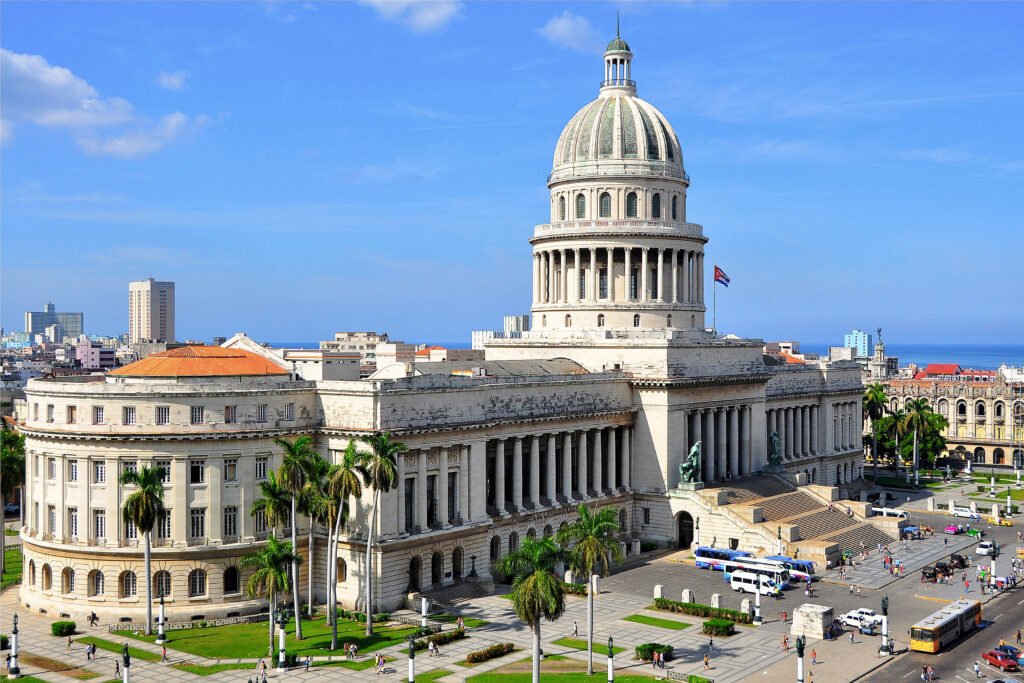
Havana is the capital of Cuba, built around a natural bay on the island’s northern coast. Founded by the Spanish in the early 16th century, its old center, Old Havana, is a UNESCO World Heritage Site, and its early-20th-century Capitolio building remains the city’s most recognizable landmark.
Where Is Havana Located?
Havana sits on Cuba’s northern coast, built around the Bahia de la Habana, a natural harbour that opens onto the Straits of Florida. Its position facing the Gulf Stream and the shipping lanes between the Caribbean and the Atlantic made the bay strategically valuable from the earliest years of Spanish colonization.
A Brief History of Havana
Founding and Growth as a Naval Hub
According to the UNESCO World Heritage Centre, Havana was founded in 1519 by the Spanish. By the 17th century it had become one of the Caribbean’s main centers for ship-building, a role tied directly to its sheltered bay and its position on Spain’s treasure-fleet route back to Europe. UNESCO describes today’s Havana as a sprawling metropolis of some two million inhabitants, whose old center nonetheless retains a mix of Baroque and neoclassical monuments alongside a homogeneous ensemble of private houses with arcades, balconies, wrought-iron gates, and internal courtyards.
Old Havana: A UNESCO World Heritage Site
UNESCO inscribed “Old Havana and its Fortification System” as a World Heritage Site in 1982, recognizing both the architectural ensemble of the old town and the network of forts built to defend the harbour from the 16th century onward. The inscription covers an architectural and urban environment largely unmatched elsewhere in the Caribbean for its density of surviving colonial-era structures.
El Capitolio
Completed in 1929, El Capitolio was built as the seat of Cuba’s Congress and remains the most recognizable building on Havana’s skyline, its dome visible across much of the old city. Its design drew visibly on the United States Capitol in Washington, D.C., though it has always been a distinct building with its own interior detail and statuary. The building ceased to house the legislature after the 1959 revolution and instead held Cuba’s Academy of Sciences and National Library of Science and Technology for several decades, before an extensive restoration returned it to legislative use as the seat of Cuba’s National Assembly in 2018.
Why Havana Matters
Havana’s four centuries as a fortified port city, from its founding through the era of Spanish treasure fleets to its current role as a national capital, have left one of the most architecturally intact colonial-era urban centers anywhere in the Americas. The scale and preservation of Old Havana’s Baroque and neoclassical core are central to why UNESCO singled it out for protection, and El Capitolio’s return to legislative use in 2018 reconnected the city’s most prominent 20th-century landmark with its original civic purpose.
Key Takeaways
- Havana was founded by the Spanish in 1519 and became a major Caribbean shipbuilding center by the 17th century. [1]
- Old Havana and its surrounding fortifications were inscribed as a UNESCO World Heritage Site in 1982. [1]
- El Capitolio, completed in 1929, was Cuba’s legislative seat until 1959 and returned to that role after restoration in 2018.
- Modern Havana is home to roughly two million people, according to UNESCO’s description of the city. [1]
Sources
Key facts
- Founded by the Spanish in 1519; became a major Caribbean shipbuilding center by the 17th century.1
- Old Havana and its Fortification System was inscribed as a UNESCO World Heritage Site in 1982.1
- El Capitolio, completed in 1929, was Cuba's legislative seat until 1959 and again since a 2018 restoration.
- UNESCO describes modern Havana as a metropolis of roughly two million inhabitants.1
Quick checkWhen was Old Havana designated a UNESCO World Heritage Site?Show answer
Old Havana and its Fortification System was inscribed as a UNESCO World Heritage Site in 1982, recognizing its colonial-era architecture and defensive forts.
Sources
- UNESCO World Heritage Centre. Old Havana and its Fortification System. Undated (accessed 2026-10-21)
Editorially reviewed by Specialty Digest Editorial TeamLast reviewed October 21, 2026Researched and drafted with AI assistanceReport an issue