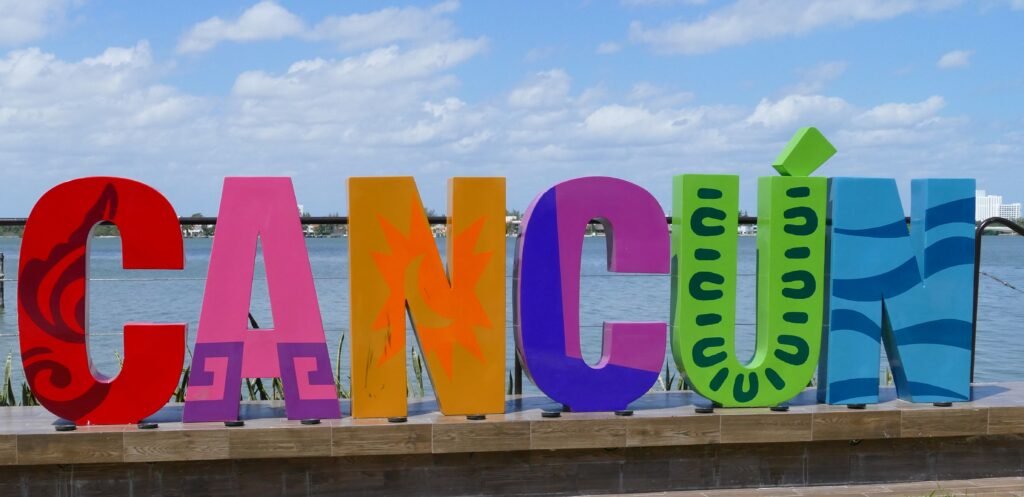
Cancun is a purpose-built resort city on the Caribbean coast of Mexico’s Yucatan Peninsula, in the state of Quintana Roo. Unlike almost every other major city in this encyclopedia, Cancun did not grow gradually over centuries; it was planned and built from essentially nothing by the Mexican government starting in 1970.
Where Is Cancun Located?
Cancun sits on Mexico’s Caribbean coast in the state of Quintana Roo, at the northeastern tip of the Yucatan Peninsula. Its hotel zone occupies a narrow, curved barrier island, often described as shaped like the number seven, that separates the turquoise waters of the Caribbean Sea from the Nichupte Lagoon.
A Brief History of Cancun
A City Chosen by Computer
Before 1970, the site of modern Cancun was home to only a small fishing settlement. Mexico’s federal tourism development agency, the Fondo Nacional de Fomento al Turismo (FONATUR), identified the location in the late 1960s through a site-selection process that weighed factors such as beach quality, water clarity, and accessibility against competing stretches of Mexican coastline. Construction of the planned resort city began in 1970, and its first major hotel opened in the mid-1970s. Within a few decades, Cancun had grown from essentially uninhabited coastline into one of the most visited beach destinations in the world, a transformation frequently cited in urban planning and tourism-development literature as a model of deliberate, state-directed resort construction.
Older History Beneath the Resort
Despite its modern origins, the ground beneath Cancun has a much older history. The El Rey archaeological site, a small complex of Maya temple platforms, stands within the hotel zone itself, predating the planned city by many centuries and now surrounded on all sides by hotel development, a striking juxtaposition between the region’s deep Maya past and its recent, engineered tourism economy.
What Is Cancun Known For?
Cancun is known above all for its hotel zone beaches and the large illuminated letter sculpture spelling out the city’s name near Playa Delfines, a popular public beach at the southern end of the strip, which has become one of the most widely photographed symbols of the city. Cancun also functions as the main gateway for visitors to the wider Riviera Maya region, including nearby Maya archaeological sites and coastal towns along the Yucatan coast.
Why Cancun Matters
Cancun is a rare example of a major city created almost entirely by deliberate government planning rather than organic settlement, making it a frequently studied case in the geography of tourism development. Its rapid growth also reshaped the economy of Quintana Roo, turning what had been a sparsely populated stretch of coastline into one of Mexico’s largest sources of tourism revenue within a single generation.
Key Takeaways
- Cancun was planned and built from essentially nothing by Mexico’s federal tourism agency, FONATUR, starting in 1970.
- Its hotel zone occupies a narrow barrier island between the Caribbean Sea and the Nichupte Lagoon, in the state of Quintana Roo.
- The El Rey Maya archaeological site sits within the modern hotel zone, predating the resort city by centuries.
- Cancun’s rapid, government-directed growth is widely cited as a model case study in planned tourism development.
Sources
Key facts
- Planned by Mexico's federal tourism agency, FONATUR, with construction beginning in 1970 on what had been a sparsely populated coastline.
- Located in the state of Quintana Roo, at the northeastern tip of the Yucatan Peninsula.
- Its hotel zone is a narrow barrier island between the Caribbean Sea and the Nichupte Lagoon.
- The El Rey Maya archaeological site sits within the modern hotel zone, predating the resort city.
Quick checkHow was the location of Cancun chosen?Show answer
Mexico's federal tourism agency, FONATUR, selected the site in the late 1960s through a planning process weighing factors like beach quality and accessibility, then built the resort city from essentially nothing starting in 1970.
Sources
- World Bank Group. Mexico country overview. Undated, accessed 2026 (accessed 2026-10-21)
Editorially reviewed by Specialty Digest Editorial TeamLast reviewed October 21, 2026Researched and drafted with AI assistanceReport an issue