Carrying capacity is the maximum population size of a species that a given environment can sustain indefinitely, given the food, water, habitat, and other resources actually available to it. The concept applies across scales, from a single pond’s fish population to an entire planet’s human population, and it sits at the center of how ecologists model population growth over time.
The logistic growth model
Ecologists commonly represent carrying capacity mathematically through the logistic growth model, developed by Pierre-Francois Verhulst in the nineteenth century, which uses the symbol K, from the German word Kapazitatsgrenze, meaning capacity limit, to represent the environment’s carrying capacity. Under this model, a small population grows rapidly because resources are abundant relative to its size, but growth slows as the population approaches K, the point at which resources become limiting, and growth stops entirely once the population reaches K itself. A population starting below K tends to keep growing, while a population that somehow starts above K tends to decline, so K functions as a stable equilibrium point that the population trends toward from either direction, assuming the environment’s resource base stays constant.
What sets the limit
Carrying capacity is not a single fixed number inherent to a species; it depends entirely on the specific environment a population occupies and whichever resource is scarcest relative to the population’s needs, commonly called the limiting factor. For one species in one environment the limiting factor might be food availability, for another it might be nesting sites, water access, or even the environment’s capacity to absorb the population’s own waste without becoming toxic or otherwise degraded. Because the limiting factor can differ by species and by location, carrying capacity for the same species can vary considerably between two superficially similar habitats, depending on which specific resource is actually in shortest supply in each one.
Carrying capacity changes over time
An environment’s carrying capacity is not fixed permanently either. Ecosystems themselves change, through disturbance, succession, climate shifts, or human alteration, and those changes shift the resource base available to a given population, raising or lowering K as a result. For humans specifically, technological advances such as improved agriculture, water management, and energy production have repeatedly raised the planet’s effective carrying capacity over history by making previously limiting resources more abundant or more efficiently used, even as critics note that environmental degradation driven by that same technological expansion could eventually lower carrying capacity again if it undermines the resource base technology currently relies on.
Overshoot: exceeding carrying capacity
A population can temporarily exceed its environment’s carrying capacity in a phenomenon ecologists call overshoot, typically followed by a decline back toward or below K once the shortfall in resources, space, or waste-absorption capacity catches up with the population. The Global Footprint Network, which tracks human resource consumption against the planet’s regenerative capacity, estimated that humanity’s resource use in 2024 ran at roughly 170 percent of what Earth’s ecosystems can regenerate in a year, a condition it describes as global ecological overshoot; the organization marks the date each year when consumption for that year exceeds Earth’s annual regenerative capacity as Earth Overshoot Day, which fell on August 1 in 2024. Overshoot in wildlife populations is often visually dramatic, as in cases of severe overgrazing, where herbivore numbers temporarily exceed what available vegetation can support, leaving visibly degraded land before the population eventually falls back in response.
Debating Earth’s human carrying capacity
Applying carrying capacity to the human species has a long and contentious history. The English economist Thomas Malthus argued in 1798 that human population would eventually outstrip the planet’s ability to produce food, since population could in principle grow geometrically while agricultural output grew only arithmetically, a prediction that has not played out as he described, largely because later agricultural, medical, and industrial advances repeatedly expanded the effective resource base available to support a growing population. Modern estimates of Earth’s human carrying capacity vary enormously, often by a factor of ten or more between different studies, precisely because the number depends heavily on assumptions about future technology, consumption patterns, and how resources are distributed, rather than on any single fixed biological ceiling the way carrying capacity works for most wild animal populations living within a stable, unmanaged environment.
A real-world example: Serengeti wildebeest
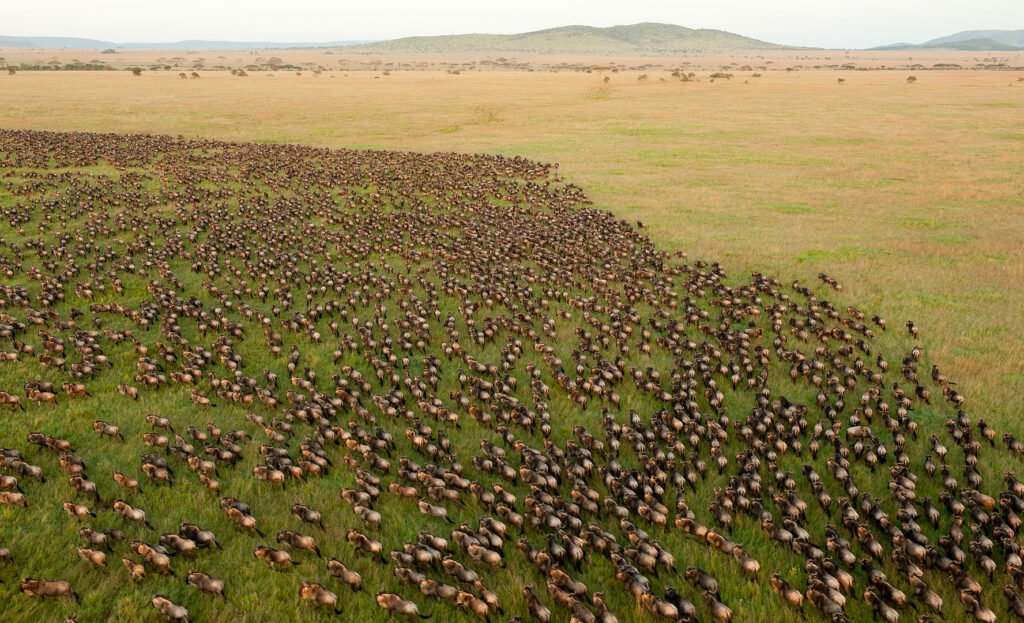
The wildebeest population of the Serengeti-Mara ecosystem in East Africa is one of the most studied real-world examples of a population regulated by its environment’s carrying capacity. Researchers have documented the population growing substantially after rinderpest, a cattle disease that had also affected wildebeest, was eradicated in the 1960s, before leveling off at a size broadly consistent with what the ecosystem’s grassland could support given seasonal rainfall patterns, illustrating the logistic growth pattern in a free-ranging wild population rather than only in laboratory conditions, and giving ecologists one of their clearest long-term datasets for watching a population settle near its environment’s carrying capacity over real decades rather than a short experimental timescale.
FAQs
Is carrying capacity the same for a species no matter where it lives? No. Carrying capacity depends on the specific resources available in a given environment and which resource is the limiting factor there, so the same species can have a much higher or lower carrying capacity in two different habitats depending on local conditions.
What happens when a population exceeds its environment’s carrying capacity? The population typically experiences overshoot, a temporary state that is usually followed by decline as resource shortages, waste accumulation, or habitat degradation catch up with the population, pushing numbers back down toward or below the environment’s actual carrying capacity.
Key facts
- The logistic growth model represents carrying capacity as K, the population level growth slows toward and eventually stops at.
- The limiting factor setting carrying capacity, such as food, water, or nesting sites, can differ by species and by location.
- Carrying capacity changes over time as ecosystems change or, for humans, as technology alters the effective resource base.
- Overshoot occurs when a population temporarily exceeds carrying capacity, typically followed by a decline back toward it.
- The Global Footprint Network estimated human resource use ran at about 170 percent of Earth's regenerative capacity in 2024, with Earth Overshoot Day falling on August 1 that year.
Related concepts
Quick checkWhy can the same species have very different carrying capacities in two habitats that look similar?Show answer
Carrying capacity depends on whichever resource is the limiting factor in a given environment, such as food, water, or nesting sites, and that limiting factor can differ between two habitats even if they otherwise look alike, so the population size each one can sustain indefinitely can differ substantially as a result.
Sources
- Wikipedia. Carrying capacity. 2024 (accessed 2026-11-01)
Editorially reviewed by Specialty Digest Editorial TeamLast reviewed November 1, 2026Researched and drafted with AI assistanceReport an issue