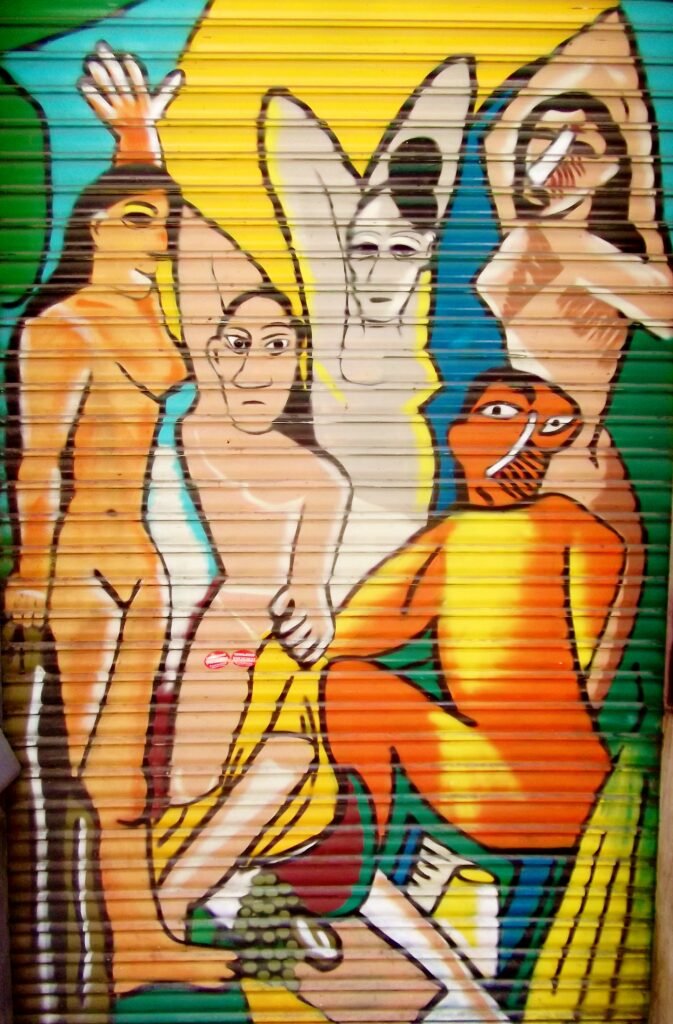
Cubism is an early twentieth-century art movement that broke objects and figures into fragmented geometric planes, often showing multiple viewpoints of the same subject simultaneously, rather than depicting a scene from a single, fixed vantage point the way centuries of Western painting tradition, built on linear perspective, generally had. Developed jointly by Pablo Picasso and Georges Braque starting around 1907, Cubism fundamentally challenged the assumption that a painting should present a single, coherent, realistic view of its subject.
Origins and early influences
Picasso’s painting Les Demoiselles d’Avignon, completed in 1907, is often identified as Cubism’s starting point, though Picasso himself did not fully develop the style’s mature geometric language in that single work. The movement grew out of Picasso’s engagement with Primitivism, including his interest in African and Iberian sculpture’s simplified, abstracted forms, combined with the strong influence of Paul Cezanne’s late paintings, which had already begun flattening and simplifying natural forms into underlying geometric structures. A hostile art critic coined the term “Cubism” in 1908, intending it somewhat dismissively to describe the style’s reduction of forms to cube-like geometric shapes, but the label stuck and was eventually embraced by the movement’s own practitioners and historians.
Analytical Cubism
The phase art historians call Analytical Cubism, running roughly from 1910 to 1912, pushed the fragmentation of form furthest. Picasso and Braque broke their subjects, frequently still lifes, musical instruments, or portraits, into interlocking geometric facets viewed from several angles at once, often rendering the subject so abstracted that it became difficult to identify without small recognizable clues, such as a spiral shape suggesting a violin’s scroll. During this phase the two artists worked so closely together, often painting in a muted, nearly monochrome palette of browns and grays, that some works from this period are difficult to attribute confidently to one artist or the other without documentation, reflecting how collaborative the style’s early development actually was.
Synthetic Cubism and collage
Around 1912, Cubism shifted into what historians call Synthetic Cubism, a phase that introduced collage, the technique of physically attaching real materials, such as newspaper clippings, wallpaper fragments, or stenciled lettering, directly onto the canvas or paper surface alongside painted elements. This phase moved away from Analytical Cubism’s fragmented, difficult-to-read compositions toward flatter, more decorative arrangements built from textured, patterned planes that function more like constructed pictorial objects than attempts to analyze a subject’s underlying geometric structure. The introduction of collage during this period had an influence on twentieth-century art that extended well beyond Cubism itself, opening the door for later artists across many movements to incorporate found materials and real-world objects directly into otherwise painted or drawn compositions.
Why Cubism broke with tradition
Cubism’s core departure from centuries of Western painting convention was its rejection of the idea that a picture should present one coherent, internally consistent view of its subject from a single fixed viewpoint, the governing assumption behind linear perspective since the Italian Renaissance. By presenting several viewpoints of the same object within a single composition, and by reducing recognizable objects to simplified geometric signs rather than naturalistic depictions, Cubism treated the picture’s own flat surface and internal structure as a subject in its own right, rather than treating the canvas purely as an illusionistic window onto a believable three-dimensional scene.
Beyond the founders: Cubism as a wider movement
Although Picasso and Braque developed Cubism’s core techniques together, the style quickly attracted other artists who extended it in their own directions. Juan Gris, a Spanish painter working in Paris alongside Picasso and Braque, became particularly associated with a more structured, colorful version of Synthetic Cubism, while other artists applied Cubist fragmentation to sculpture and to Futurism’s related interest in depicting motion and machinery. This wider circle of practitioners meant Cubism was never a tightly closed, two-person project but a broader shift in approach that other painters adapted to their own subjects and temperaments, contributing to the style’s rapid spread across the Paris art world in the years before the First World War.
Public reception and the 1913 Armory Show
Cubism provoked strong, often hostile, public reaction when it first reached wider audiences outside the relatively small circle of Parisian artists and collectors who had followed its early development. The 1913 International Exhibition of Modern Art, commonly known as the Armory Show, introduced Cubism and other European modernist movements to American audiences in New York, Chicago, and Boston, and the fragmented, seemingly unintelligible appearance of Cubist paintings to viewers accustomed to realistic representation generated significant public mockery and controversy in the press at the time. That same controversy, in retrospect, is often cited by historians as evidence of just how fundamentally Cubism had broken with the representational expectations most viewers still brought to painting, even among audiences who had already encountered other forms of early modern art.
Influence on later art and design
Cubism’s fragmented, multi-perspective approach influenced numerous later movements and individual artists across painting, sculpture, architecture, and graphic design throughout the twentieth century, including Futurism’s interest in depicting movement through overlapping forms and various strands of abstract art that pushed even further away from recognizable subject matter altogether. Its legitimization of collage as a serious artistic technique also had a lasting influence on later twentieth-century art movements, including various forms of assemblage and mixed-media work that continued building on the idea that a picture could incorporate real, physical fragments of the world rather than representing it purely through paint.
FAQs
Did Picasso and Braque work entirely independently, or together? They worked in close collaboration, especially during the Analytical Cubism phase from roughly 1910 to 1912, often developing techniques jointly and producing work so similar in style that some pieces from that period are difficult to attribute confidently to one artist without documented provenance.
Is Cubism considered a form of abstract art? It sits on the boundary: Cubist works usually retain some recognizable connection to real subjects, such as a guitar or a human figure, even as they fragment and distort that subject’s appearance, distinguishing Cubism from fully abstract art, which abandons recognizable subject matter altogether.
Key facts
- Developed by Pablo Picasso and Georges Braque starting c. 1907
- Les Demoiselles d'Avignon (1907) often cited as the starting point
- Two main phases: Analytical Cubism (c.1910-12), Synthetic Cubism (1912-14, introduced collage)
- Term coined dismissively by a hostile critic in 1908
Related concepts
Quick checkIs Cubism considered a form of abstract art?Show answer
It sits on the boundary: Cubist works usually retain some recognizable connection to real subjects, unlike fully abstract art.
Sources
- Encyclopaedia Britannica. Cubism and its consequences. https://www.britannica.com/art/Western-painting/Cubism-and-its-consequences
Editorially reviewed by Specialty Digest Editorial TeamLast reviewed November 1, 2026Researched and drafted with AI assistanceReport an issue