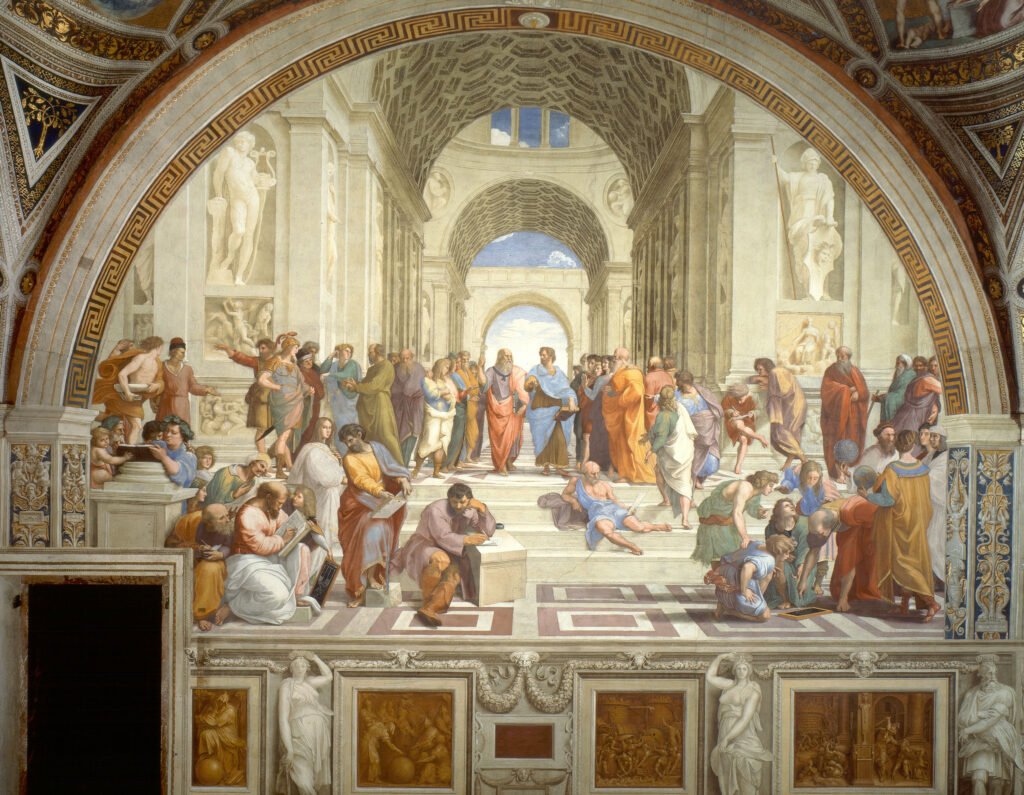
Perspective, in the visual arts, is a set of techniques for representing three-dimensional space and depth on a flat, two-dimensional surface, so that objects appear to recede into the distance the way they do to the human eye. The most influential version, linear perspective, uses converging lines and a vanishing point to create a convincing illusion of depth, and its systematic development during the early Italian Renaissance fundamentally changed how Western artists depicted the physical world.
Brunelleschi’s experiment
The architect and engineer Filippo Brunelleschi is credited with developing linear perspective as a rigorous, repeatable system in Florence around 1420. According to accounts of his famous demonstration, Brunelleschi painted a perspectivally accurate image of the Florence Baptistry using a single vanishing point on the horizon line, with orthogonal lines receding toward it. He then cut a small hole through the center of the panel and had viewers look through the hole from the back of the painting while he held a mirror in front of it, reflecting the painted image back at them; when he removed the mirror, the real Baptistry appeared in exactly the same place, convincing viewers that his systematic method could reproduce how three-dimensional space actually appears to the eye.
Alberti’s codification
Within a couple of decades of Brunelleschi’s demonstration, the architect and theorist Leon Battista Alberti wrote the treatise “On Painting,” which recorded Brunelleschi’s discovery in written form and turned it into a practical manual other artists could study and apply. Alberti’s text explained how to construct a perspectival grid, often compared to looking through a window divided into squares, giving painters a repeatable method for placing figures and objects at the correct relative size and position as they receded into pictorial space, rather than relying purely on intuition or observation.
How linear perspective works
In one-point linear perspective, all parallel lines receding away from the viewer appear to converge at a single vanishing point on the horizon, the same effect a viewer sees looking down a long, straight road or hallway. More complex compositions use two-point or three-point perspective, with two or three vanishing points respectively, to represent objects viewed at an angle rather than straight on. Objects are also drawn smaller as they recede from the viewer, following consistent proportional rules derived from the geometry of the vanishing point system, which is what allows a painted scene to convey a convincing and measurable sense of distance rather than simply implying depth loosely.
A landmark demonstration: The School of Athens
Raphael’s fresco The School of Athens, painted for the Vatican in the early sixteenth century, is one of the most widely cited demonstrations of mature Renaissance linear perspective in practice. The painting’s architectural setting, modeled on grand classical buildings, uses a single vanishing point positioned precisely between the two central figures, Plato and Aristotle, with the receding lines of the floor tiles and the architecture’s coffered arches all converging toward that point, reinforcing the composition’s sense of a vast, orderly architectural space receding into the distance behind the figures.
Before and after linear perspective
Before the Renaissance, many European and earlier artistic traditions, including medieval European art and various non-Western traditions, represented space using other conventions, such as scaling figures by importance rather than by distance, a method sometimes called hierarchical proportion, rather than by consistent geometric depth. Following its development in Florence, linear perspective spread rapidly across Italian and then broader European art, becoming a dominant convention for representing space for centuries, though it was never universally adopted; some later movements, including various strands of modern art in the nineteenth and twentieth centuries, consciously rejected strict linear perspective in favor of flattened space, multiple viewpoints, or other approaches that prioritized expressive or conceptual goals over optical realism.
Atmospheric perspective
Linear perspective is not the only technique artists use to suggest depth. Atmospheric perspective, sometimes called aerial perspective, creates a sense of distance by making objects farther from the viewer appear lighter, hazier, and bluer in tone, mimicking the way real atmospheric particles and moisture scatter light over long distances and soften the apparent color and clarity of distant mountains, buildings, or landscape features. Leonardo da Vinci wrote about this effect in his own notebooks and used it extensively in his landscape backgrounds, often combining it with linear perspective in the same composition so that a scene’s architecture recedes according to converging lines while its distant hills fade into a soft, pale blue haze, giving two complementary and physically grounded cues for depth within a single image.
Perspective beyond painting
Linear perspective’s principles extended well beyond easel painting into architecture, stage design, and later photography and film, since any medium representing three-dimensional space on a flat surface, or through a single lens, follows broadly similar geometric rules. Architectural drawings use perspective and related projection techniques to show how a proposed building will appear from a given viewpoint before construction begins, while cinematographers and photographers manipulate lens choice and camera position to control how depth and spatial relationships appear within a single flat frame, applying the same underlying principles Brunelleschi and Alberti first worked out for painted panels nearly six centuries ago.
FAQs
Did artists use any form of perspective before Brunelleschi? Scholars debate whether certain techniques approximating perspective existed in antiquity, but if any systematic method existed, the knowledge was lost; Brunelleschi’s early fifteenth-century demonstration is generally credited as the starting point for perspective as a rigorous, teachable system in Western art.
Why did some later artists deliberately abandon linear perspective? Movements such as Cubism and other strands of modern art rejected strict linear perspective because they prioritized representing multiple viewpoints, emotional expression, or the flatness of the picture plane itself over creating a convincing illusion of single-viewpoint, three-dimensional depth.
Key facts
- Developed by Filippo Brunelleschi in Florence, c. 1420
- Codified in writing by Leon Battista Alberti's treatise On Painting
- Uses one or more vanishing points on a horizon line
- Raphael's The School of Athens is a landmark demonstration
Related concepts
Quick checkWhy did some later artists deliberately abandon linear perspective?Show answer
Movements like Cubism prioritized multiple viewpoints and the flatness of the picture plane over single-viewpoint illusionistic depth.
Sources
- Smarthistory. Linear Perspective: Brunelleschi's Experiment. https://smarthistory.org/linear-perspective
Editorially reviewed by Specialty Digest Editorial TeamLast reviewed November 1, 2026Researched and drafted with AI assistanceReport an issue