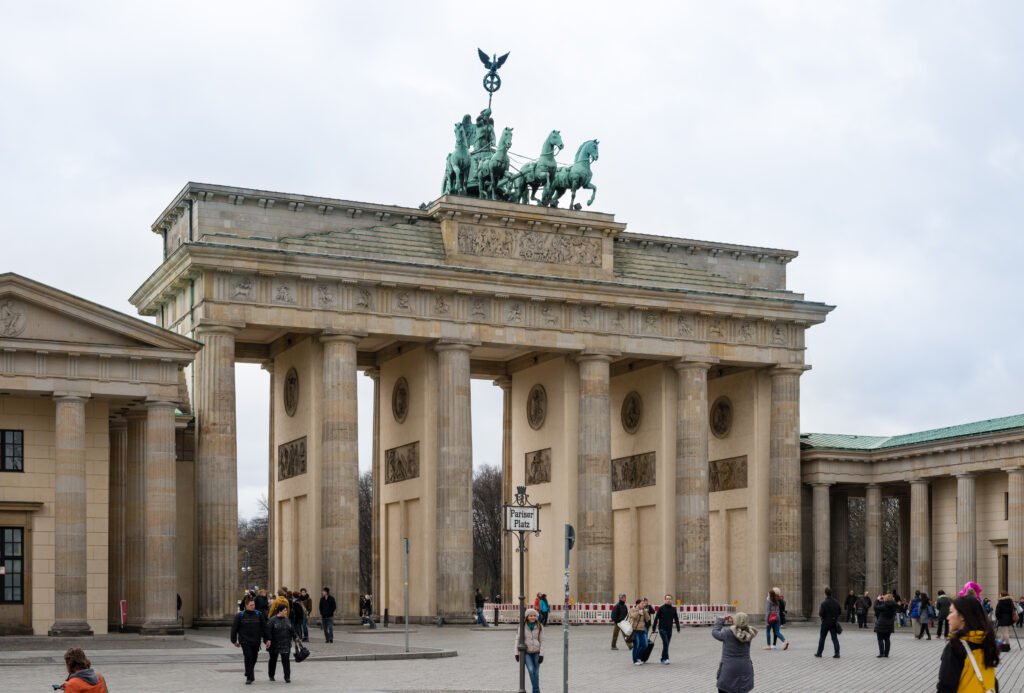
Neoclassical architecture is a style that revived the forms of ancient Greek and Roman architecture, emphasizing symmetry, simple geometric volumes, and flat wall surfaces rather than heavy ornament. It emerged in the mid-eighteenth century as a deliberate reaction against the elaborate curves and dense ornamentation of the Baroque and Rococo styles that preceded it.
Palladian roots
Much of Neoclassicism’s early vocabulary came through Palladian architecture, based on the sixteenth-century Venetian architect Andrea Palladio’s own classically inspired villas, which had already become well established in Georgian Britain by the early eighteenth century. Chiswick House, completed in 1729 near London, directly reinterpreted Palladio’s Villa Capra while stripping away much of its decorative detail, anticipating Neoclassicism’s later emphasis on restraint.
Archaeology and the Enlightenment
Neoclassicism’s rise was closely tied to new archaeological discoveries and Enlightenment rationalism. Excavations at Pompeii and Herculaneum, along with the Society of Dilettanti’s 1751 expedition to study ancient Greek sites directly, gave architects far more accurate models of classical building than earlier generations had possessed, and from around 1800 a specifically Greek Revival phase added authentically Greek forms alongside the earlier Roman-influenced Neoclassicism. Architect-theorists such as Etienne-Louis Boullee and Claude Nicolas Ledoux pushed the style toward bold, abstract geometric forms that reflected the era’s broader intellectual embrace of empirical observation and rational order.
Key buildings across Europe and America
Neoclassical landmarks spread quickly across Europe and the Americas, including the Petit Trianon at Versailles, completed in 1768; the Pantheon in Paris, completed in 1790; the Brandenburg Gate in Berlin, completed in 1791; and, in the young United States, the White House and the U.S. Capitol in Washington, D.C., whose builders deliberately chose the style to evoke the civic virtues associated with ancient Greek democracy and the Roman republic.
Reaction against Rococo
Neoclassicism positioned itself explicitly against the Rococo style’s asymmetrical curves, pastel colors, and dense surface ornament, favoring instead clearly legible geometric volumes, restrained flat facades, and an emphasis on the wall itself as a plain, orderly surface rather than a canvas for decorative light-and-shadow effects. This shift reflected a broader eighteenth-century taste for what contemporaries saw as rational clarity over what they regarded as Rococo’s excessive, even frivolous, decorative indulgence.
Legacy
Neoclassical architecture remained a dominant style for civic and governmental buildings well into the nineteenth century and continues to be used today specifically because of its strong association with order, permanence, and democratic legitimacy, making it a recurring choice for courthouses, legislatures, and national museums around the world long after its original eighteenth-century context had passed.
Regional variations
Neoclassicism took somewhat different forms in different countries. In France, the style became closely associated with the Napoleonic Empire, producing a grander, more imperial variant sometimes called Empire style, exemplified by the Arc de Triomphe. In Britain and its American colonies, Neoclassicism more often expressed republican or civic virtue rather than imperial grandeur, while in Russia, Catherine the Great promoted Neoclassical building across St. Petersburg as a way of visually aligning the Russian court with the classical learning admired across the rest of Enlightenment Europe.
Interiors and decorative arts
Neoclassicism extended well beyond building exteriors into interior design and decorative arts, where designers such as Robert Adam in Britain developed delicate, restrained ornamental schemes drawing directly on newly rediscovered Roman decorative motifs, applying the same archaeological seriousness to furniture, plasterwork, and fireplace surrounds that architects applied to building facades. This comprehensive approach meant a fully Neoclassical house could present a unified classical vision from its exterior columns down to its smallest decorative details.
Decline into eclecticism
By the mid-nineteenth century, strict Neoclassicism gradually gave way to a more eclectic Victorian-era approach that freely mixed classical elements with Gothic, Renaissance, and other historical references within a single building, as architects and patrons grew less committed to Neoclassicism’s comparatively austere archaeological correctness. Even so, Neoclassicism never entirely disappeared, periodically resurging whenever architects or governments wanted to invoke its particular associations with reason, order, and democratic legitimacy.
Neoclassicism and civic identity today
Many national capitals outside Europe and the United States also adopted Neoclassical forms for key government buildings during periods of nation-building, finding that the style’s associations with reason, order, and classical democratic tradition translated readily into a visual language for newly established states seeking international legitimacy. This continued adoption, long after the style’s original eighteenth-century European context, reflects how thoroughly Neoclassicism’s symbolic associations outlasted the specific historical circumstances that first produced it.
Notable Neoclassical architects
Beyond Boullee and Ledoux, architects including Robert Adam, John Soane in Britain, and Karl Friedrich Schinkel in Prussia each developed influential regional variations on Neoclassical design, applying its shared vocabulary of columns, pediments, and restrained ornament to projects ranging from private country houses to major public museums and government buildings across their respective countries.
Materials in Neoclassical construction
Neoclassical buildings typically favored stone, stucco over brick, and later cast iron, materials capable of producing the crisp, flat surfaces and precise geometric detail the style demanded, in contrast to the more elaborately molded plaster and carved stone surfaces favored by the preceding Baroque and Rococo styles.
FAQs
What inspired the choice of Neoclassical architecture for government buildings like the US Capitol? The style’s direct visual connection to ancient Greek democracy and the Roman republic made it an appealing symbolic choice for a new nation wanting to project civic virtue and democratic legitimacy through its public architecture.
Is Neoclassical architecture the same as Palladian architecture? They are closely related but not identical; Palladian architecture specifically follows the sixteenth-century architect Andrea Palladio’s particular classical vocabulary, while Neoclassicism is a broader later movement drawing on Palladio alongside newer archaeological knowledge of ancient Greek and Roman buildings directly.
Key facts
- Emerged in the mid-18th century as a reaction against Baroque and Rococo ornament
- Drew on Palladian architecture and new archaeological discoveries at Pompeii and Herculaneum
- The US Capitol and White House deliberately used the style to evoke democratic legitimacy
- Remains a common choice for courthouses, legislatures and national museums today
Related concepts
Quick checkWhat ancient cities' excavation helped fuel Neoclassical architecture's rise?Show answer
Pompeii and Herculaneum, whose excavations gave architects far more accurate models of ancient classical buildings.
Sources
- Wikipedia, Neoclassical architecture
- Wikipedia, Palladian architecture
- Mayfair Gallery, Neoclassical Style Guide
Editorially reviewed by Specialty Digest Editorial TeamLast reviewed November 1, 2026Researched and drafted with AI assistanceReport an issue