Baroque is the dramatic, highly ornamented style that dominated European art and architecture from roughly 1600 to the early eighteenth century, marked by intense movement, strong contrasts of light and shadow, and a theatrical sense of grandeur intended to overwhelm the viewer emotionally rather than simply please the eye. The style first took shape in Rome before spreading across Catholic Europe and, in modified form, into Protestant regions as well, eventually touching painting, sculpture, architecture, and interior decoration alike.
The Counter-Reformation and the Council of Trent
Baroque art emerged directly out of the Catholic Church’s response to the Protestant Reformation. The Council of Trent, which met in sessions between 1545 and 1563, called for religious art that moved ordinary worshippers emotionally and communicated Catholic doctrine clearly and persuasively, rejecting the cooler, more intellectualized idealism of much High Renaissance art in favor of imagery designed to produce immediate devotional feeling. Church patrons across Italy embraced this new emotional directness as a tool for reaffirming Catholic authority.
The Church of the Gesu
Rome’s Church of the Gesu, completed in 1584 as the mother church of the Jesuit order, is often cited as the first truly Baroque facade, its dynamic combination of columns, pediments, and scroll-shaped buttresses creating a dramatic play of light and shadow that later Baroque architects across Europe would imitate and elaborate. The church’s interior similarly set a template other Baroque buildings would follow, with an illusionistic ceiling fresco that appears to open directly into painted heaven above the congregation below.
Caravaggio and tenebrism
Painter Michelangelo Merisi da Caravaggio, active in Rome from the 1590s until his death in 1610, is frequently called the father of Baroque painting for developing chiaroscuro, the dramatic contrast of light and dark, into the even more extreme technique known as tenebrism, in which figures emerge from near-total darkness into sharp, isolated pools of light. Caravaggio also insisted on using ordinary, sometimes rough-looking models for religious figures, grounding sacred scenes in a startling physical realism that scandalized some patrons while profoundly influencing painters across Europe, including many who had never met him directly but studied his canvases in Rome.
Bernini and St. Peter’s
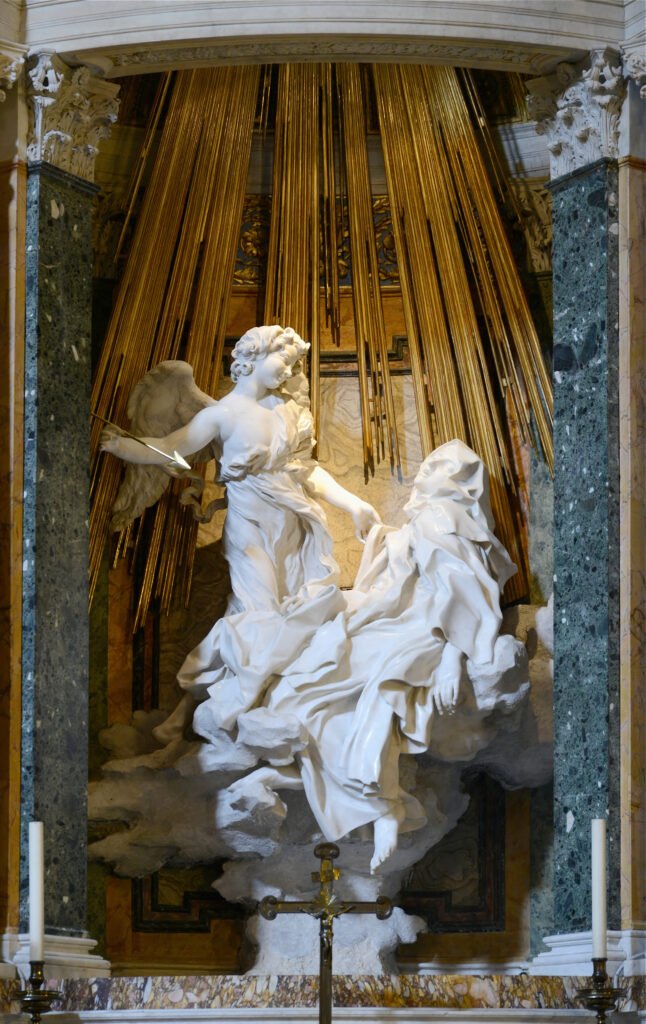
Sculptor and architect Gian Lorenzo Bernini, named chief architect of St. Peter’s Basilica in 1629, became the Baroque era’s dominant artistic figure in Rome, designing the massive bronze Baldachin that rises over the basilica’s main altar and later the sweeping colonnaded piazza in front of the church. Bernini’s sculpture group the Ecstasy of Saint Teresa, completed in 1652, exemplifies Baroque sculpture’s ambition to capture an intense, almost theatrical emotional and spiritual moment frozen in marble, using dramatic lighting and fluttering drapery carved from solid stone to heighten the sense of divine rapture.
Movement, theatricality, and illusionism
Baroque artists across media shared a common interest in dynamic diagonal composition, dramatic lighting, and illusionistic effects that blurred the boundary between painted or sculpted space and the real space a viewer occupied. Ceiling painters developed quadratura, a technique using painted architecture and perspective to make a flat ceiling appear to open upward into an impossibly deep painted sky, while trompe l’oeil effects elsewhere tricked viewers into perceiving painted objects, draperies, or figures as physically present in the room rather than rendered in paint. These techniques served the broader Baroque goal of collapsing the distance between artwork and audience.
Baroque beyond Italy
The Baroque style spread well beyond Italy, taking distinct regional forms. Flemish painter Peter Paul Rubens brought Baroque’s dynamic movement and rich color to Northern Europe in enormous, energetic canvases produced with the help of a large workshop, while Spanish painter Diego Velazquez combined Baroque drama with penetrating psychological realism in works such as Las Meninas. In France, King Louis XIV harnessed Baroque grandeur for explicitly political ends at the Palace of Versailles, using scale, mirrors, and ornament to project absolute royal power, a use of the style quite different from the devotional aims that had originally driven Baroque art in Counter-Reformation Rome.
Transition to Rococo
By around 1720, the Baroque’s weighty drama and grandeur gradually gave way to Rococo, a lighter, more playful and intimate decorative style associated with French aristocratic interiors, pastel color, and delicate asymmetrical ornamental curves. Rococo retained some Baroque theatricality but redirected it toward private pleasure, wit, and domestic comfort rather than the religious and political grandeur that had defined the Baroque at its height, and by the mid-eighteenth century it had largely displaced Baroque as Europe’s dominant decorative style.
Lasting influence
Despite giving way to Rococo and later to Neoclassicism, Baroque architecture and painting left an enduring mark on European cities, where Baroque churches, palaces, and public squares still shape the visual character of Rome, Vienna, and many other historic capitals. Art historians continue to treat the period as a pivotal moment when European art learned to engage viewers through direct emotional and physical drama rather than restrained classical idealism alone.
The Dutch Golden Age
The Dutch Republic developed a related but distinctive artistic tradition during the same period, often treated separately as the Dutch Golden Age rather than classified simply as Baroque, since Protestant Holland lacked the Catholic Church’s patronage driving Baroque art elsewhere in Europe. Painters including Rembrandt van Rijn and Johannes Vermeer shared Baroque painting’s interest in dramatic light and shadow while applying it to intimate domestic scenes, portraits, and still lifes rather than the grand religious and mythological subjects favored in Rome.
FAQs
What makes Caravaggio important to Baroque painting? Caravaggio developed tenebrism, an extreme form of light-and-dark contrast, and used realistic, often rough-looking models for religious figures, establishing a dramatic, physically grounded style that influenced painters across Baroque Europe.
How does Baroque differ from Rococo? Baroque emphasizes weighty drama, religious and political grandeur, and intense contrast, while the later Rococo style that emerged around 1720 favored lighter, more playful ornament suited to private aristocratic interiors.
Key facts
- The Council of Trent (1545-63) called for emotionally direct religious art
- The Church of the Gesu (1584) is often called the first truly Baroque facade
- Caravaggio developed tenebrism, an extreme form of chiaroscuro
- Bernini became chief architect of St. Peter's Basilica in 1629
- Baroque gave way to the lighter Rococo style around 1720
Related concepts
Quick checkWhat Church reform movement helped give rise to the Baroque style?Show answer
The Counter-Reformation, formalized at the Council of Trent (1545-63), which called for emotionally direct religious art.
Sources
- Britannica, Baroque art and architecture
- The Art Story, Baroque Art Movement Overview
- Smarthistory, Baroque art in Italy
Editorially reviewed by Specialty Digest Editorial TeamLast reviewed November 1, 2026Researched and drafted with AI assistanceReport an issue