Pop art is an art movement that emerged in the mid-1950s and flourished through the 1960s, drawing its imagery directly from mass consumer culture, advertising, comic books, and celebrity, deliberately blurring the line between fine art and the commercial visual world that surrounded ordinary postwar life.
British origins
The movement’s first widely recognized milestone is generally considered to be Richard Hamilton’s 1956 collage Just What Is It That Makes Today’s Homes So Different, So Appealing?, created for the catalogue and poster of the This Is Tomorrow exhibition in London. Built entirely from clippings taken from American magazines, including a bodybuilder, a vacuum cleaner, a television, and a movie poster, the collage directly depicted the era’s new consumer abundance rather than commenting on it from a traditional artistic distance. Hamilton worked as part of London’s Independent Group, a circle of artists and critics who had begun seriously discussing mass media and consumer imagery as legitimate subjects for art years before the term pop art became widely used.
Warhol and the soup cans
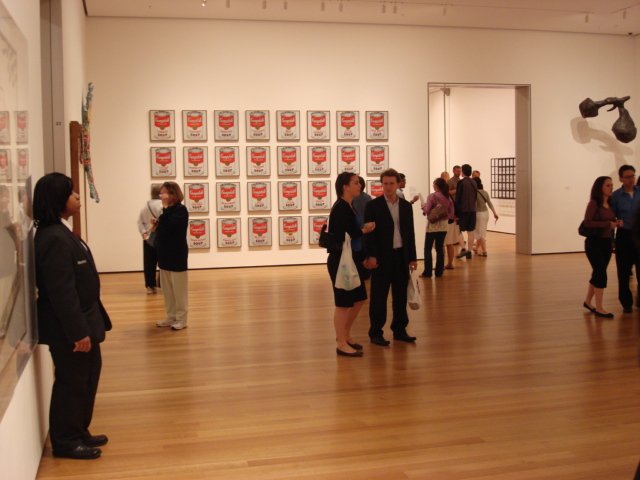
American artist Andy Warhol became Pop Art’s most recognizable figure with his Campbell’s Soup Cans, a set of thirty-two canvases, one for each variety the company sold, painted in late 1961 and first exhibited in 1962 at the Ferus Gallery in Los Angeles. The canvases were displayed in a single row on narrow shelf-like ledges, deliberately echoing a supermarket shelf, and although only a handful sold at the time, dealer Irving Blum later purchased the complete set; the Museum of Modern Art eventually acquired it for the collection in 1996. Warhol ran his New York studio, known as the Factory, as a semi-industrial operation, producing silkscreen prints in multiples that mimicked the repetitive branding and mass manufacture the paintings themselves depicted.
Lichtenstein and comic-book imagery
Roy Lichtenstein became equally associated with the movement through paintings that enlarged and reproduced comic-book panels, deliberately replicating the visible dot patterns of commercial printing technology within fine-art paintings, collapsing the usual distinction between a mass-produced image and an original artwork.
British versus American Pop Art
British Pop Art tended to approach American consumer imagery with an ironic, somewhat distanced curiosity, examining it as an imported cultural phenomenon, while American Pop Art, working from inside that same consumer culture, engaged more directly and matter-of-factly with its own advertising, branding, and celebrity imagery.
Legacy
Pop Art’s deliberate embrace of commercial and mass-media imagery permanently widened what counted as acceptable subject matter for serious art, directly influencing later movements including Neo-Pop and much of contemporary art’s continued engagement with branding, celebrity, and consumer culture.
Claes Oldenburg and soft sculpture
American sculptor Claes Oldenburg extended Pop Art’s consumer-culture imagery into three dimensions, creating oversized soft sculptures of everyday objects such as hamburgers, typewriters, and clothespins, translating the movement’s fascination with ordinary mass-produced goods into a tactile, often humorously oversized physical form.
James Rosenquist and billboard-scale painting
Painter James Rosenquist, who had worked professionally painting billboard advertisements before turning to fine art, brought that commercial billboard scale and fragmented, overlapping composition directly into large Pop Art paintings, combining disparate consumer and media images within a single sprawling canvas.
Pop Art exhibitions and institutional recognition
Major museum exhibitions through the 1960s, including shows in New York and London, helped move Pop Art from a provocative curiosity into a critically recognized movement, even as some critics continued to question whether work drawing so directly on advertising and mass media deserved serious artistic consideration.
Commercial and advertising crossover
Pop Art’s relationship with advertising ran in both directions: just as Pop artists borrowed directly from commercial visual language, advertisers and later graphic designers borrowed back from Pop Art’s bold color, flattened forms, and ironic consumer imagery, blurring the boundary between fine art and commercial design that the movement had first called into question.
Women and Pop Art
Although men including Warhol, Lichtenstein, and Hamilton dominated the movement’s early critical reception, women artists such as Pauline Boty in Britain also produced significant Pop Art work engaging with celebrity and consumer imagery, work that received considerably less contemporary recognition and has only more recently been reassessed by art historians.
Pop Art’s lasting market presence
Works by leading Pop artists, particularly Warhol, have since become some of the most commercially valuable paintings of the twentieth century at auction, a market success that itself illustrates the movement’s original argument that commercial value and artistic value need not be treated as opposites.
Pop Art and architecture
Pop Art’s playful embrace of bold color, oversized scale, and popular imagery also influenced architecture and interior design during the 1960s, encouraging a lighter, more irreverent visual sensibility that stood in deliberate contrast to the austere seriousness of strict modernist design.
Pop Art merchandise and reproduction
Pop Art imagery has been reproduced extensively on posters, clothing, and other merchandise, a form of mass-market circulation that, fittingly, extends the movement’s original fascination with repetition and mass production into the ongoing commercial afterlife of its own best-known images.
FAQs
What makes Richard Hamilton’s 1956 collage historically important? It is widely regarded as the first widely recognized work of Pop Art, built from clippings of American consumer imagery that directly represented, rather than commented on from a distance, the era’s new mass consumer culture.
Why did Andy Warhol paint thirty-two Campbell’s Soup Cans? He painted one canvas for each soup variety the company sold at the time, using repetition and uniform presentation to echo the mass production and branding of the product itself.
Key facts
- Richard Hamilton's 1956 collage is widely considered the movement's first iconic work
- Andy Warhol's 32 Campbell's Soup Cans (1961-62) echoed supermarket branding and repetition
- Roy Lichtenstein enlarged comic-book panels and printing dot patterns into fine art
- British Pop Art approached consumer imagery ironically; American Pop Art engaged it more directly
Related concepts
Quick checkWhat kind of imagery did Pop Art draw on?Show answer
Mass consumer culture, advertising, comic books, and celebrity imagery.
Sources
- Wikipedia, Just What Is It That Makes Today's Homes So Different, So Appealing?
- Wikipedia, Campbell's Soup Cans
Editorially reviewed by Specialty Digest Editorial TeamLast reviewed November 1, 2026Researched and drafted with AI assistanceReport an issue