Sculpture is the art of creating three-dimensional works by carving, modeling, casting, or assembling material into a shape meant to be experienced in physical space rather than on a flat surface. Because a sculpture occupies real volume, viewers typically can walk around it and view it from multiple angles, a spatial quality unique among the major visual arts.
Carving and modeling
Carving is a subtractive process in which a sculptor removes material, usually stone or wood, cutting away larger masses first before refining smaller forms and finally finishing the surface, a sequence that applies regardless of the material used. Modeling works in the opposite direction, building a form up from a soft, pliable material such as clay or wax that the sculptor adds to and reshapes directly by hand, often as a preliminary step toward casting a more permanent version in metal.
Casting and assembly
Casting creates a sculpture by pouring a liquid material, most commonly bronze, into a mold taken from an original model, allowing a single design to be reproduced as a durable, detailed multiple. Assembly, sometimes called construction, joins separate pieces of material, which may include found or manufactured objects rather than material shaped specifically for the artwork, into a single finished sculpture.
From ancient idealism to Renaissance naturalism
Ancient Egyptian sculpture favored a rigid, frontal pose repeated across centuries of royal and religious statuary, prioritizing a consistent, formulaic representation of the human figure over individualized naturalism. Classical Greek sculptors broke from that formula by developing contrapposto, a relaxed stance in which a figure’s weight shifts onto one leg, a seemingly small adjustment that introduced a far more lifelike sense of movement and anatomical ease into standing figures. Centuries later, Renaissance sculptor Michelangelo famously described his process as liberating a figure he believed already existed within a block of marble, extending carving’s ancient subtractive logic into a celebrated artistic philosophy.
Rodin and the move toward modern sculpture
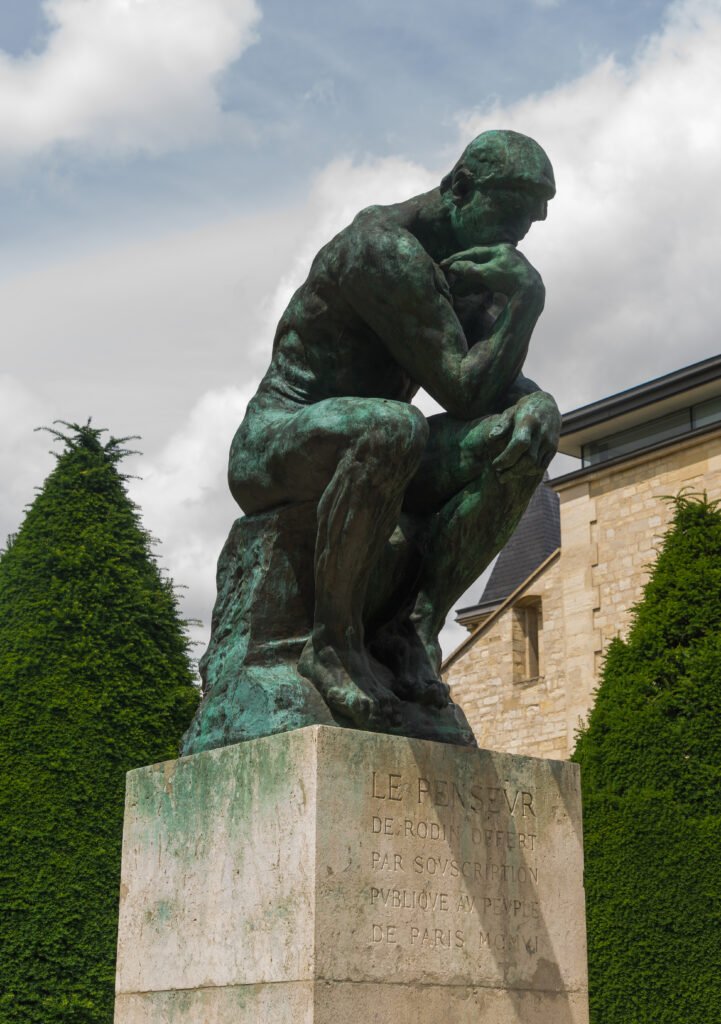
French sculptor Auguste Rodin broke decisively from the smooth, idealized finish favored by official nineteenth-century academic sculpture, giving works such as The Thinker a rough, visibly worked surface that emphasized emotional and physical intensity over polished perfection. Rodin’s expressive departure from academic convention is widely considered a pivotal opening toward the far more radical experiments that would follow in twentieth-century sculpture.
Duchamp and the readymade
Marcel Duchamp pushed sculpture’s boundaries further still beginning around 1914 by designating ordinary manufactured objects, which he called readymades, as artworks simply through his own act of selection rather than any physical shaping on his part. His 1917 readymade Fountain, an ordinary urinal signed with the pseudonym ‘R. Mutt,’ was submitted to a New York exhibition and kept from public view amid controversy, becoming one of the most influential and widely debated gestures in the history of modern art precisely because it questioned what made an object a sculpture at all. Duchamp produced only around a dozen readymades across three decades, yet their influence on later conceptual and assemblage art has been enormous.
Monumental and public sculpture
Sculpture has long served public and civic purposes beyond the gallery, from ancient commemorative statues of rulers to twentieth and twenty-first century monumental and site-specific works designed for parks, plazas, and public buildings, where scale and surrounding architecture become as central to the work’s effect as the material itself.
Materials across history
Sculptors have worked in an enormous range of materials over time, including stone such as marble and granite, wood, clay, wax, plaster, bronze and other metals, and, more recently, synthetic materials such as plastic and fiberglass, each offering different advantages in durability, cost, and the kind of surface detail or color a sculptor can achieve.
Relief sculpture
Not all sculpture stands fully independent in space; relief sculpture remains partially attached to a flat background, projecting outward from it to varying degrees, from the barely raised surfaces of low relief to the deeply undercut forms of high relief, a format long used for architectural ornament, commemorative plaques, and narrative friezes.
Kinetic and installation sculpture
Twentieth-century sculptors expanded the medium further still with kinetic sculpture, which incorporates actual movement, whether driven by motors, wind, or a viewer’s own touch, and with large-scale installation work that invites a viewer to move through or around an entire constructed environment rather than viewing a single discrete object from without.
Sculpture conservation
Because sculpture is physically exposed to weather, pollution, and simple wear in a way many paintings are not, conservators face ongoing challenges protecting outdoor bronze and stone sculpture from corrosion and erosion, often requiring specialized cleaning, protective coatings, and periodic structural repair to keep historic public monuments stable and legible for future viewers.
Sculpture and scale
Sculptors work across an enormous range of scale, from small, intimately handled objects meant to be held or viewed up close to colossal public monuments visible from a considerable distance, and that choice of scale shapes nearly every other decision about material, technique, and installation a sculptor makes.
FAQs
What is the difference between carving and modeling? Carving removes material from a solid block, such as stone or wood, while modeling builds a form up from a soft, pliable material such as clay, usually working toward a final cast version.
Why is Duchamp’s Fountain considered important to modern sculpture? By designating an ordinary manufactured urinal as an artwork simply through his own selection, Duchamp challenged the basic assumption that a sculpture had to be physically shaped by the artist, influencing much later conceptual art.
Key facts
- Carving is subtractive; modeling is additive
- Contrapposto, developed by Classical Greek sculptors, introduced lifelike weight-shifted posture
- Rodin's rough, expressive surfaces opened the way to modern sculpture
- Duchamp's readymades (from 1914) designated manufactured objects as art
Related concepts
Quick checkWhat is the key difference between carving and casting as sculptural techniques?Show answer
Carving removes material from a solid block, while casting reproduces a form by pouring liquid material, usually bronze, into a mold.
Sources
- Britannica, Sculpture
- Wikipedia, Readymades of Marcel Duchamp
- Wikipedia, Fountain (Duchamp)
Editorially reviewed by Specialty Digest Editorial TeamLast reviewed November 1, 2026Researched and drafted with AI assistanceReport an issue