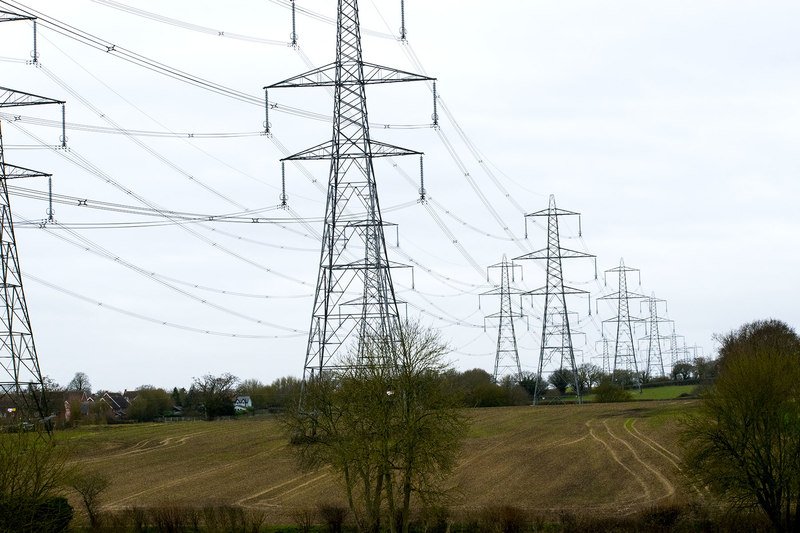
The power grid is the interconnected network of generating stations, transmission lines, substations, and distribution wires that produces electricity and delivers it to homes, businesses, and factories. Grids operate as a continuously balanced system: the amount of electricity generated at any instant must closely match the amount being consumed, since electricity cannot be stored in large quantities as easily as other forms of energy, which makes grid operation a constant, real-time balancing act performed by control centers monitoring the system around the clock.
Generation, Transmission, and Distribution
A power grid is typically divided into three layers. Generation happens at power plants, which may burn fossil fuels, split atoms in a nuclear reactor, or capture energy from wind, sunlight, or flowing water. Transmission moves that electricity over long distances at very high voltages, often hundreds of thousands of volts, because higher voltage reduces the energy lost as heat along the way. Distribution then takes over closer to the end user, stepping voltage down through transformers in stages until it reaches a level safe for homes and businesses, typically delivered through local poles and underground cables.
Why Grids Must Stay Balanced
Alternating current grids run at a precise frequency, 50 or 60 hertz depending on the region, and that frequency only stays stable when generation and demand are closely matched second by second. If demand suddenly exceeds supply, frequency drops; if supply exceeds demand, frequency rises, and large deviations in either direction can damage equipment or trigger automatic protective shutdowns. Grid operators use forecasting tools to predict demand hours and days in advance, scheduling power plants to come online or ramp down accordingly, while some plants are kept in reserve specifically to respond within seconds to unexpected swings.
Grid Interconnection and Reliability
Most countries link individual utilities into larger interconnected grids, allowing electricity to flow across regions so that a shortfall in one area can be covered by surplus generation elsewhere. This interconnection improves reliability but also means that a serious disturbance, such as a major equipment failure or storm damage, can cascade across a wider area if not contained quickly, which is why grid operators maintain extensive protective relaying systems designed to isolate faults before they spread. Blackouts are rare in developed grids but draw intense scrutiny when they occur precisely because so much depends on continuous electricity supply.
The Rise of the Smart Grid
Traditional grids were built to send power in one direction, from large centralized plants to passive consumers, but the growth of rooftop solar panels, home batteries, and electric vehicles has introduced two-way power flows that older grid designs were not built to handle. Smart grid technology adds digital sensors, communication networks, and automated controls throughout the system, allowing operators to detect problems faster, manage distributed generation from thousands of small sources, and give consumers more detailed information about their own electricity use through smart meters.
Integrating Renewable Energy
Wind and solar power generate electricity only when the wind blows or the sun shines, introducing variability that grid operators did not need to manage as heavily when fossil fuel and nuclear plants, which can run continuously, dominated generation. Grids accommodate this variability through a combination of energy storage, such as large batteries and pumped hydroelectric storage facilities, demand response programs that pay consumers to shift usage away from peak periods, and maintaining flexible backup generation that can ramp up quickly when renewable output drops.
History of Grid Development
Early electrical systems in the late nineteenth century served small, isolated areas around individual power plants, with Thomas Edison’s direct current systems and George Westinghouse’s alternating current systems competing for dominance in what became known as the War of the Currents. Alternating current eventually prevailed because it could be transmitted efficiently over long distances at high voltage, enabling the large interconnected regional and national grids that developed through the twentieth century as electricity demand grew alongside industrialization and household electrification.
Modern Challenges and Investment Needs
Much of the transmission and distribution infrastructure in older industrialized countries was built decades ago and now requires significant investment to replace aging equipment, strengthen defenses against extreme weather, and expand capacity for growing electricity demand from data centers and electric vehicle charging. Cybersecurity has also become a major concern, since grids increasingly rely on digital control systems that could be targeted by attackers, pushing utilities and regulators to treat grid security as seriously as the physical reliability engineers have long focused on. Many of these upgrades are expensive and slow to complete, since new transmission lines often require years of permitting and negotiation with landowners and communities before construction can even begin, a pace that has become a genuine bottleneck for connecting new wind and solar projects to the grid.
FAQs
Why is electricity transmitted at high voltage?
Transmitting electricity at high voltage reduces the current needed to deliver the same amount of power, which sharply cuts the energy lost as heat in transmission lines over long distances, a relationship that explains why transmission lines are strung so high above the ground on tall towers and why their voltage is stepped down gradually rather than all at once.
What makes a smart grid different from a traditional grid?
A smart grid adds digital sensors, two-way communication, and automated controls that let operators manage distributed generation and respond to problems far faster than a traditional one-way grid built only to send power outward from centralized plants.
Editorially reviewed by Specialty Digest Editorial TeamLast reviewed November 2, 2026Researched and drafted with AI assistanceReport an issue