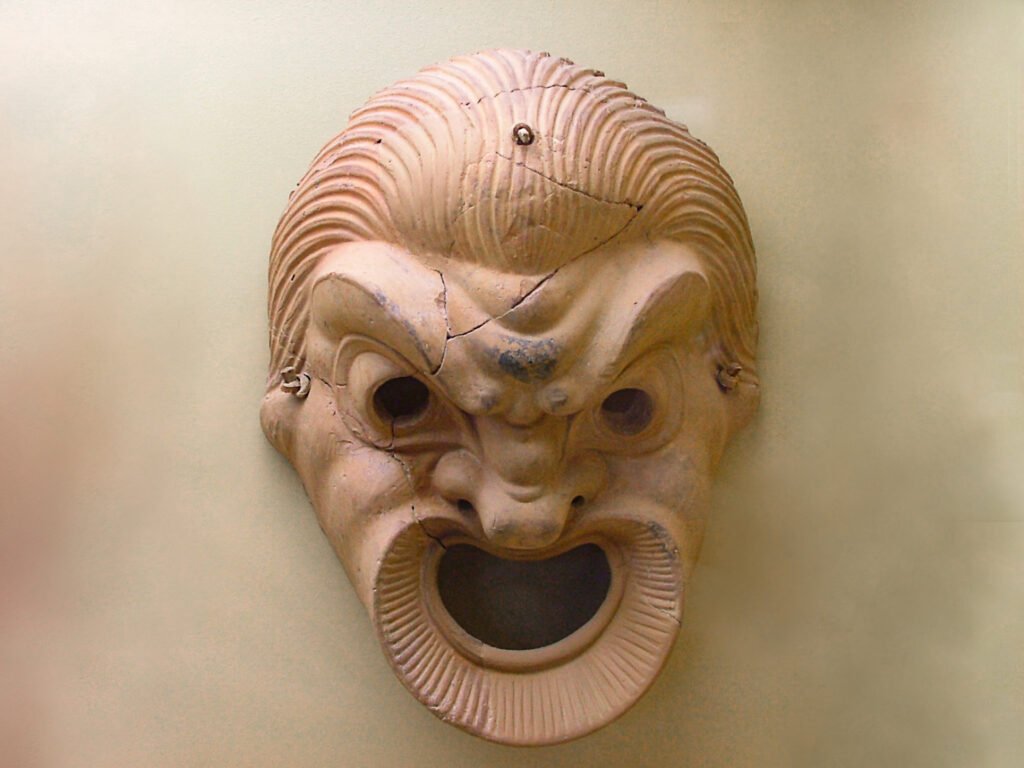
Tragedy is a genre of drama, and by extension a broader literary mode, that depicts the serious downfall of a central character, traditionally a person of high status, through a combination of personal failing, circumstance, and forces beyond their full control, producing an outcome that is sorrowful but also meant to provoke deep reflection in the audience. The genre originated in ancient Greece, where tragic plays were performed at religious festivals and competitions, and the surviving works of playwrights such as Sophocles, Aeschylus, and Euripides remain the foundational texts for how tragedy has been understood and theorized ever since.
The philosopher Aristotle, in his Poetics, offered one of the earliest and most influential analyses of tragedy, arguing that a well-constructed tragedy should provoke catharsis, a purging or emotional release of pity and fear in the audience, through a plot built around a protagonist’s hamartia, often translated as a tragic flaw or error in judgment, that sets a chain of events toward downfall in motion. Although later critics have challenged or refined various parts of Aristotle’s framework, his emphasis on plot structure, the protagonist’s error, and the emotional effect on an audience remains a standard starting point for discussing how tragedy works and continues to shape how critics analyze dramatic structure today.
The Tragic Hero and the Question of Fate
A central feature of most tragedies is the tragic hero, a protagonist whose admirable qualities, such as ambition, courage, or pride, become entangled with a flaw or error that contributes directly to their downfall. In Sophocles’s Oedipus Rex, Oedipus’s relentless pursuit of truth, itself a virtue, leads him inexorably to the devastating discovery of his own hidden past. Shakespeare’s tragedies, including Hamlet, Macbeth, and King Lear, adapted this basic structure for the English Renaissance stage, often combining personal flaws, such as Macbeth’s ambition or Lear’s pride, with political intrigue and supernatural elements largely absent from the more austere conventions of Greek tragedy. A recurring tension in tragic drama is the question of how much a character’s downfall results from their own choices versus forces of fate, divine will, or circumstance beyond their control, and different tragedies strike this balance quite differently, often reflecting the particular religious and philosophical assumptions of the culture that produced them.
Tragedy Beyond the Stage
While tragedy originated as a dramatic genre meant for performance, the term and its core concerns have extended well beyond the theater into novels, film, and even everyday language, where a “tragic” outcome generally implies serious, often irreversible loss combined with some element of human responsibility or missed opportunity rather than pure accident or misfortune. Literary critics distinguish tragedy from related but distinct modes such as melodrama, which emphasizes sensational plot and exaggerated emotion over the deeper moral and psychological complexity tragedy traditionally aims for, and from simple misfortune narratives that lack tragedy’s characteristic entanglement of a character’s own choices and responsibility with their eventual downfall.
Modern Tragedy and the Common Man
Tragedy evolved considerably as it moved into the modern era, and one of the most significant shifts concerned the social status of its protagonists. Classical and Renaissance tragedy had generally focused on kings, nobles, and other figures of high social standing, on the theory that their downfall carried greater weight and implication for an entire community or kingdom. In the twentieth century, playwrights such as Arthur Miller argued forcefully that ordinary people could serve as tragic protagonists just as effectively, a claim he put into practice with Death of a Salesman, whose protagonist Willy Loman is an aging, unsuccessful traveling salesman rather than a prince or general. Miller contended that the common man is as apt a subject for tragedy as kings were, since what matters is the intensity of the character’s struggle and the seriousness of what is at stake for them personally, not their inherited social rank or title.
Tragic conventions and concerns also appear well outside the Western theatrical tradition that produced Aristotle’s framework. Sanskrit dramatic theory, for instance, developed its own distinct classification of dramatic moods and effects that does not map neatly onto the Aristotelian idea of catharsis at all, while many oral and literary traditions across Africa and Asia explore downfall, loss, and moral reckoning through narrative structures shaped by their own cultural and religious frameworks rather than imported Greek categories, often with their own distinct terminology for the emotional and moral effects such stories are meant to produce. Comparative literary scholars increasingly caution against treating the Aristotelian model as a universal definition of tragic storytelling rather than one influential framework among several distinct traditions.
FAQs
What is a tragic flaw, or hamartia?
An error in judgment or character flaw in the protagonist that sets in motion the chain of events leading to their downfall, a concept central to Aristotle’s analysis of tragedy.
What did Aristotle mean by catharsis?
A purging or emotional release of pity and fear that a well-constructed tragedy is meant to provoke in its audience through the protagonist’s suffering and downfall.
How do Shakespeare’s tragedies differ from ancient Greek tragedy?
Shakespeare combined personal flaws with political intrigue and supernatural elements, such as ghosts and prophecy, that were largely absent from the more tightly structured plots of Greek tragedy.
How is tragedy different from melodrama?
Melodrama emphasizes sensational plot and exaggerated emotion, while tragedy traditionally aims for deeper moral and psychological complexity in how a character’s own choices entangle with their downfall.
Key facts
- Originated in ancient Greece with playwrights such as Sophocles and Euripides.
- Aristotle's Poetics introduced the concepts of catharsis and hamartia (tragic flaw).
- Shakespeare's tragedies added political intrigue and supernatural elements to the form.
- Arthur Miller argued ordinary people, not only nobles, could be tragic protagonists.
In the news
Quick checkWhat is catharsis, and why did Aristotle consider it central to tragedy?Show answer
Catharsis is the purging or emotional release of pity and fear that Aristotle argued a well-constructed tragedy should provoke in its audience through the protagonist's suffering and downfall.
Sources
- Aristotle, Poetics
- Encyclopaedia Britannica, 'tragedy'
- Arthur Miller, 'Tragedy and the Common Man' (essay)
Editorially reviewed by Specialty Digest Editorial TeamLast reviewed November 2, 2026Researched and drafted with AI assistanceReport an issue