Logic is the systematic study of valid reasoning, concerned with identifying which patterns of inference reliably lead from true premises to true conclusions and which patterns, despite sometimes feeling persuasive, do not. As a branch of philosophy with deep connections to mathematics and, more recently, computer science, logic provides tools for evaluating whether an argument’s conclusion genuinely follows from its premises, independent of whether the premises or conclusion happen to be true in any particular case.
The foundational distinction in logic is between an argument’s validity and the truth of its premises. A valid argument is one in which the conclusion must be true whenever all the premises are true, regardless of what those premises actually claim, while a sound argument is a valid argument whose premises are also, in fact, true. This distinction matters because an argument can be perfectly valid in its logical structure while still being unpersuasive or even false in its conclusion, simply because one or more of its starting premises turns out to be factually mistaken.
Aristotle and the Syllogism
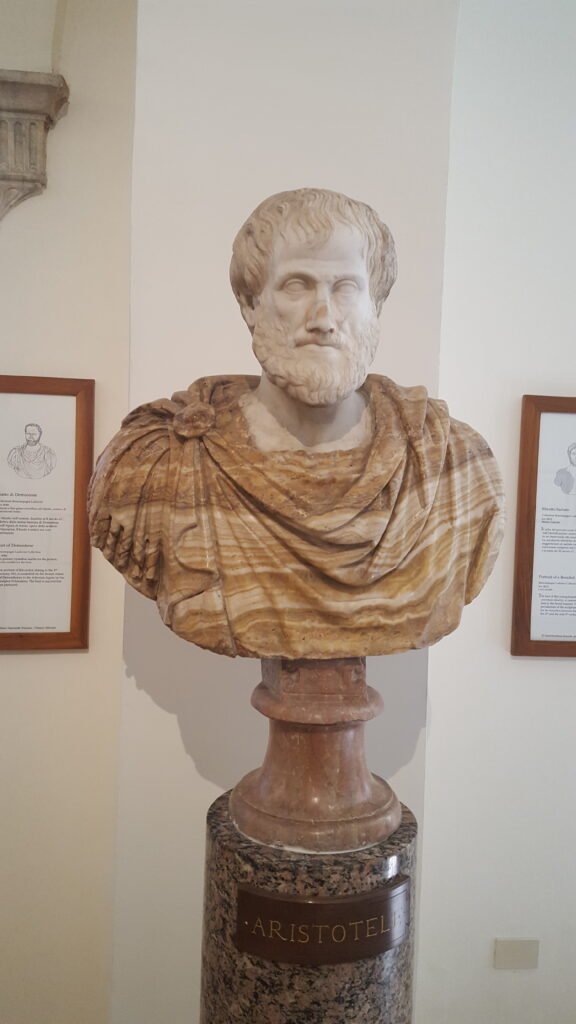
Aristotle is traditionally credited as the founder of formal logic in the Western tradition, primarily through his systematic study of the syllogism, a form of argument built from two premises and a conclusion, such as the classic example that all humans are mortal, Socrates is human, and therefore Socrates is mortal. Aristotle’s logical works, later grouped together as the Organon, dominated Western logical thought for roughly two thousand years, and his basic framework for classifying valid argument forms remained the standard reference point until the development of modern symbolic logic in the nineteenth and twentieth centuries.
Deductive and Inductive Reasoning
Logic distinguishes between deductive and inductive reasoning as two fundamentally different ways arguments can support their conclusions. Deductive reasoning aims for certainty, where a valid deductive argument guarantees its conclusion given true premises, as in mathematical proofs or the syllogism above. Inductive reasoning, by contrast, draws general conclusions from specific observations or patterns, such as concluding that the sun will rise tomorrow because it always has before, and such conclusions are probable rather than certain, since even a large number of consistent observations cannot logically guarantee that a pattern will continue to hold.
Modern Symbolic Logic
Beginning in the nineteenth century, logicians including George Boole and later Gottlob Frege developed symbolic logic, which represents logical relationships using precise mathematical notation rather than ordinary language, allowing for far more rigorous analysis of complex arguments than Aristotle’s syllogistic framework could easily handle. This development connected logic closely to the foundations of mathematics and, through the twentieth-century work of figures such as Alan Turing, to the theoretical basis of modern computer science, since digital computers fundamentally operate by executing long chains of logical operations on binary values.
Common Logical Fallacies
Logic also provides a vocabulary for identifying common fallacies, which are patterns of reasoning that appear persuasive but fail to establish their conclusions validly. These include the ad hominem fallacy, attacking a person’s character or motives instead of the substance of their argument, the straw man fallacy, deliberately misrepresenting someone’s actual position to make it easier to attack, and the slippery slope fallacy, assuming without adequate justification that one small initial step will inevitably lead to a chain of increasingly extreme and undesirable consequences. Recognizing these recurring patterns is a core, highly practical application of logic in everyday argument, debate, and critical evaluation of claims.
Logical Traditions Beyond Aristotle
While Aristotle’s syllogistic logic dominated Western philosophy for centuries, sophisticated traditions of formal reasoning developed independently in other parts of the world well before and alongside it. In ancient India, the Nyaya school developed a detailed theory of inference built around a five-part argument structure and careful analysis of valid versus invalid sources of knowledge, debated extensively alongside rival Buddhist and Jain logical traditions over many centuries. In ancient China, the Mohist school, associated with the philosopher Mozi and his later followers, developed its own systematic analysis of argumentation, naming, and valid inference, addressing many of the same basic questions about sound reasoning that occupied Greek philosophers, though largely independently and using very different technical vocabulary.
These non-Western logical traditions were not simply early or incomplete versions of what Aristotle later formalized. Each developed its own distinct concerns, such as the Nyaya school’s sustained interest in the reliability of perception and testimony as sources of knowledge, or Mohist debates over the proper use of names and categories in argument, that reflect the particular philosophical and religious questions those traditions were most invested in resolving within their own cultural and intellectual contexts.
FAQs
What is the difference between a valid and a sound argument?
A valid argument’s conclusion must be true whenever its premises are true, regardless of content. A sound argument is a valid argument whose premises are also actually true.
What is a syllogism?
A form of argument, central to Aristotle’s logic, built from two premises and a conclusion, such as: all humans are mortal, Socrates is human, therefore Socrates is mortal.
How does deductive reasoning differ from inductive reasoning?
Deductive reasoning guarantees its conclusion given true premises, while inductive reasoning draws probable, not certain, general conclusions from specific observations or patterns.
Why is logic connected to computer science?
Digital computers operate by executing chains of logical operations on binary values, a connection made explicit through the development of symbolic logic and the work of figures such as Alan Turing.
Key facts
- Aristotle's syllogism dominated Western logic for roughly two thousand years.
- A valid argument's conclusion follows necessarily; a sound argument is also true in its premises.
- Deductive reasoning aims for certainty; inductive reasoning yields probable conclusions.
- The Nyaya school in India and the Mohist school in China developed independent logical traditions.
In the news
- HistoryThis Day in History, October 25: Henry V’s Outnumbered Army Wins at Agincourt
- ScienceOccam’s Razor: The Simplicity Principle That Guides Scientific Discovery
- BusinessWhy Are Central Banks Independent From Governments?
- BusinessHow Do Regulators Decide a Company Is Too Powerful?
- SocietyWhy Do Some Countries Use Fahrenheit Instead of Celsius?
Quick checkWhat is the difference between a valid argument and a sound argument?Show answer
A valid argument's conclusion must be true whenever its premises are true, regardless of content. A sound argument is a valid argument whose premises are also actually true.
Sources
- Aristotle, Organon
- Encyclopaedia Britannica, 'logic'
- Stanford Encyclopedia of Philosophy, 'Logic and Ontology' and related entries
Editorially reviewed by Specialty Digest Editorial TeamLast reviewed November 2, 2026Researched and drafted with AI assistanceReport an issue