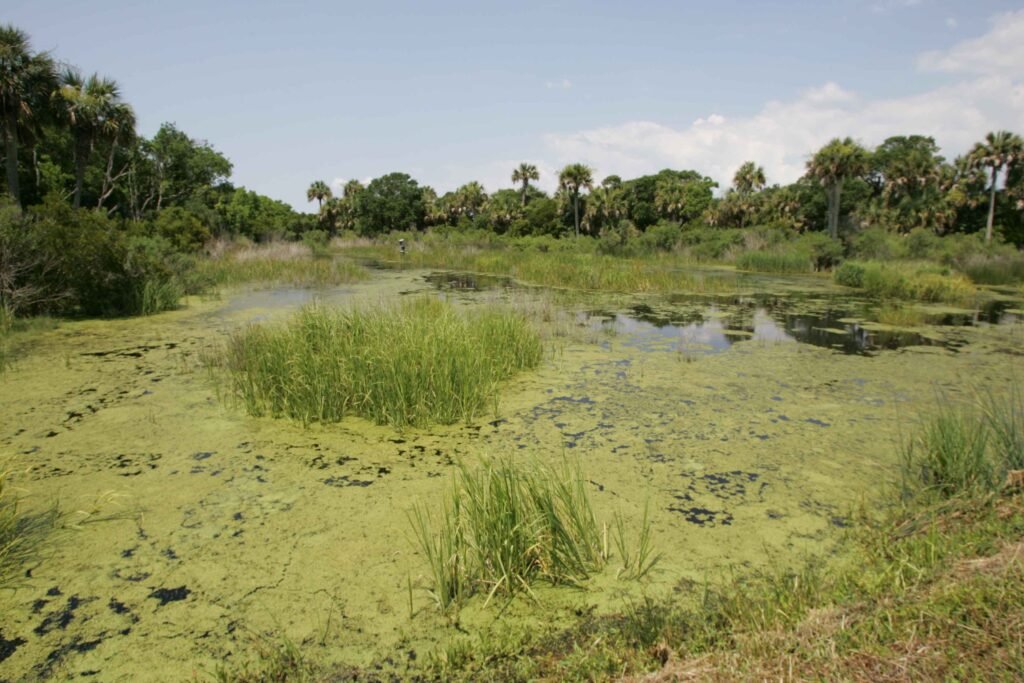
A wetland is land where water covers the soil, or saturates it close to the surface, for all or part of the year, creating conditions distinct enough from both dry land and open water to support their own characteristic plants, soils, and animal life. Marshes, swamps, bogs, fens, and many floodplains and river deltas all fall under the broad umbrella of wetlands, even though they differ considerably in water chemistry, vegetation, and how permanently they stay wet.
Types of wetlands
Marshes are wetlands dominated by soft-stemmed, grasslike plants growing in mineral-rich soil, and they can be freshwater or, near coastlines, tidal and salt-influenced. Swamps are distinguished mainly by woody vegetation, meaning trees or shrubs rather than grasses, growing in standing or slow-moving water. Bogs accumulate partially decayed plant material as peat in acidic, nutrient-poor water that is fed mainly by rainfall rather than groundwater or rivers, which supports a distinctive community of mosses and specialized plants adapted to those harsh conditions. Fens are similarly peat-forming but, unlike bogs, are fed by mineral-rich groundwater, giving them less acidic conditions and generally greater plant diversity. Coastal wetlands, including tidal marshes and mangrove forests, add another dimension entirely, since they must tolerate regular flooding by salt or brackish water.
Ecosystem services wetlands provide
Wetlands act as natural water filters, trapping sediment and absorbing excess nutrients before they reach rivers, lakes, or the ocean, which is one reason restored or constructed wetlands are sometimes used deliberately to treat polluted runoff. They also function as natural flood control, since their soils and vegetation can absorb and temporarily store large volumes of water during heavy rain or snowmelt, reducing peak flows downstream and lowering the risk of damaging floods for communities further along a given river system. Many wetlands, particularly peat-forming bogs and fens, store large amounts of carbon in their waterlogged soils, where slow decomposition locks organic matter away far longer than it would persist in drier soil. Wetlands are additionally disproportionately important for biodiversity relative to their land area, serving as breeding grounds, nurseries, and migratory stopover sites for an enormous range of birds, fish, amphibians, and invertebrates.
Global wetland loss
Wetlands have been drained and converted to farmland, urban development, and other uses more aggressively than almost any other habitat type. A 2014 review of 189 reports on wetland change, published in the journal Marine and Freshwater Research, estimated that the world has lost an average of 54 to 57 percent of its natural wetlands since around 1700, with losses possibly as high as 87 percent by some estimates. The same review found that the pace of loss accelerated sharply over the twentieth and early twenty-first centuries, running roughly 3.7 times faster than the long-term historical average and pushing cumulative losses since 1900 alone to an estimated 64 to 71 percent. Inland wetlands have generally been lost faster than coastal ones, loss rates in Europe and North America have slowed in recent decades, and large-scale conversion of both coastal and inland wetlands continues at a high pace across much of Asia.
International protection: the Ramsar Convention
The Convention on Wetlands, commonly called the Ramsar Convention after the Iranian city where it was signed in 1971, is the main international treaty focused specifically on wetland conservation. Member countries designate Wetlands of International Importance, informally called Ramsar sites, and commit to using wetlands within their borders wisely rather than treating them automatically as land awaiting conversion to other uses. The convention reflects a broader shift in how wetlands have been viewed over the past half-century, from land widely considered wasteland suitable mainly for draining, toward ecosystems recognized for the distinct, hard-to-replace services described above.
A case study: the Florida Everglades
The Everglades in southern Florida illustrate both the scale of wetland loss and the difficulty of reversing it. Roughly half of the historical Everglades wetland system has been drained or converted since large-scale canal building and agricultural development began in the early twentieth century, fragmenting what was once a slow-moving sheet of water flowing from Lake Okeechobee toward Florida Bay into a patchwork separated by levees, canals, and farmland. The Comprehensive Everglades Restoration Plan, a multi-decade, multi-billion-dollar effort involving both federal and Florida state agencies, aims to restore more natural water flow through the remaining system, illustrating how expensive and slow restoring a degraded wetland can be compared with the relatively low cost of draining one in the first place.
Why wetlands matter beyond their size
Wetlands cover a relatively small share of Earth’s land surface compared with forests or grasslands, yet they support a disproportionate share of global biodiversity and provide flood control, water filtration, and carbon storage services that are often expensive or impossible to fully replace with engineered alternatives once a wetland is drained. This combination of high ecological value and historically rapid loss is why wetland restoration, not just protection of what remains, has become an increasingly prominent part of conservation and climate policy in recent decades.
FAQs
What is the difference between a bog and a fen? Both accumulate peat, but a bog is fed mainly by rainfall and has acidic, nutrient-poor conditions, while a fen is fed by mineral-rich groundwater, giving it less acidic water and typically greater plant diversity.
Why have wetlands been lost faster than most other habitat types? Wetlands were historically viewed as unproductive land best converted through draining for farming or development, and because they often sit on flat, fertile, or otherwise valuable land, they faced especially strong and sustained pressure for conversion compared with many other ecosystems.
Key facts
- Marshes have grasslike vegetation, swamps have woody vegetation, bogs are rain-fed and acidic, and fens are fed by mineral-rich groundwater.
- Wetlands filter pollutants, control flooding, and store large amounts of carbon in their waterlogged soils.
- A 2014 review estimated the world has lost 54 to 57 percent of natural wetlands since 1700, with losses possibly as high as 87 percent.
- Wetland loss ran about 3.7 times faster during the 20th and early 21st centuries than the long-term historical average.
- The 1971 Ramsar Convention is the main international treaty focused specifically on wetland conservation.
Related concepts
In the news
Quick checkWhy are wetlands considered disproportionately important for biodiversity relative to their land area?Show answer
Wetlands serve as breeding grounds, nurseries, and migratory stopover sites for an unusually wide range of birds, fish, amphibians, and invertebrates relative to the modest share of land they actually cover, which is why their loss has an outsized effect on biodiversity compared to losing an equivalent area of many other habitat types.
Sources
- MedWet / Davidson, N.C.. How much wetland has the world lost? Long-term and recent trends in global wetland area (Marine and Freshwater Research, 2014). 2014 (accessed 2026-11-01)
Editorially reviewed by Specialty Digest Editorial TeamLast reviewed November 1, 2026Researched and drafted with AI assistanceReport an issue