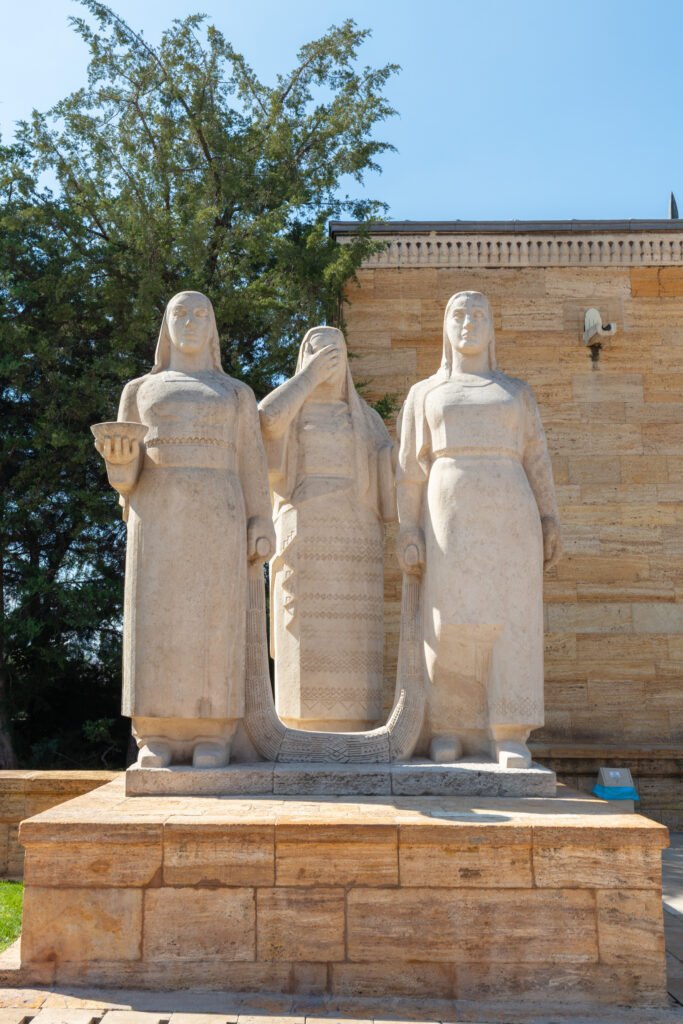
Ankara is the capital of Turkey, chosen for that role in 1923 by Mustafa Kemal Ataturk when the Republic of Turkey replaced the Ottoman Empire. Though far older than its status as capital suggests, with roots reaching back to the Bronze Age, Ankara’s modern identity is defined above all by its role as the seat of the Turkish republic and by Anitkabir, Ataturk’s mausoleum.
Where Is Ankara Located?
Ankara sits on the Anatolian plateau in central Turkey, well inland from the country’s coastlines, in contrast to Istanbul’s position on the Bosphorus. Its central location within Turkey’s borders, rather than on a coast or border region, was part of the reasoning behind its selection as the new republic’s capital.
The Origins and History of Ankara
The site has been settled since at least the Bronze Age and was controlled in turn by Hittites, Phrygians, and later the Celtic Galatians, who made the city, then called Ancyra, their regional capital. Rome absorbed the city in the first century BCE, and the Roman emperor Augustus had a temple built there that still stands in part, carrying an inscribed copy of his own account of his achievements, known as the Monumentum Ancyranum.
Ankara remained a provincial city of modest importance through the Byzantine, Seljuk, and Ottoman periods. Its decisive transformation came after the First World War, when Mustafa Kemal Ataturk based the Turkish independence movement there and, after the Republic of Turkey was founded in 1923, made it the new country’s capital in place of Istanbul. The choice was deliberate: a central Anatolian city with no strong association with the Ottoman imperial court was meant to symbolize a break from the old empire and a new, more centrally Turkish national identity.
Government Today
Ankara is the seat of the Turkish presidency, the Grand National Assembly of Turkey, and the country’s main government ministries. Its role as the administrative and political center of Turkey has shaped much of its modern growth, with the city expanding rapidly through the twentieth century as a planned, purpose-built capital alongside its older settled core.
Culture and Daily Life in Ankara
Ankara functions as Turkey’s second-largest city after Istanbul and hosts several of the country’s leading universities alongside its government institutions. Its Museum of Anatolian Civilizations holds one of the world’s most important collections of Hittite artifacts, reflecting the long span of settlement on and around the site before it became a modern capital.
Ankara’s Most Famous Landmarks
Anitkabir, the mausoleum of Mustafa Kemal Ataturk, is Ankara’s most visited and most recognized monument. Built between 1944 and 1953 on a hill overlooking the city, it combines ancient and modern architectural elements and serves as both a memorial and a site of national ceremony. The Temple of Augustus and Rome, with its surviving inscription of Augustus’s own account of his reign, remains one of the city’s most significant surviving ancient structures.
What Is Ankara Known For?
Ankara is known as the capital of modern Turkey, chosen deliberately to replace Istanbul after the Ottoman Empire’s fall, and for Anitkabir, the mausoleum of the republic’s founder, Mustafa Kemal Ataturk. It is also known for its much older history as the ancient city of Ancyra.
Why Ankara Matters
Ankara matters as the clearest physical symbol of Turkey’s twentieth-century transformation from the Ottoman Empire into a modern republic, a status it holds specifically because it was chosen, rather than inherited, as capital. Its older Hittite, Phrygian, Galatian, and Roman layers also make it a significant site in its own right for understanding ancient Anatolian history.
Key facts
- Settled since at least the Bronze Age, later the Galatian and Roman city of Ancyra1
- Became the capital of the Republic of Turkey in 19231
- Replaced Istanbul as capital to symbolize a break from the Ottoman Empire1
- Anitkabir, Ataturk's mausoleum, was built between 1944 and 19531
- Turkey's second-largest city after Istanbul1
Quick checkWhy did Turkey choose Ankara as its capital instead of Istanbul?Show answer
Ataturk chose the centrally located Ankara in 1923 to symbolize a break from the Ottoman imperial past centered on Istanbul.
Sources
- Encyclopaedia Britannica. Ankara. Undated (accessed Accessed 2026-10-06)
Editorially reviewed by Specialty Digest Editorial TeamLast reviewed October 6, 2026Researched and drafted with AI assistanceReport an issue