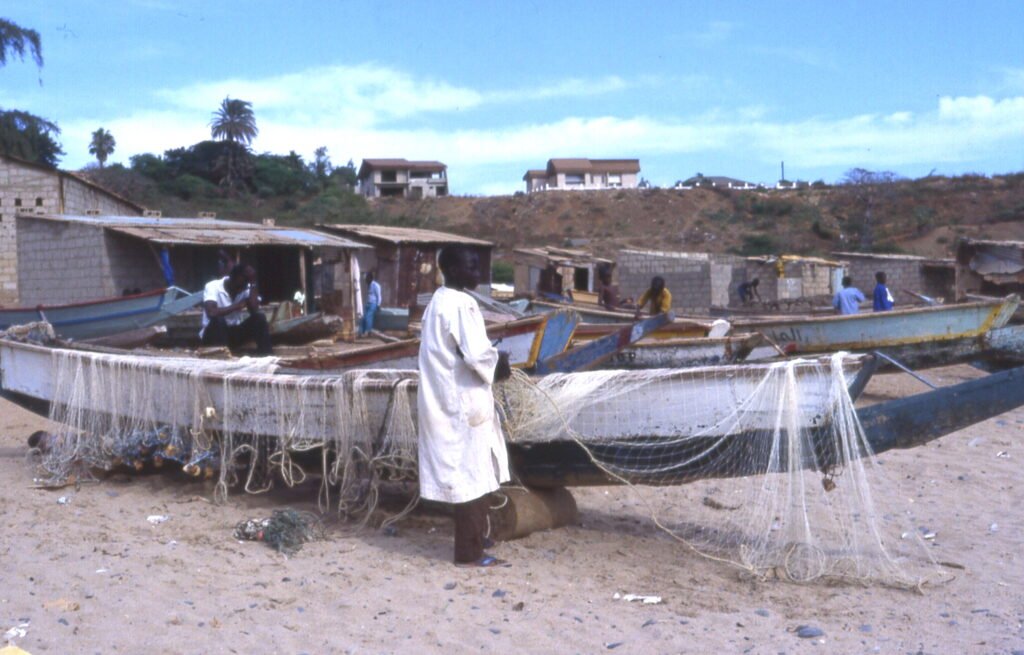
Artisanal fishing is small-scale fishing conducted by individuals or families using relatively simple vessels, gear, and techniques, typically for local consumption or sale rather than large-scale commercial export. It remains a vital source of food and income for coastal and riverine communities across much of the developing world.
Characteristic Methods and Gear
Artisanal fishers commonly use small open boats, canoes, or rafts, often without mechanized propulsion, alongside hand-operated gear such as handlines, small gillnets, traps, and cast nets suited to nearby waters. Trips are typically short, lasting hours rather than days, and catches are usually landed and sold fresh at local markets the same day.
Economic and Social Role
Artisanal fisheries employ tens of millions of people worldwide, far more than industrial fishing fleets relative to the volume of fish landed, and they supply a disproportionately large share of the fish consumed directly by coastal communities in low-income countries. Women frequently play a central role in artisanal fisheries through processing, marketing, and small-scale trading of the catch, even where fishing itself is predominantly done by men.
Sustainability Considerations
Because artisanal gear is generally more selective and lower-impact than industrial trawling or longlining, small-scale fisheries often have a smaller ecological footprint per unit of effort, though their cumulative impact can still be significant where fishing pressure is intense and management is weak. Traditional ecological knowledge passed down through generations frequently informs informal local management practices, such as seasonal closures around spawning grounds.
Challenges Facing Artisanal Fishers
Competition from industrial fleets, including foreign vessels operating in the same coastal waters, can deplete stocks that artisanal communities depend on and has triggered conflict in several regions. Artisanal fishers also often have limited access to credit, cold storage, and formal markets, which can trap them in low-value sales even when catches are strong, and they are frequently underrepresented in national fisheries policy decisions.
Policy Recognition and Support
International bodies, including the Food and Agriculture Organization, have increasingly recognized artisanal and small-scale fisheries as essential to global food security and have developed voluntary guidelines encouraging governments to secure their access rights, improve market infrastructure, and include them meaningfully in fisheries governance. Co-management arrangements that give artisanal communities formal authority over local waters have shown particular promise in several coastal regions.
Food Security Role
In many coastal and island nations, fish caught by artisanal fishers supply the majority of locally consumed animal protein, making small-scale fisheries a cornerstone of food security that is often overlooked in national economic statistics focused on export-oriented industrial fishing. Disruptions to artisanal fishing, whether from overfishing, pollution, or displacement by other coastal development, can therefore have outsized effects on local nutrition even when the economic value involved appears small at a national scale.
Modernization and Adaptation
Some artisanal fishing communities have adopted selective modern technology, such as GPS devices, solar-powered ice boxes, and mobile phone market price information, without abandoning the small-scale character of their operations, improving both safety and economic returns. Development programs increasingly focus on this kind of targeted modernization, aiming to strengthen artisanal fisheries’ resilience and profitability while preserving the low-impact, community-based character that distinguishes them from industrial fishing.
Cultural Significance
Artisanal fishing is often deeply embedded in local culture and identity, with specific boat designs, fishing techniques, and seasonal practices passed down through generations and tied closely to community festivals, cuisine, and oral history in many coastal regions. This cultural dimension adds a layer of value to artisanal fisheries that extends well beyond their direct economic or nutritional contribution, and it is increasingly cited by policymakers seeking to justify protecting small-scale fishing access against competing commercial and industrial interests.
Climate Vulnerability
Artisanal fishing communities are often highly exposed to climate-related risks, including sea level rise, more intense storms, and shifting fish distributions, while typically having fewer financial resources to adapt compared with larger commercial operations that can relocate or diversify more easily. International climate adaptation funding has increasingly begun targeting small-scale fishing communities specifically, recognizing both their vulnerability and their importance to local food security in a warming world.
Looking Ahead
Growing recognition of artisanal fishing’s importance to global food security has strengthened calls for dedicated investment in small-scale fisheries, including secure access rights, better market infrastructure, and climate adaptation support tailored to their specific needs. How successfully these commitments translate into on-the-ground improvements will likely shape the livelihoods of tens of millions of fishing families over the coming decades.
Gender Dimensions
Development and fisheries policy research increasingly highlights that women’s extensive but often informal roles in artisanal fisheries, particularly in post-harvest processing and marketing, are frequently undercounted in official statistics that focus narrowly on who operates fishing vessels. Programs aimed at strengthening artisanal fisheries increasingly include specific support for these processing and marketing roles, recognizing their substantial contribution to the economic value that small-scale fishing ultimately generates for coastal households.
Related Specialties
Supporting artisanal fisheries effectively draws on development economics, anthropology, and marine biology together, since solutions that ignore any one of these dimensions tend to overlook either the cultural realities or the ecological constraints that shape small-scale fishing communities. This interdisciplinary approach has become standard in major international development programs focused on small-scale fisheries.
As climate pressures and competition for coastal resources intensify, the resilience of artisanal fishing communities will depend heavily on whether policy commitments to support them translate into durable, well-funded action at the local level.
Artisanal fishing will likely remain central to coastal food security and livelihoods for the foreseeable future, making continued investment in its sustainability and resilience a matter of considerable global importance.
Key facts
- Uses simple vessels and hand-operated gear like handlines and traps.|Employs tens of millions of people worldwide.|Generally lower ecological footprint than industrial fishing.|Faces competition from industrial fleets and limited market access.
Quick checkHow does artisanal fishing differ from industrial fishing?Show answer
Artisanal fishing uses small vessels and simple gear for local food and income, while industrial fishing uses large mechanized vessels for bulk commercial harvest, often for export.
Sources
- FAO Fisheries and Aquaculture Department
Editorially reviewed by Specialty Digest Editorial TeamLast reviewed November 3, 2026Researched and drafted with AI assistanceReport an issue